


























Views
Downloads


Essential Comparing Objects Worksheet | Grade 1 Math Aligned
Paste this activity's link or code into your existing LMS (Google Classroom, Canvas, Teams, Schoology, Moodle, etc.).
Students can open and work on the activity right away, with no student login required.
You'll still be able to track student progress and results from your teacher account.
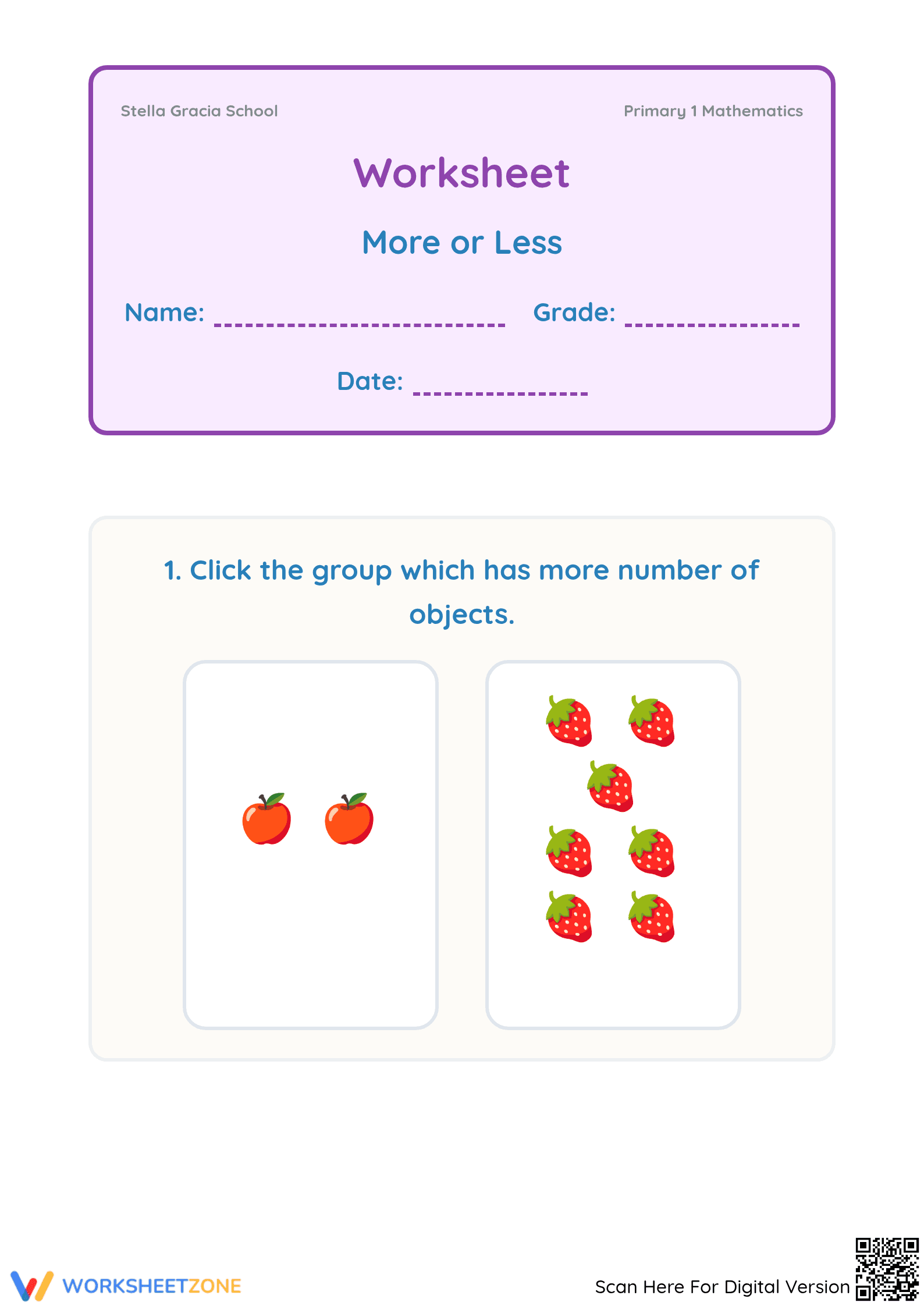
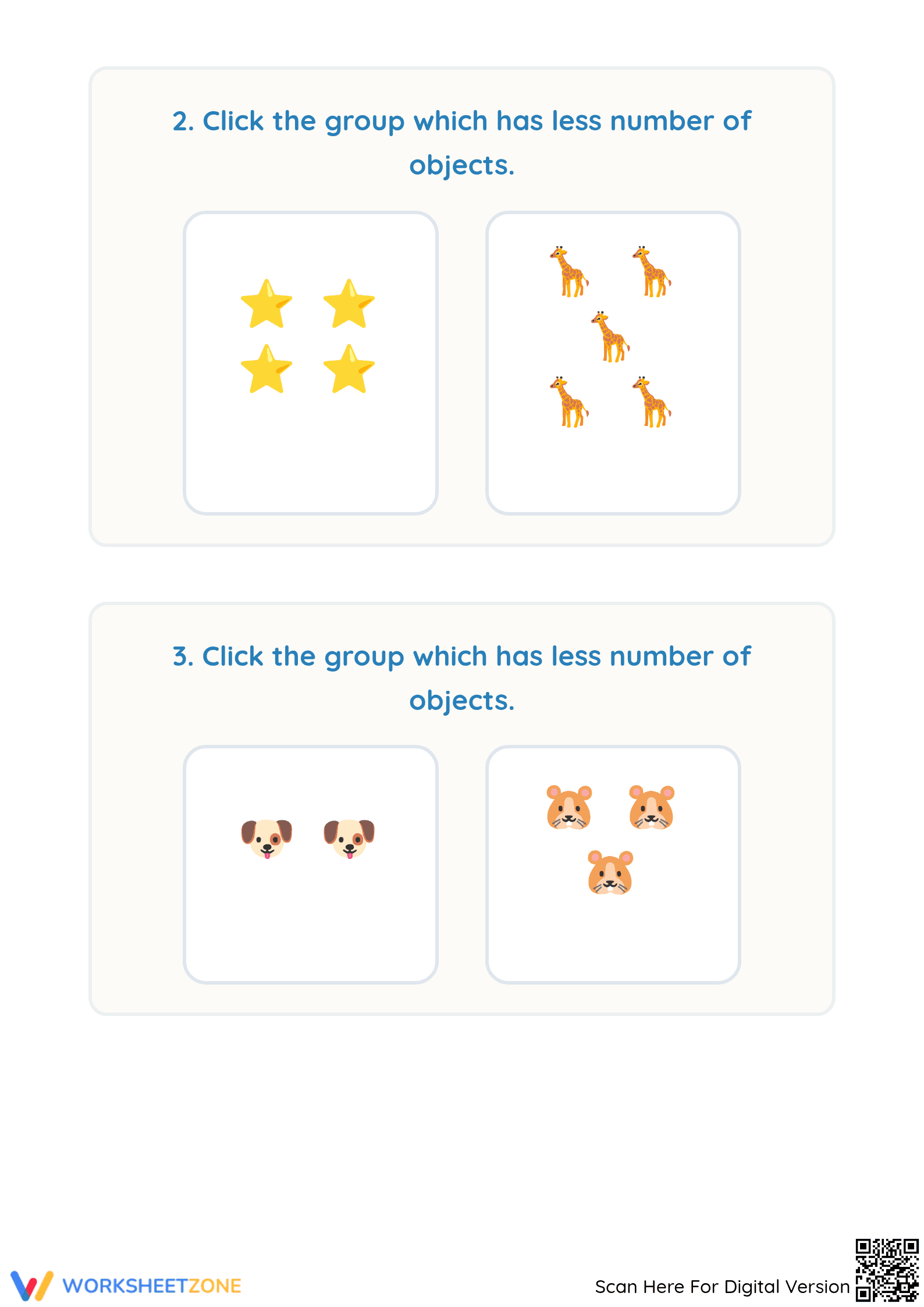
This essential comparing objects worksheet helps early learners master the fundamental skill of identifying greater and lesser quantities. By comparing groups of items, students build the numerical fluency required for more complex mathematical operations. This 5-page resource ensures students can confidently determine which sets have more, less, or equal amounts of objects.
At a Glance
- Grade: Grade 1 · Subject: Math
- Standard:
CCSS.MATH.CONTENT.K.CC.C.6— Identify if objects in one group are greater, less, or equal to another- Skill Focus: Comparing Quantities
- Format: 5 pages · 25 problems · Answer key included · PDF
- Best For: Daily math centers and small group instruction
- Time: 15–20 minutes
What's Inside
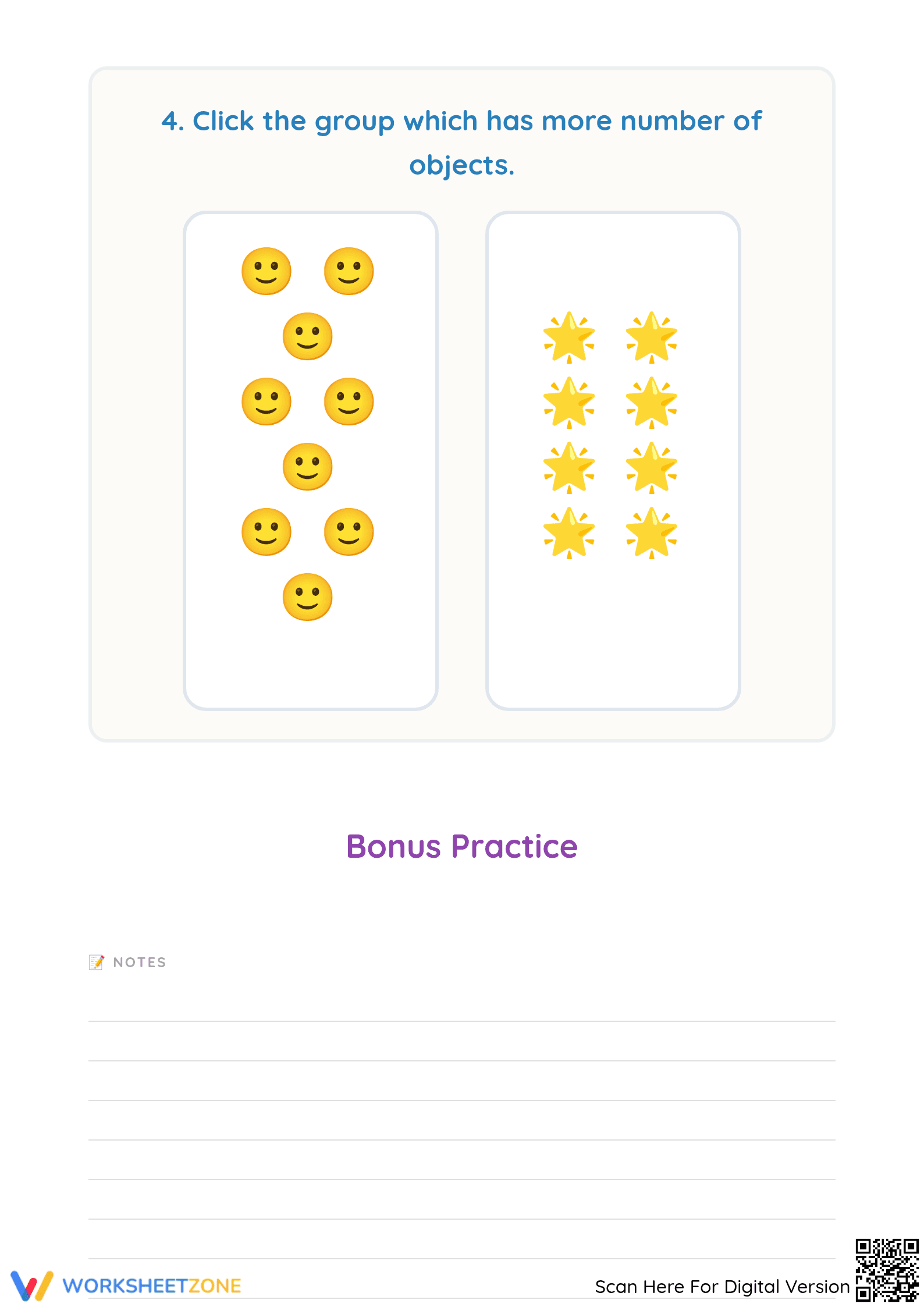
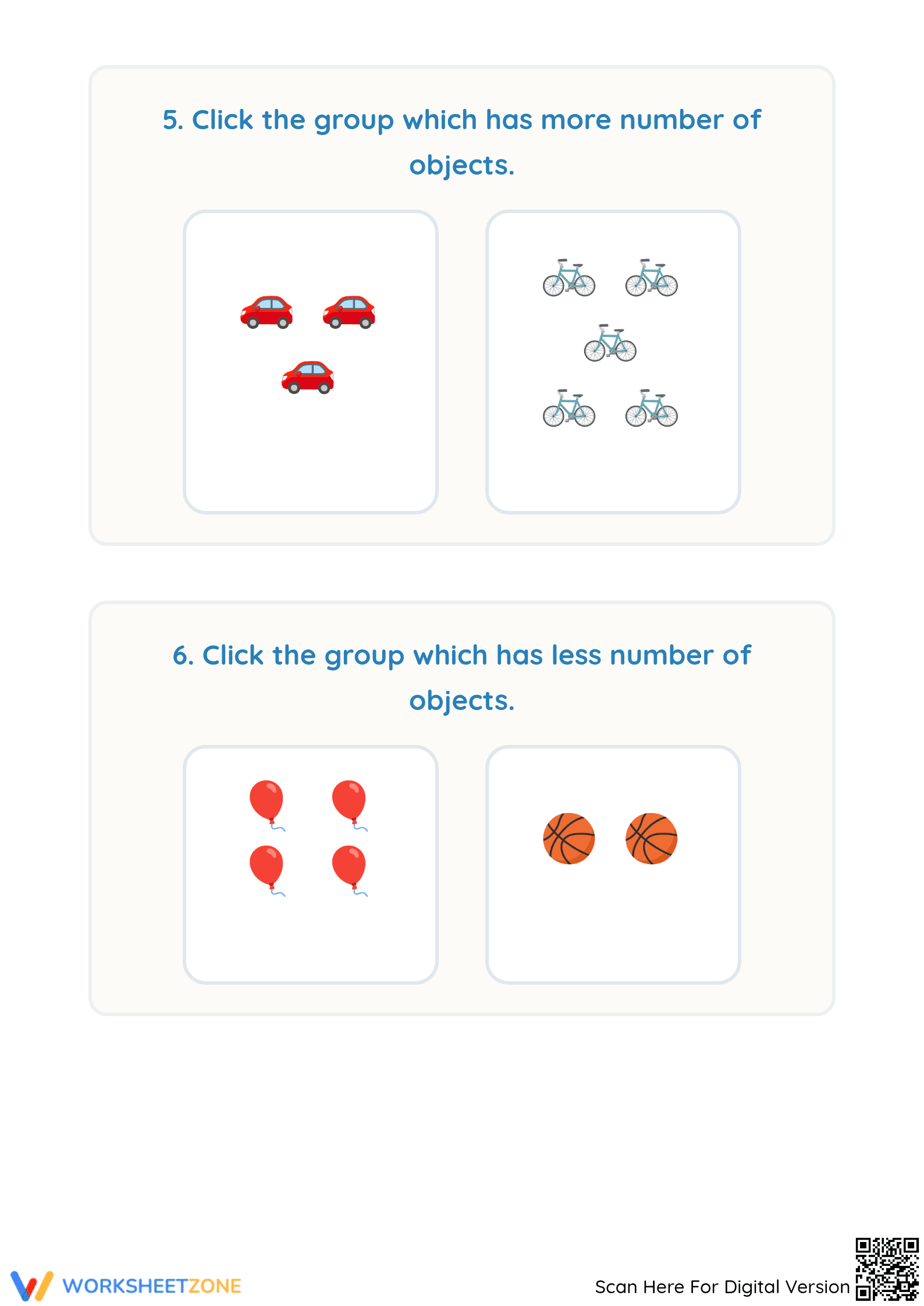
This worksheet package contains five distinct pages of guided practice, featuring 25 individual comparison tasks. Each page presents students with pairs of object groups requiring them to count and compare. The clean layout includes clear instructional prompts and dedicated spaces for marking answers. A full answer key is provided to facilitate quick grading and self-correction.
Skill Progression
- Guided Practice: The first two pages feature simple, high-contrast shapes to help students establish the concept of magnitude with minimal visual distraction.
- Supported Practice: Pages three and four introduce varied object types and slightly larger sets, requiring more careful counting and one-to-one correspondence.
- Independent Practice: The final page challenges students to compare quantities with smaller visual differences, cementing their ability to recognize set sizes reliably.
The resource follows a gradual-release model, moving from explicit visual cues to independent quantity comparison tasks.
Standards Alignment
This resource is primary aligned to `CCSS.MATH.CONTENT.K.CC.C.6`: Identify whether the number of objects in one group is greater than, less than, or equal to the number of objects in another group. It also supports `CCSS.MATH.CONTENT.1.NBT.B.3` by laying the foundation for comparing larger numbers. Both standard codes can be copied directly into lesson plans, IEP goals, or district curriculum mapping tools.
How to Use It
Introduce this worksheet during your direct instruction on number sense to provide immediate, hands-on practice. It works exceptionally well as a formative assessment; observe students as they count the items to ensure they are using stable order and cardinality. Most students will complete one page in approximately 5 minutes, making it a flexible tool for exit tickets.
Who It's For
Designed for Kindergarten and Grade 1 students, this worksheet is ideal for learners who need repetitive, structured practice with quantities. It provides necessary scaffolding for students with IEP goals related to basic numeracy. Pair this resource with physical manipulatives like counting bears to bridge the gap between concrete and representational learning.
The development of quantity comparison skills is a critical predictor of later mathematical success, as highlighted by researchers such as Fisher & Frey (2014). This worksheet targets CCSS.MATH.CONTENT.K.CC.C.6 by providing 25 structured opportunities for students to engage in magnitude comparison. By requiring students to visually analyze and count sets of objects, the resource reinforces the principle of one-to-one correspondence and the understanding of relative number size. Effective early math instruction emphasizes the transition from perceptual subitizing to conceptual counting, a progression this 5-page PDF supports through varied set sizes and object types. Research from NAEP suggests that early mastery of these foundational skills significantly reduces the math gap in upper elementary grades. This worksheet serves as a reliable tool for teachers to monitor student progress in cardinality and comparison, ensuring all learners develop a robust sense of number before advancing to symbolic addition and subtraction.


