


























Views
Downloads

Comparing Expressions Worksheet | Essential Grade 2 Math
Paste this activity's link or code into your existing LMS (Google Classroom, Canvas, Teams, Schoology, Moodle, etc.).
Students can open and work on the activity right away, with no student login required.
You'll still be able to track student progress and results from your teacher account.
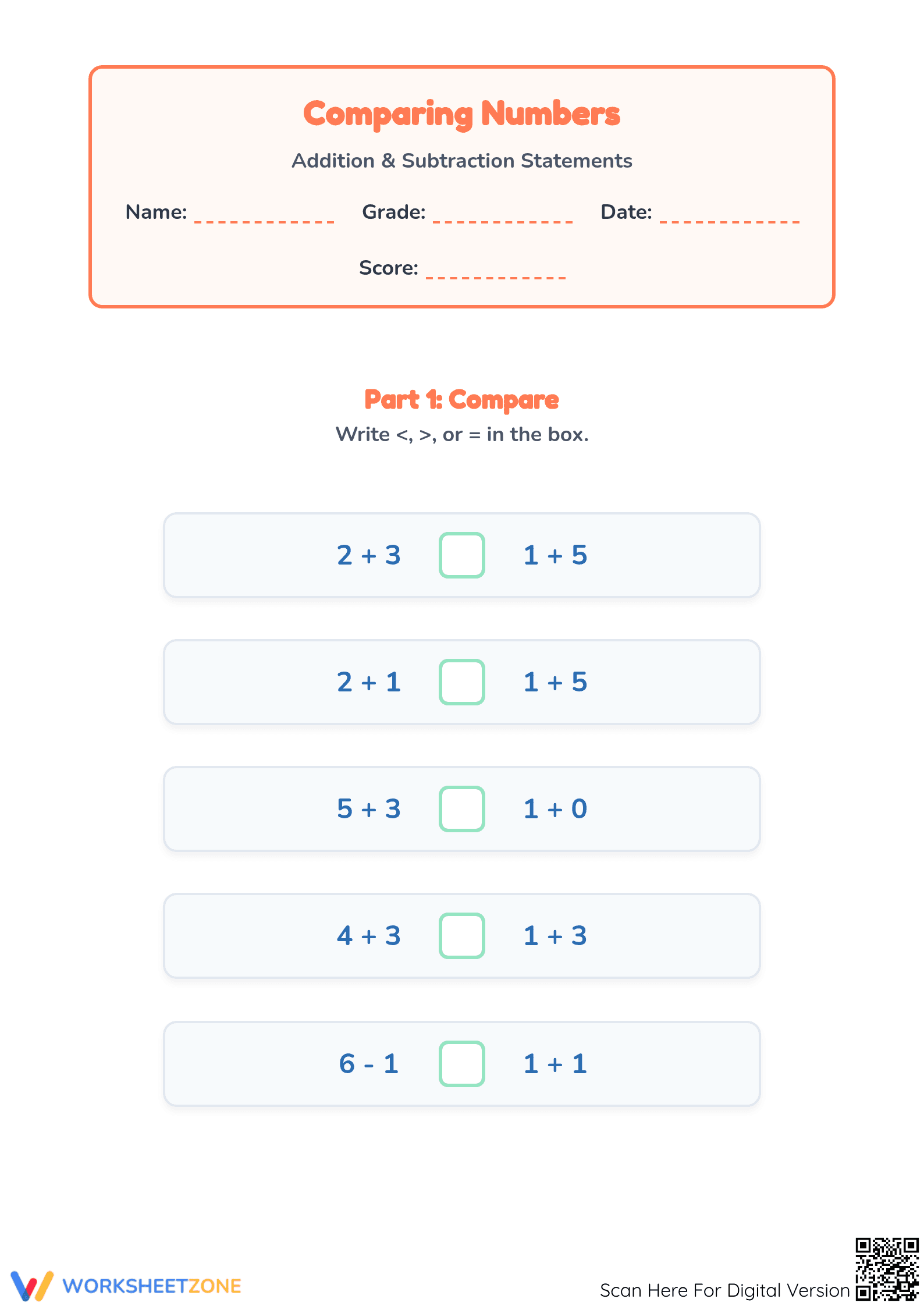
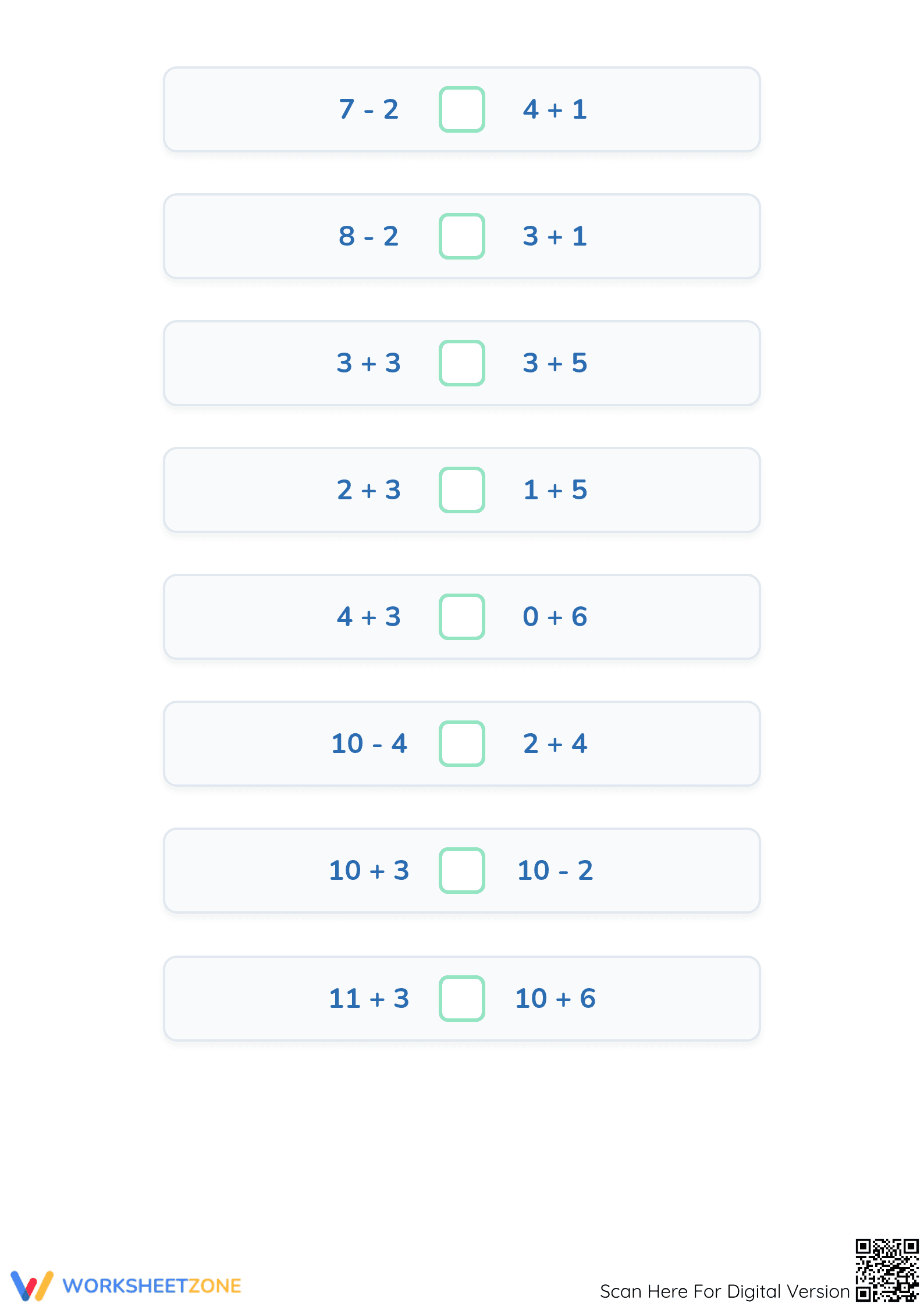
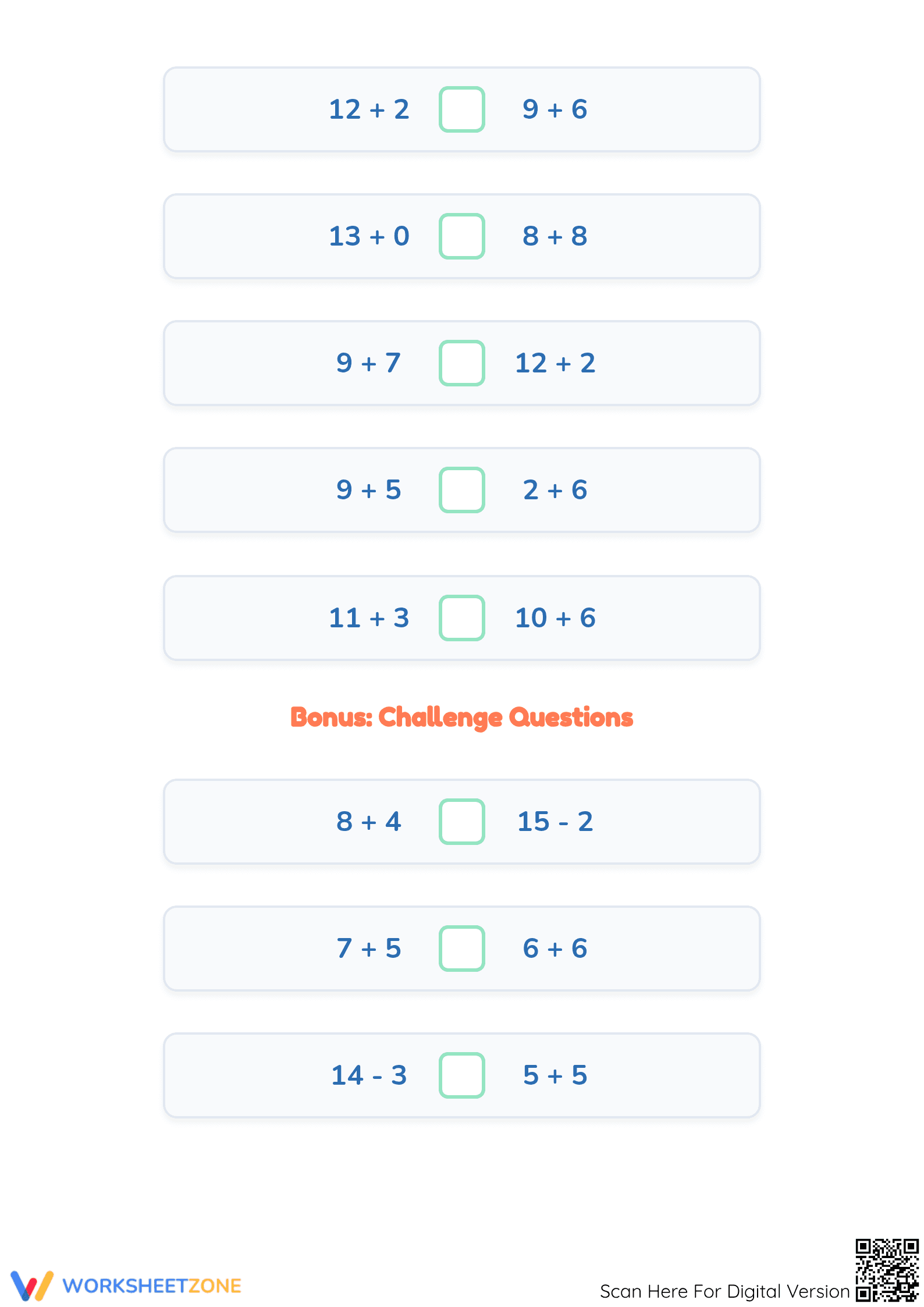
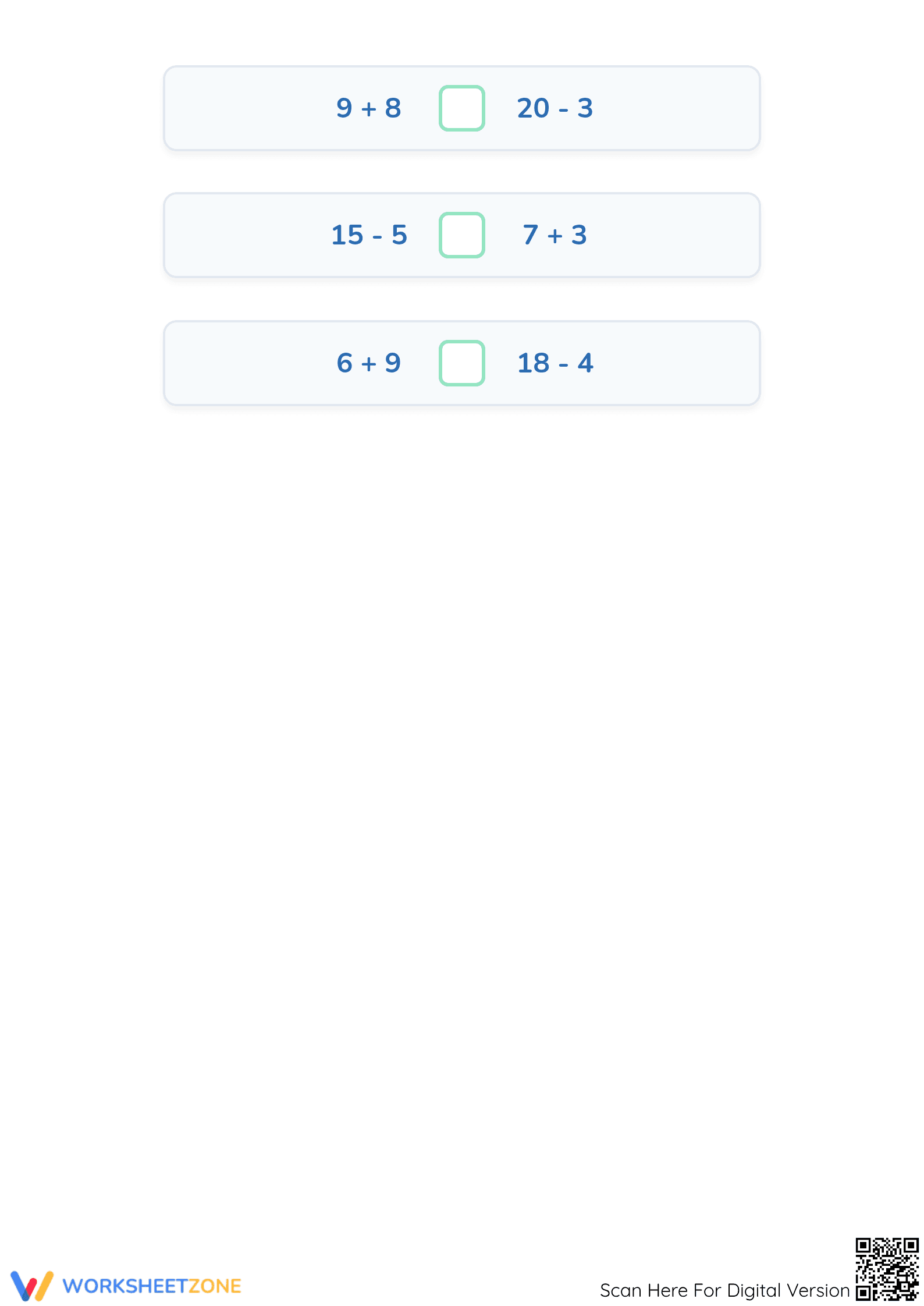
This comprehensive math worksheet strengthens mental computation and relational thinking by requiring students to compare addition and subtraction expressions. Students solve problems on both sides of a comparison circle and insert the correct inequality or equality symbol. This process ensures mastery of basic operations while building foundational skills for future algebraic reasoning.
At a Glance
- Grade: 2 · Subject: Math
- Standard:
CCSS.MATH.CONTENT.2.OA.B.2— Fluently add and subtract within 20 using mental strategies- Skill Focus: Comparing sums and differences
- Format: 4 pages · 80 problems · Answer key included · PDF
- Best For: Morning work or skill reinforcement
- Time: 15–20 minutes
What's Inside: This resource contains four structured pages of comparison tasks designed for repetitive practice and skill mastery. Each page presents 20 unique problems where students evaluate expressions like 8 + 5 and 15 - 2 before choosing the appropriate symbol. The layout is clean and distraction-free, featuring large comparison circles that are easy for young learners to navigate. A complete answer key is provided for rapid grading or student self-correction.
Skill Progression
- Guided Practice: Initial problems utilize small single-digit additions and subtractions to build student confidence in the comparison workflow.
- Supported Practice: Middle sections increase complexity by mixing operations and requiring students to compute values up to 20 on both sides of the circle.
- Independent Practice: Final tasks challenge students with larger numbers and near-equivalents to sharpen their accuracy and attention to detail.
This structure follows the gradual-release model, moving from simple computation to complex relational evaluation across 80 unique opportunities for practice.
Standards Alignment
The primary focus of this worksheet is CCSS.MATH.CONTENT.2.OA.B.2, which requires students to fluently add and subtract within 20. It also supports CCSS.MATH.CONTENT.1.OA.D.7 by reinforcing the meaning of mathematical symbols and relational statements. Both standard codes can be copied directly into lesson plans, IEP goals, or district curriculum mapping tools.
How to Use It
This worksheet is ideal for use during a math center rotation or as a quick formative assessment after a lesson on comparison symbols. Teachers should observe students during the first five problems to ensure they are computing both sides before selecting a symbol. The expected completion time for one page is roughly 15 to 20 minutes, depending on student fluency levels.
Who It's For
This resource is designed for Grade 2 students but is highly effective for Grade 1 enrichment or as a review for Grade 3 and 4 students needing to strengthen mental math speed. It pairs naturally with physical number lines or addition charts for students who require extra scaffolding during independent work time.
Research from Fisher & Frey (2014) emphasizes that the gradual release of responsibility model is most effective when students engage in repetitive, low-stakes practice that bridges procedural fluency with conceptual understanding. This worksheet targets the core requirement of CCSS.MATH.CONTENT.2.OA.B.2 by requiring students to not only compute sums and differences within 20 but also to evaluate those results against one another using relational symbols. By forcing students to hold two numerical values in their working memory before applying a comparison rule, the task builds cognitive endurance and mental math agility. According to the NAEP framework, early mastery of these relational concepts is a strong predictor of success in later algebraic thinking, as it reinforces the logic of the equal sign and inequalities. Educators can use these 80 structured problems to identify specific gaps in computation versus gaps in comparison logic, allowing for targeted intervention during small-group instruction.


