


























Views
Plays




Comparing Fractions Worksheet | Grade 5-6 Essential
Paste this activity's link or code into your existing LMS (Google Classroom, Canvas, Teams, Schoology, Moodle, etc.).
Students can open and work on the activity right away, with no student login required.
You'll still be able to track student progress and results from your teacher account.
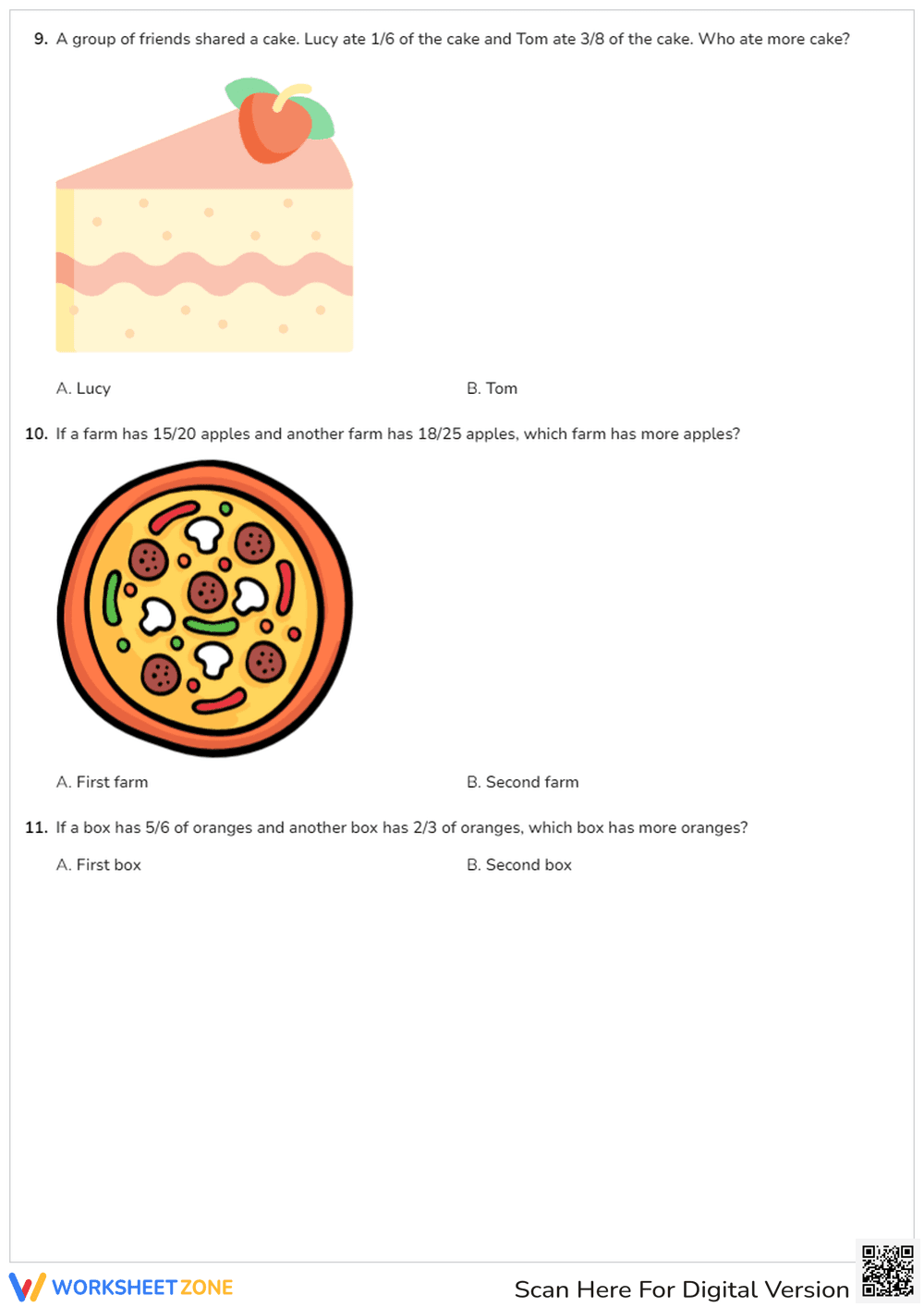
This Grade 5-6 math worksheet provides a comprehensive set of 12 problems designed to help students master the skill of comparing fractions with unlike denominators. By integrating real-world word problems and visual cues, the resource ensures students can accurately determine which fraction represents a larger or smaller quantity. Students will move beyond basic computation to apply their knowledge in practical scenarios.
At a Glance
- Grade: 5-6 · Subject: Math
- Standard:
CCSS.MATH.CONTENT.4.NF.A.2— Compare two fractions with different numerators and denominators using symbols or reasoning- Skill Focus: Comparing fractions with unlike denominators
- Format: 4 pages · 12 problems · Answer key included · PDF
- Best For: Independent practice and formative assessment
- Time: 20–30 minutes
The worksheet consists of 4 clearly organized pages containing 12 multiple-choice questions. Each question presents a unique scenario, such as comparing portions of pizza, cake, or candy bags, which helps ground abstract concepts in reality. The layout includes large, friendly illustrations to support visual learners and reduce math anxiety. A full answer key is provided to facilitate quick grading and immediate student feedback.
This resource is designed for a zero-prep classroom environment, allowing teachers to transition from instruction to practice in under 2 minutes. First, print the 4-page PDF. Second, distribute the 12-question set to students for independent work. Finally, use the included answer key to review results or allow for self-grading. This streamlined workflow makes it an ideal choice for emergency sub plans or unexpected schedule shifts.
This resource is primarily aligned with `CCSS.MATH.CONTENT.4.NF.A.2`, which focuses on comparing two fractions with different numerators and different denominators. While the skill is introduced in 4th grade, the complexity of the word problems and the application to 5th and 6th-grade curriculum makes it a vital tool for remediation and mastery. Both standard codes can be copied directly into lesson plans, IEP goals, or district curriculum mapping tools.
Use this worksheet as a formative assessment immediately following a lesson on finding common denominators. It serves as an excellent check for understanding to see if students can apply the concept to word problems. Alternatively, assign it as a homework packet to reinforce the day's instruction. Teachers should observe whether students are drawing their own models to solve the 12 problems. Expect completion within 20 to 30 minutes.
This resource is tailored for 5th and 6th-grade students who are refining their fraction sense. It is particularly effective for students who benefit from visual aids and contextualized learning. It pairs naturally with a fraction anchor chart or a direct instruction lesson on equivalent fractions. The multiple-choice format also supports English Language Learners by providing clear options and reducing the linguistic load of responses.
The CCSS.MATH.CONTENT.4.NF.A.2 standard requires students to compare two fractions with different numerators and denominators by creating common denominators. This worksheet facilitates this by providing 12 distinct opportunities to apply mathematical reasoning within relatable contexts like sharing pizza. According to Fisher & Frey (2014), scaffolded word problems help bridge the gap between abstract numerical manipulation and conceptual understanding. By requiring students to identify the greater share in a story-based format, the resource reinforces the magnitude of fractions beyond simple rote memorization. This approach aligns with best practices for middle-grade mathematics, ensuring that students can justify their conclusions using visual models or algebraic methods. The inclusion of 12 problems allows for sufficient repetition to achieve fluency while maintaining student engagement through varied scenarios. This resource is a reliable tool for tracking progress toward fraction mastery.


