


























Views
Downloads
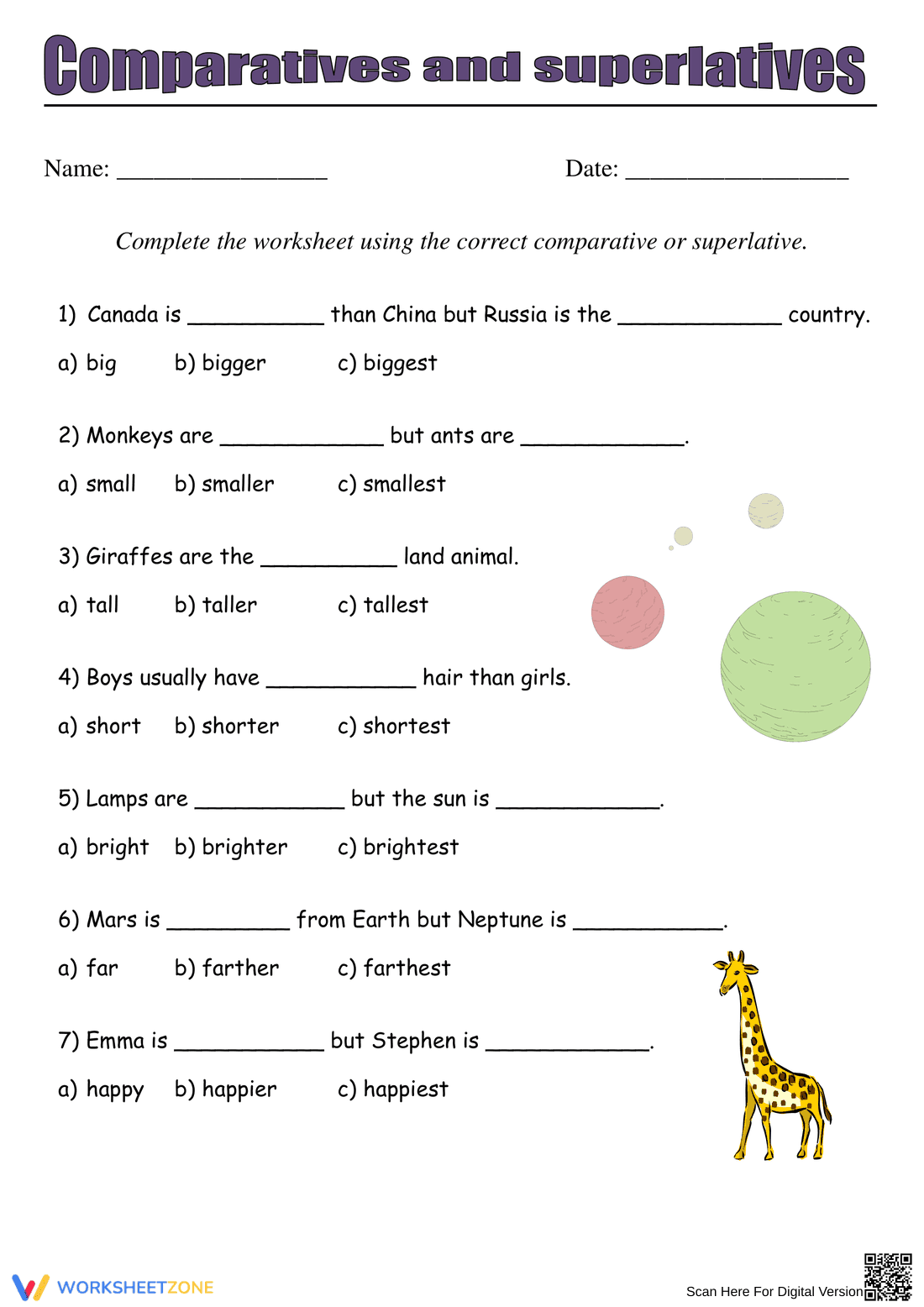

Essential Comparatives and Superlatives Worksheet | Grade 3
Paste this activity's link or code into your existing LMS (Google Classroom, Canvas, Teams, Schoology, Moodle, etc.).
Students can open and work on the activity right away, with no student login required.
You'll still be able to track student progress and results from your teacher account.
Master the nuances of comparative and superlative adjectives with this focused grammar resource. This worksheet guides students through real-world comparisons to solidify their understanding of adjective degrees. By choosing correct forms in context, learners build the linguistic precision necessary for clear descriptive writing and communication.
At a Glance
- Grade: 3 · Subject: English Language Arts
- Standard:
CCSS.ELA-LITERACY.L.3.1.G— Form and use comparative and superlative adjectives and adverbs correctly in sentences- Skill Focus: Comparative and Superlative Adjectives
- Format: 1 page · 7 problems · Answer key included · PDF
- Best For: Independent grammar practice or quick assessment
- Time: 10–15 minutes
Inside this single-page PDF, you will find seven constructed multiple-choice questions. Each task requires students to evaluate a sentence and select the most appropriate adjective form. The layout features clear spacing and engaging visual cues to maintain student interest while providing a professional, distraction-free environment for essential grammar mastery.
The worksheet follows a strategic skill progression to ensure learner success. First, guided practice uses familiar geographical comparisons like country sizes to establish the "than" vs "the" distinction. Next, supported practice introduces animal traits and physical properties, challenging students to apply rules to different adjective stems. Finally, independent practice requires students to determine the correct degree without explicit scaffolding, completing the gradual release of responsibility model.
This resource is aligned to CCSS.ELA-LITERACY.L.3.1.G: "Form and use comparative and superlative adjectives and adverbs, and choose between them depending on what is to be modified." It also supports CCSS.ELA-LITERACY.L.2.1.E for second-grade enrichment. Both standard codes can be copied directly into lesson plans, IEP goals, or district curriculum mapping tools to ensure instructional compliance and tracking.
Use this worksheet as a formative assessment after direct instruction on adjective degrees. As students work, circulate and observe if they are identifying signal words like "than" for comparatives or "the" for superlatives. It also serves as an excellent bell-ringer or homework assignment. Most students will complete the seven tasks within 15 minutes, making it a perfect tool for checking for understanding mid-lesson.
Designed for students in Grades 2 through 4, this worksheet is particularly effective for English Language Learners (ELLs) who are navigating the irregular patterns of English adjectives. It pairs naturally with descriptive writing prompts or anchor charts detailing common "er" and "est" endings. The multiple-choice format provides necessary support for struggling readers while still demanding critical thinking about sentence structure and meaning.
Grammar instruction is most effective when skills like using comparative and superlative adjectives are practiced within meaningful contexts. This worksheet utilizes the CCSS.ELA-LITERACY.L.3.1.G standard to help Grade 3 students distinguish between degrees of comparison, a fundamental step in developing descriptive writing fluency. By selecting between forms like "bigger" and "biggest," students learn how specific word choices alter the meaning and precision of their statements. Research by Fisher & Frey (2014) emphasizes that "checks for understanding" through scaffolded practice are vital for moving students toward independent mastery of complex language conventions. This resource provides seven high-impact tasks that allow teachers to quickly identify which students have mastered the rule and which require additional intervention. It is an essential component of a comprehensive language arts curriculum, ensuring students can accurately describe relationships between objects, people, and ideas in both academic and social contexts.


