




























Views
Downloads
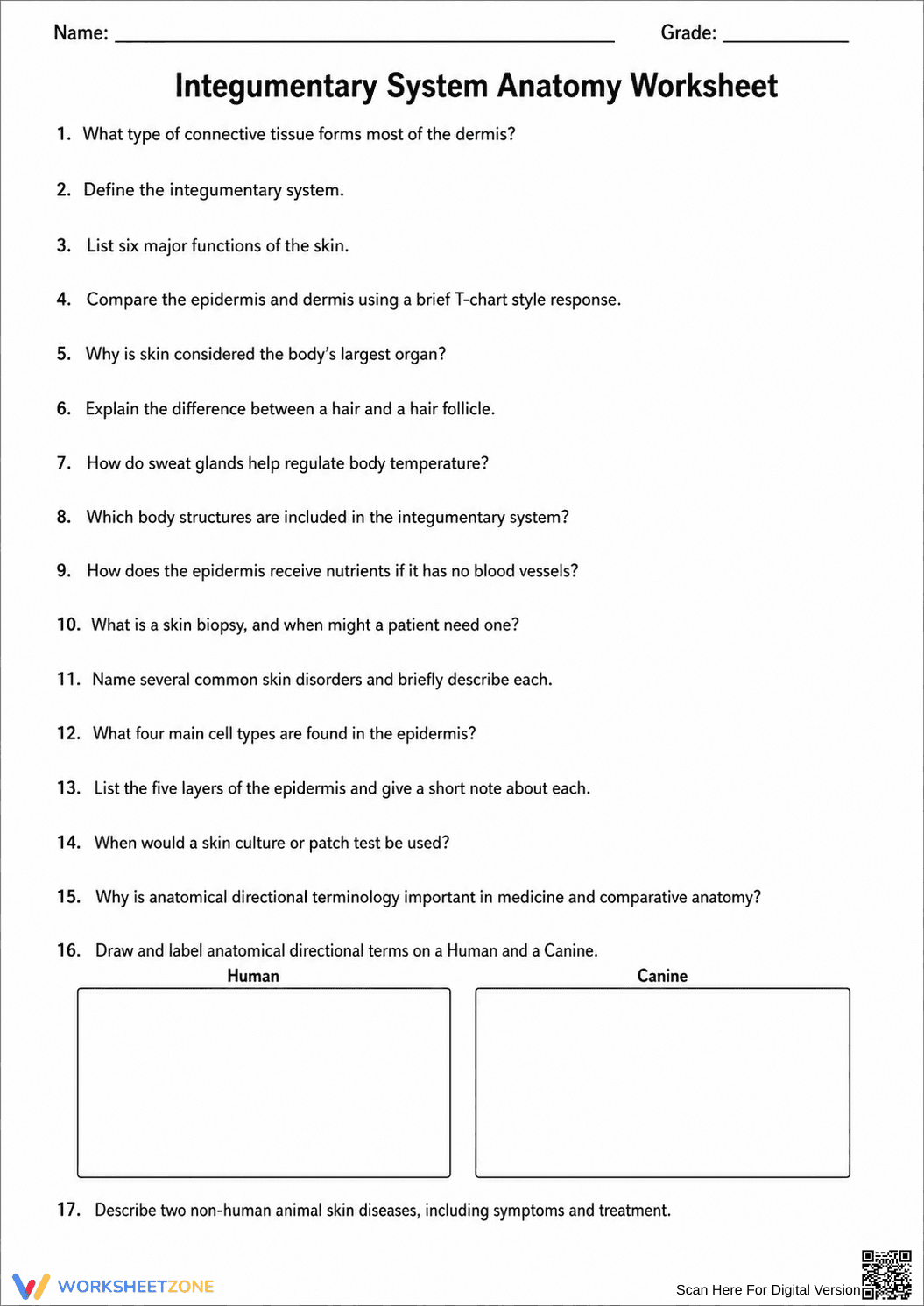

Essential Integumentary System Anatomy Worksheet | Grade 9

Paste this activity's link or code into your existing LMS (Google Classroom, Canvas, Teams, Schoology, Moodle, etc.).
Students can open and work on the activity right away, with no student login required.
You'll still be able to track student progress and results from your teacher account.
This comprehensive review worksheet facilitates a deep understanding of the integumentary system, moving beyond simple identification to functional analysis and comparative anatomy. Students will demonstrate mastery by explaining physiological processes, comparing tissue layers, and applying directional terminology to both human and canine models to ensure a holistic grasp of biological structures.
At a Glance
- Grade: 9 · Subject: Biology
- Standard:
HS-LS1-2— Develop and use a model to illustrate the hierarchical organization of interacting systems- Skill Focus: Skin anatomy and comparative terminology
- Format: 1 page · 17 problems · Answer key included · PDF
- Best For: End-of-unit review or anatomy lab prep
- Time: 30–45 minutes
What's Inside: This single-page intensive review features 17 structured tasks ranging from short-answer definitions to complex comparative analysis. The layout includes a dedicated T-chart prompt for comparing the epidermis and dermis, as well as two specialized drawing frames for visualizing anatomical directional terms. The resource includes a full answer key for efficient grading or student self-correction.
Skill Progression
- Guided Practice: The first 8 questions establish a baseline by requiring students to define the system, list functions, and identify connective tissues and glands.
- Supported Practice: Tasks 9 through 14 transition into clinical and physiological applications, such as explaining nutrient absorption in the epidermis and the purpose of skin biopsies.
- Independent Practice: The final 3 tasks require high-level synthesis, including a comparative drawing exercise and an analysis of non-human animal skin diseases.
This structure follows a gradual-release model, ensuring students are cognitively prepared for the complex comparative tasks at the end of the session.
Standards Alignment
This resource is aligned to `HS-LS1-2`, which requires students to illustrate how the organization of interacting systems provides specific functions within multicellular organisms. By examining the integumentary system's role in temperature regulation and protection, students meet this rigorous benchmark. Both standard codes can be copied directly into lesson plans, IEP goals, or district curriculum mapping tools.
How to Use It
This worksheet is best utilized as a summative review after direct instruction on tissue types and the human body systems. It serves as an excellent formative assessment tool; teachers should observe student progress on question 16 to ensure they correctly apply directional terms like dorsal, ventral, and lateral across different species. Expected completion time is 35 minutes for most high school biology students.
Who It's For
This resource is designed for Grade 9-12 biology students, particularly those in honors or pre-anatomy tracks. It is highly effective for students who benefit from visual learning and comparative logic. Pair this worksheet with a high-resolution skin cross-section anchor chart for maximum instructional impact.
According to Fisher & Frey (2014), the use of comparative organizers and visual labeling tasks significantly increases long-term retention of complex anatomical terminology. This worksheet applies those principles by requiring students to translate abstract directional terms into concrete drawings on both human and canine figures. By engaging with the HS-LS1-2 standard through 17 distinct tasks, students move from rote memorization to a functional understanding of how the integumentary system maintains homeostasis. The inclusion of clinical contexts, such as biopsies and skin cultures, provides the real-world relevance necessary for high school engagement. This resource provides the rigorous practice required for mastery in modern science classrooms.


