


























Views
Downloads

Comparative Adjectives Worksheet | Grade 2 Essential
Paste this activity's link or code into your existing LMS (Google Classroom, Canvas, Teams, Schoology, Moodle, etc.).
Students can open and work on the activity right away, with no student login required.
You'll still be able to track student progress and results from your teacher account.
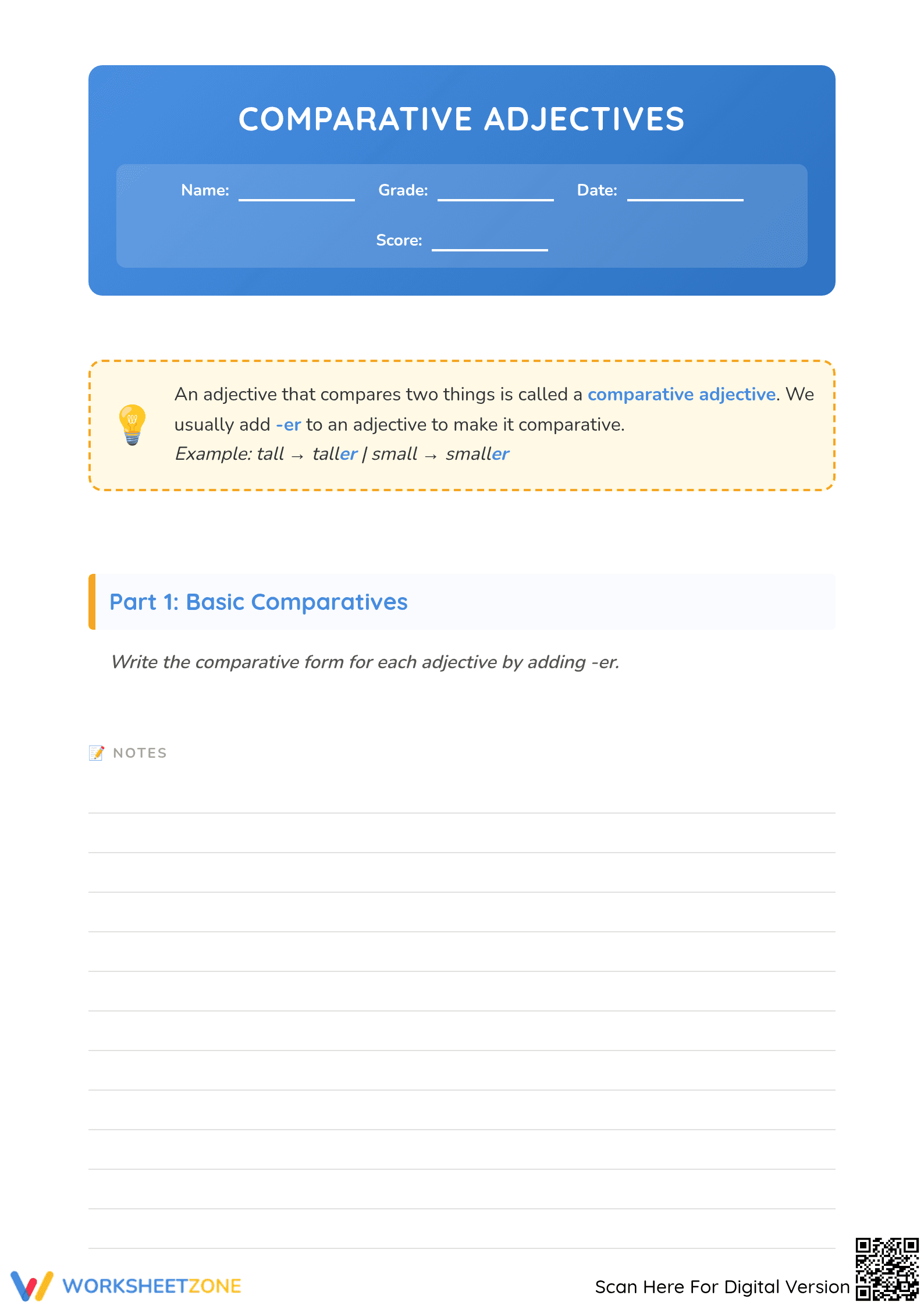
This Grade 2 ELA worksheet provides comprehensive practice with comparative adjectives, focusing on the "-er" suffix. Students learn to transform base adjectives and apply them within context to compare two nouns. By completing these exercises, learners develop the grammatical precision necessary for descriptive writing and clear communication.
At a Glance
- Grade: 2 · Subject: ELA
- Standard:
CCSS.ELA-LITERACY.L.2.1.E— Use adjectives and adverbs to modify nouns and verbs correctly- Skill Focus: Comparative adjectives and spelling rules
- Format: 5 pages · 24 problems · Answer key included · PDF
- Best For: Grammar centers and independent practice
- Time: 25–35 minutes
What's Inside: This 5-page PDF includes a structured introduction to comparative forms, followed by five distinct parts. It features two reference boxes explaining basic suffix addition and complex spelling changes. Students engage with 24 tasks ranging from table completion to sentence-level application. A full answer key is provided for quick grading or student self-correction.
Skill Progression
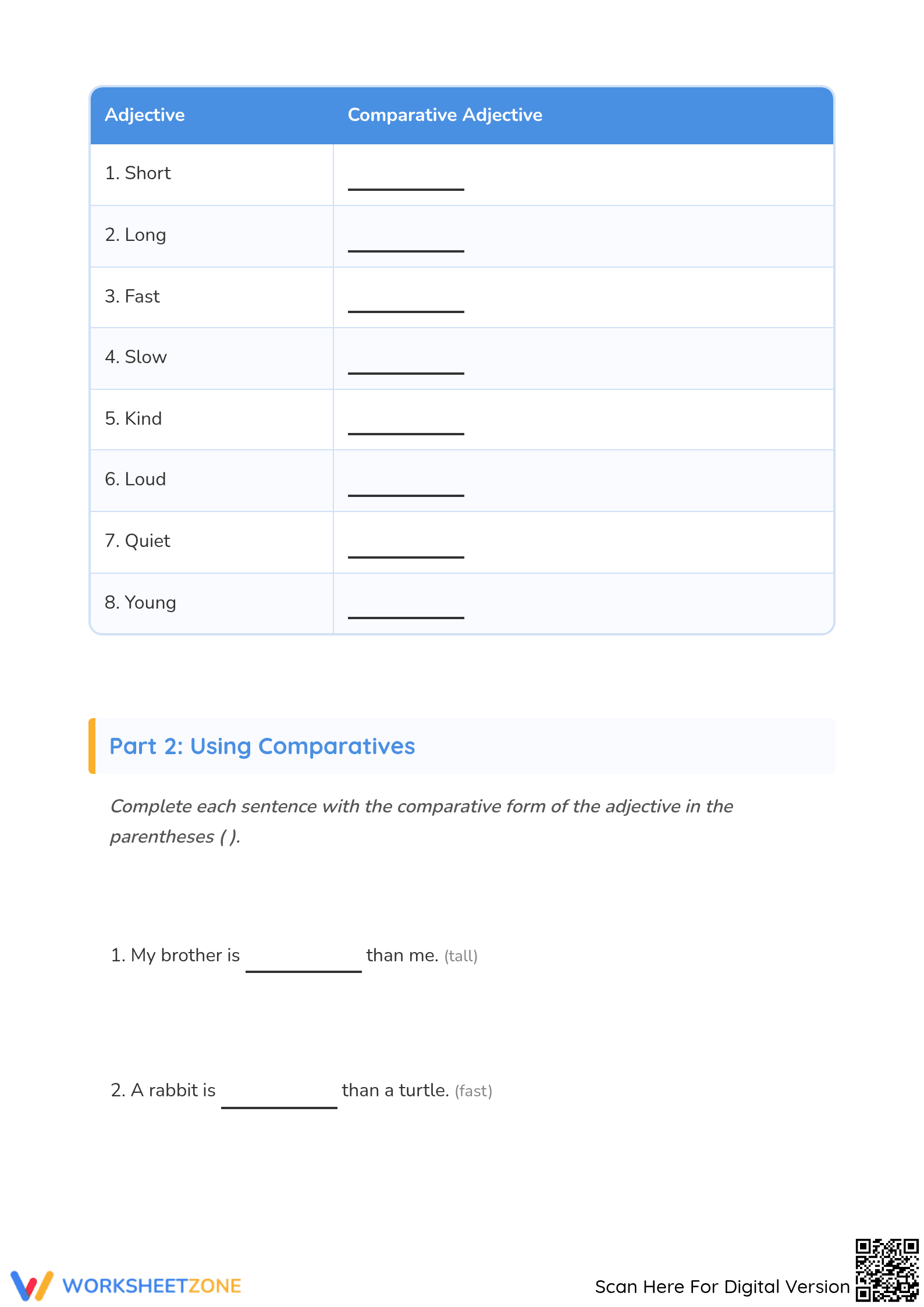
- Guided Practice: Students begin with 8 basic transformations, adding "-er" to simple adjectives like "short" and "fast" to build initial confidence.
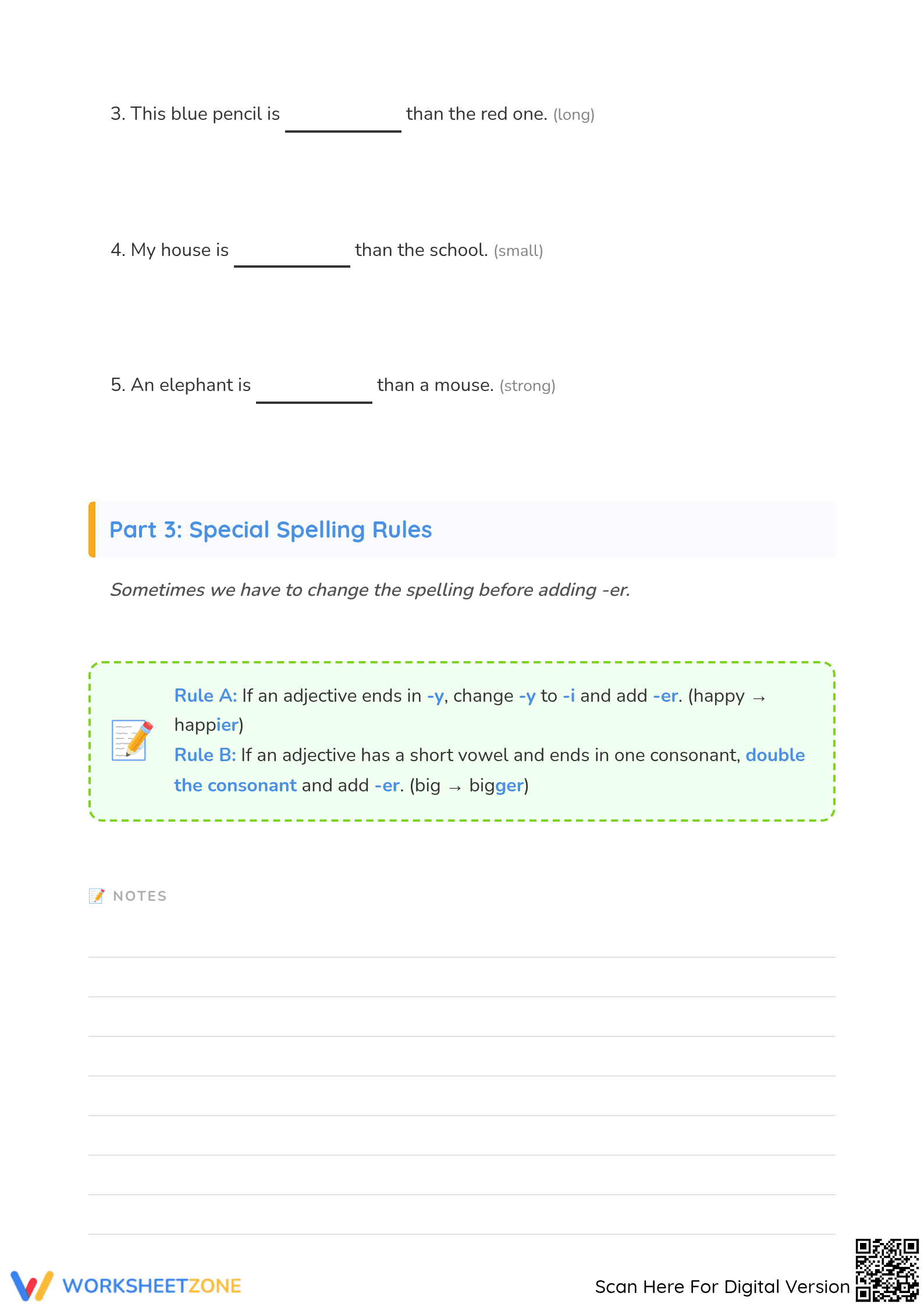
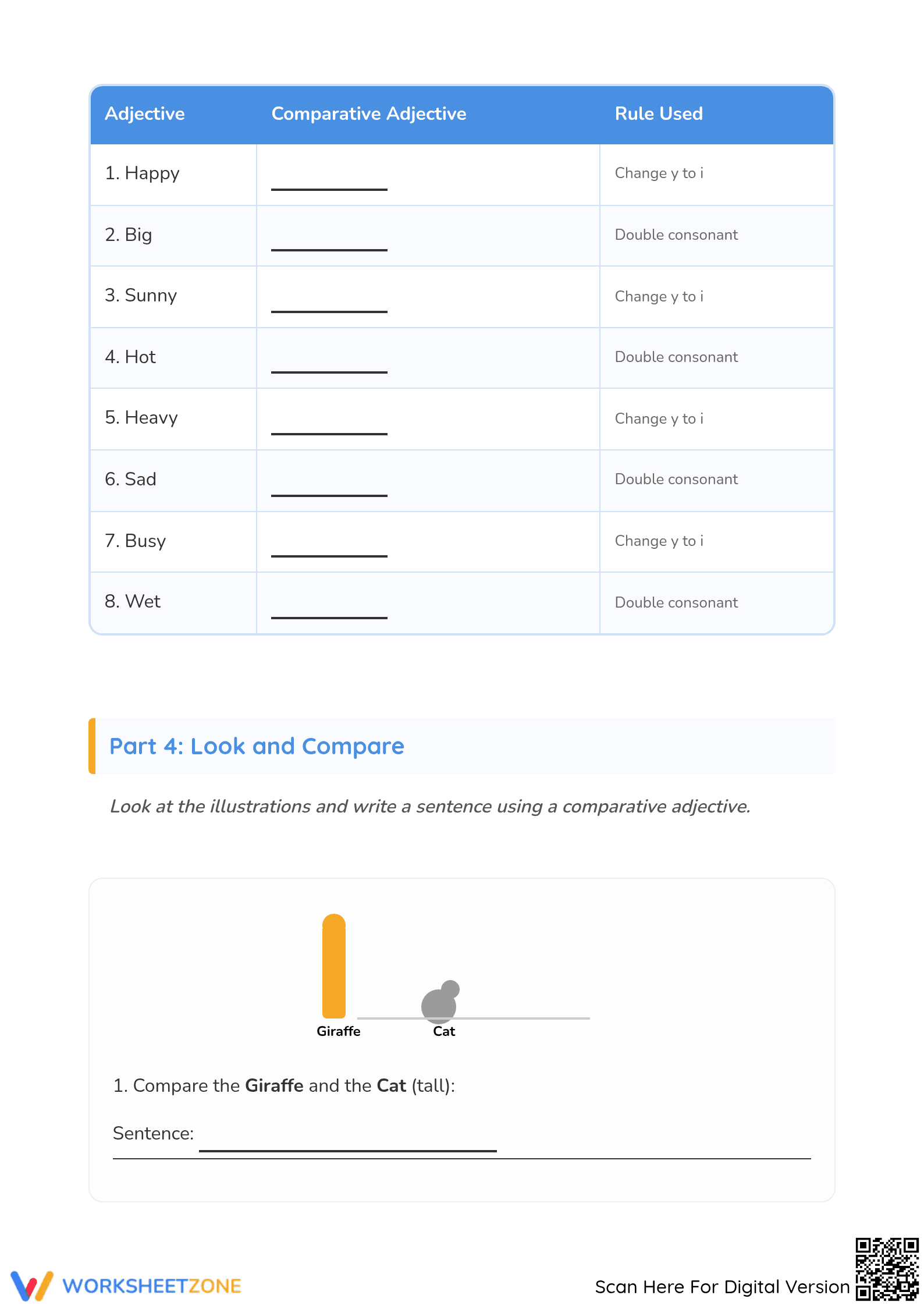
- Supported Practice: Learners apply these forms in 5 fill-in-the-blank sentences and tackle 8 advanced spelling challenges involving "y-to-i" changes and consonant doubling.
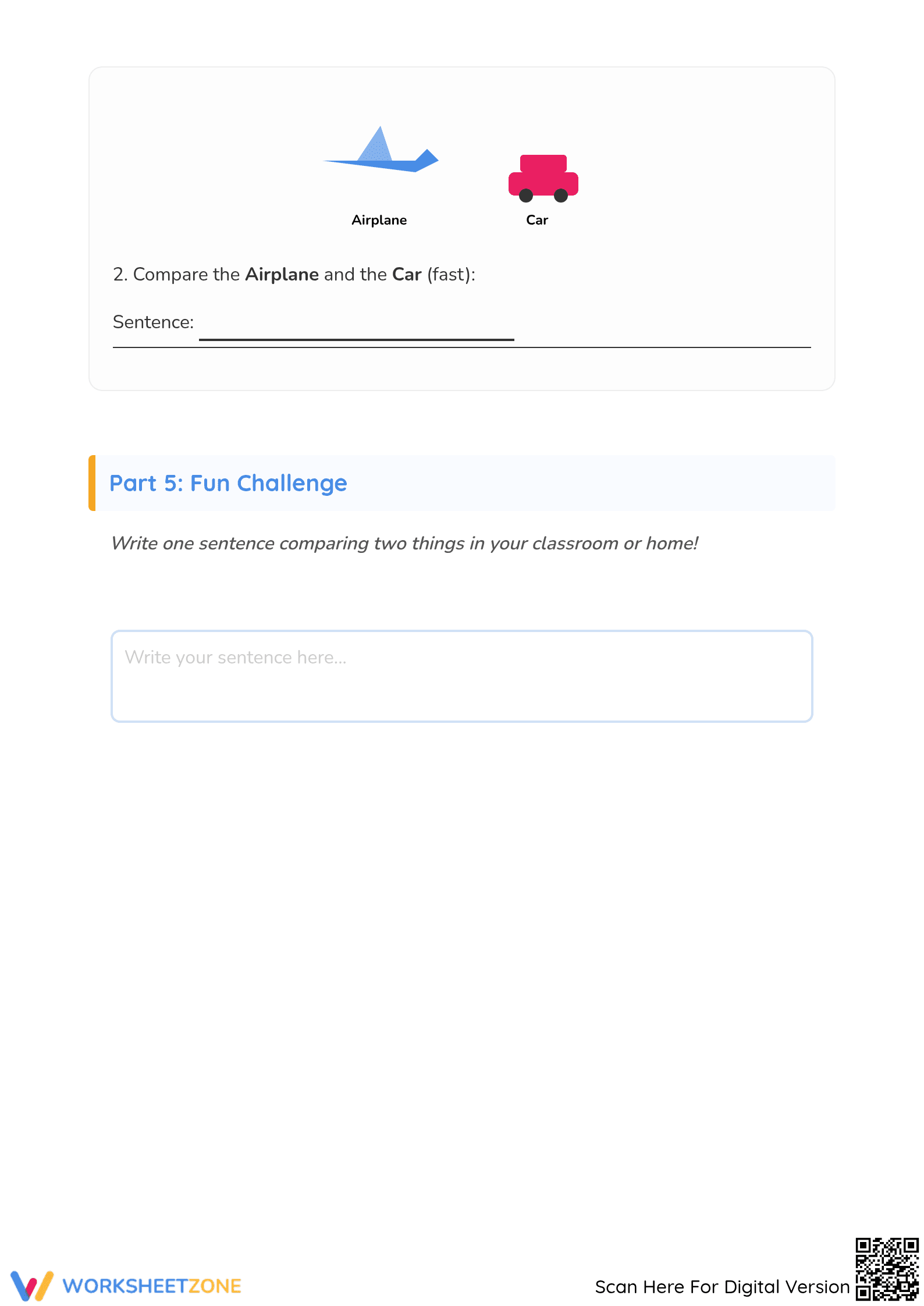
- Independent Practice: The final 3 tasks require students to generate original sentences based on visual prompts and personal observations.
This sequence follows a gradual-release model, moving from rote suffix application to higher-order sentence construction.
Standards Alignment
The primary focus is CCSS.ELA-LITERACY.L.2.1.E, which requires students to use adjectives and adverbs correctly. This resource specifically targets the comparative forms used to modify nouns. Additionally, it supports CCSS.ELA-LITERACY.L.2.2.D by reinforcing spelling patterns when adding suffixes. Both standard codes can be copied directly into lesson plans, IEP goals, or district curriculum mapping tools.
How to Use It
Use this worksheet during the "independent practice" phase of a grammar lesson on comparisons. It works well as a rotating station in an ELA block or as a formative assessment after direct instruction. Teachers should observe students during Part 3 to ensure they are correctly applying the "double the consonant" rule. Completion typically takes 30 minutes.
Who It's For
This resource is designed for second-grade students mastering basic grammar. It is also suitable for third-grade review or English Language Learners (ELL) who need explicit instruction on suffix rules. Pair this with a visual anchor chart showing "big" vs "bigger" to support visual learners.
This Grade 2 ELA resource targets CCSS.ELA-LITERACY.L.2.1.E by providing 24 structured tasks on comparative adjectives. Research from Fisher & Frey (2014) emphasizes that the gradual release of responsibility—moving from isolated word transformation to contextual sentence writing—is critical for linguistic mastery. By explicitly teaching the spelling rules for "-er" suffixes, such as changing "y" to "i" or doubling final consonants, this worksheet addresses common phonics-to-grammar gaps identified in early elementary learners. The inclusion of visual prompts in the final sections aligns with evidence-based practices for multi-modal learning, ensuring students can map abstract grammatical rules to concrete comparisons. This comprehensive 5-page set provides the repetition necessary for students to internalize comparative structures, facilitating a smoother transition into more complex descriptive writing. The provided answer key ensures instructional consistency across different classroom settings or home-school environments.


