


























Views
Downloads
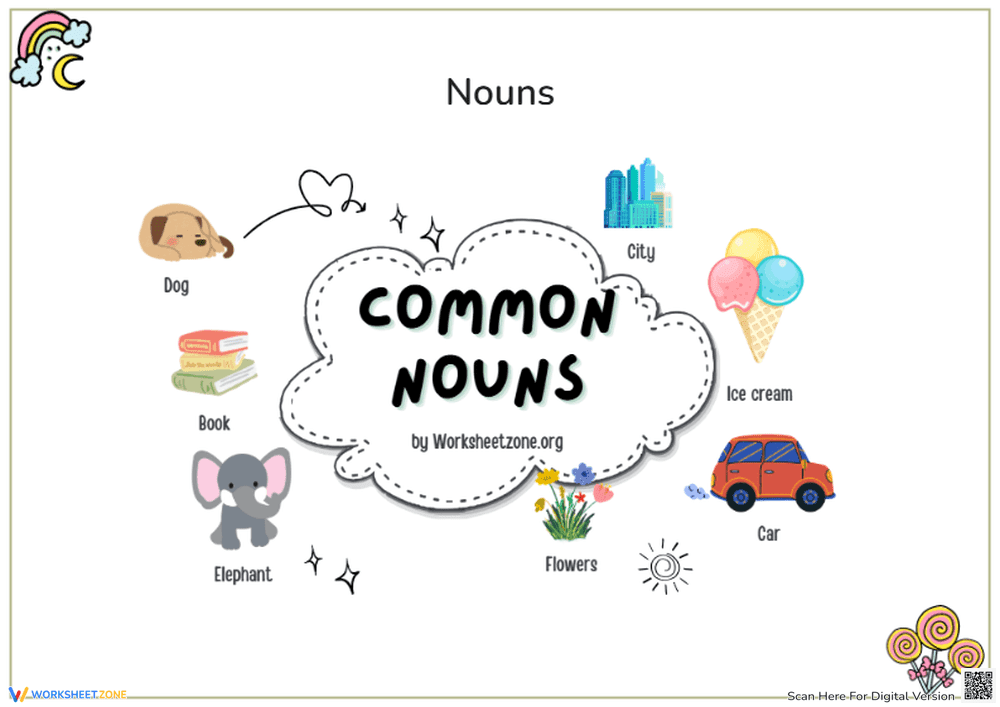

Printable Common Nouns Anchor Chart | Grade 2-3 ELA
Paste this activity's link or code into your existing LMS (Google Classroom, Canvas, Teams, Schoology, Moodle, etc.).
Students can open and work on the activity right away, with no student login required.
You'll still be able to track student progress and results from your teacher account.
This printable common nouns anchor chart helps second and third-grade students identify everyday nouns through clear visual examples. By linking words like dog, city, and book to colorful illustrations, learners build a strong foundation in grammar and parts of speech. Students quickly grasp how to recognize people, places, and things in their writing.
At a Glance
- Grade: Grade 2 - Grade 3 · Subject: ELA Grammar
- Standard:
CCSS.ELA-LITERACY.L.2.1— Demonstrate command of standard English grammar conventions when writing or speaking- Skill Focus: Common noun identification
- Format: 1 page · 7 visual examples · Reference chart · PDF
- Best For: Grammar introduction and visual classroom reference
- Time: 10–15 minutes
What's Inside
This single-page PDF serves as a visual anchor chart featuring seven distinct common noun examples: dog, book, elephant, flowers, city, ice cream, and car. Each noun is paired with a vibrant, kid-friendly illustration to reinforce the concept of nouns as people, places, or things. The clean layout acts as a self-explanatory reference tool, making it easy for young learners to study independently without overwhelming text.
Zero-Prep Workflow
This resource requires zero preparation, making it an ideal addition to emergency sub plans or daily grammar routines. Teachers can implement this tool in under two minutes using a simple three-step workflow. First, print the single-page PDF or project it onto a smartboard (1 minute). Second, distribute the sheet to students or have them add it to their grammar journals (1 minute). Third, review the seven illustrated examples as a whole group to check for understanding (5 minutes).
Standards Alignment
This worksheet aligns directly with CCSS.ELA-LITERACY.L.2.1, which requires students to demonstrate command of the conventions of standard English grammar and usage when writing or speaking. It also supports CCSS.ELA-LITERACY.L.3.1.A by helping students explain the function of nouns in sentences. Both standard codes can be copied directly into lesson plans, IEP goals, or district curriculum mapping tools.
How to Use It
Use this resource during direct instruction as a visual introduction to parts of speech, or print it as a desk reference for independent writing time. For a quick formative assessment, point to an illustration and ask students to write a sentence using that specific common noun, observing if they capitalize it incorrectly. The activity takes approximately 10 to 15 minutes to introduce and discuss.
Who It's For
This sheet targets second and third-grade students learning basic grammar mechanics, including English language learners who benefit from visual vocabulary support. It works well for small-group intervention or as a student binder insert. Pair this visual guide with a reading passage to have students search for and highlight common nouns in context.
This grammar reference tool aligns with standard CCSS.ELA-LITERACY.L.2.1 to help early elementary students master the identification of common nouns. According to research from Fisher & Frey (2014) on gradual release of responsibility, visual anchors provide essential scaffolding that supports students as they transition from guided instruction to independent writing tasks. By associating words like city, car, and dog with clear illustrations, the worksheet reduces cognitive load and helps students store grammatical concepts in long-term memory. Educators can use this resource to establish a baseline for parts of speech before moving to complex sentence structures. The structured layout ensures that students focus on the core skill of noun recognition without unnecessary distractions. This visual aid serves as a reliable tool for classroom instruction, intervention groups, or home practice.


