


























Views
Downloads


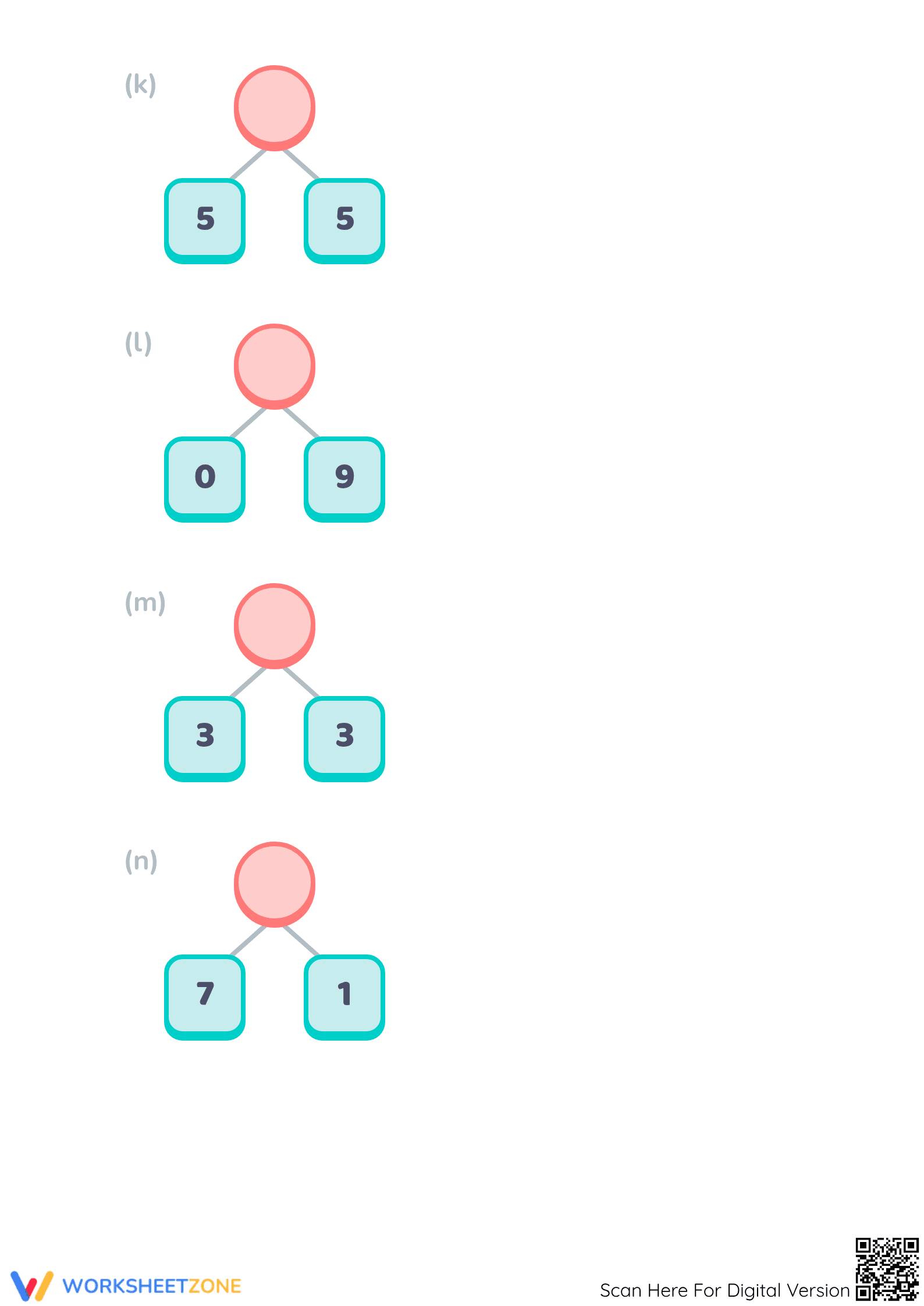


Essential Combination Numbers Worksheet | Grades 1-3 Math
Paste this activity's link or code into your existing LMS (Google Classroom, Canvas, Teams, Schoology, Moodle, etc.).
Students can open and work on the activity right away, with no student login required.
You'll still be able to track student progress and results from your teacher account.
Building strong number sense begins with mastering how numbers can be composed and decomposed. This combination numbers worksheet provides Grade 1, 2, and 3 students with structured practice in identifying all possible pairs that sum to a target total. By completing these visual number houses, students develop the mathematical fluency required for advanced arithmetic.
At a Glance
- Grade: 1-3 · Subject: Math
- Standard:
CCSS.MATH.CONTENT.1.OA.C.6— Fluently add and subtract within 10 using various strategies- Skill Focus: Number Combinations and Decompositions
- Format: 5 pages · 40 problems · Answer key included · PDF
- Best For: Daily math centers and fluency drills
- Time: 15–25 minutes
The resource includes five dedicated pages of number combination practice. Each page features a large 'number house' where students must list every possible additive pair for a specific total. This structured layout helps students systematically work through combinations, ensuring they capture every iteration from zero to the target number. A full answer key is included for quick grading or self-correction.
Skill Progression
- Guided Practice: Initial tasks introduce the target number with a worked example, showing how zero and the whole number form the first combination.
- Supported Practice: Students fill in thirty partially completed frames, using numerical patterns to discover remaining pairs.
- Independent Practice: The final twenty-five tasks require students to generate entire combination lists without prompts, solidifying their mental math agility.
This gradual release model ensures students move from pattern recognition to total automaticity through repeated exposure to fact families.
Standards Alignment
This worksheet is primary aligned to `CCSS.MATH.CONTENT.1.OA.C.6`: "Add and subtract within 20, demonstrating fluency for addition and subtraction within 10." It also supports Grade 2 and 3 standards involving mental math strategies and properties of operations. Both standard codes can be copied directly into lesson plans, IEP goals, or district curriculum mapping tools.
How to Use It
Use this worksheet during the 'You Do' portion of a math lesson to check for understanding of number bonds. It serves as an excellent formative assessment tool; observe if students work sequentially (e.g., 0+10, 1+9) or randomly, as sequential work indicates higher-order strategic thinking. The expected completion time is twenty minutes, making it ideal for a focused 'Bell Ringer' activity or a homework reinforcement task.
Who It's For
This resource is designed for Grade 1 through 3 students who are developing their foundational number sense. It is particularly effective for learners who require visual structures to organize their mathematical thinking. Pair this worksheet with physical manipulatives like counters or Rekenreks to provide a concrete-to-abstract bridge for students who are still mastering basic addition facts.
This worksheet aligns with CCSS.MATH.CONTENT.1.OA.C.6, which focuses on developing fluency for addition and subtraction within ten. By decomposing numbers into various combinations, students build the conceptual foundation necessary for more complex mental math and algebraic thinking in later grades. Research from the RAND AIRS 2024 report highlights that frequent, targeted practice with number bonds and fact families significantly improves computational automaticity in early elementary learners. These exercises encourage students to visualize number relationships rather than relying solely on rote memorization. The structured format of the combination houses provides a clear visual cue for part-part-whole relationships, a critical component of mathematical literacy. Teachers can use these forty targeted problems to identify specific gaps in number sense or to provide enrichment for students mastering basic addition. This systematic approach ensures that students can confidently manipulate numbers, providing a bridge between concrete counting and abstract arithmetic operations across the first through third-grade levels.


