Why Orange Is a Strong Starting Color for Kids
Orange is one of the most recognizable colors in a young child's world — it appears on pumpkins, carrots, tigers, monarch butterflies, and the glow of a setting sun. Because kids encounter it so often, pairing the spoken word "orange" with a familiar image is one of the fastest ways to build early color vocabulary. As a secondary color on the color wheel, it also gives slightly older children a concrete example of what happens when red and yellow mix — a hands-on color theory lesson built right into a simple coloring activity.
Pumpkins, Carrots, and Tigers: What the Sheets Include
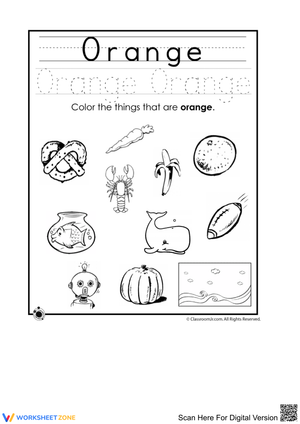
The color orange coloring pages on Worksheetzone feature clearly outlined objects sized for small hands: a round pumpkin, a bunch of carrots with feathery tops, a peeled orange with visible segments, a monarch butterfly, and a prowling tiger. Most designs print the word "ORANGE" in large traceable letters beside the image, connecting the color to its written name while kids fill in the picture.
Thicker outlines on single-object pages suit toddlers, while slightly busier scenes — a fall harvest basket, a leafy autumn tree — offer more challenge for kindergarteners and first graders who can handle finer detail.
How to Use These Printables at Home or in Class
- Color-of-the-week focus: Introduce one sheet per day — the carrot page Monday, the pumpkin by Friday — as part of a themed learning center rotation.
- Pair a page with an orange-colored snack, like mandarin segments or cantaloupe, for a multisensory experience that anchors the color in memory.
- Print the same page twice and let kids compare results when one uses crayons and the other uses markers — a quick visual lesson on tone and saturation.
Worksheetzone offers one free download per day, no login required. Watermarked versions are available at no cost after logging in, and a membership starting at $0.99/week removes watermarks across the full library.
Frequently Asked Questions
What age group fits these color orange coloring pages best?
Ages 2–6 get the most from this collection. Thick-outlined single objects suit toddlers and preschoolers, while the more detailed scene pages challenge kindergarteners who can handle finer lines.
What coloring tools bring out orange most accurately?
Crayola's standard "Orange" crayon covers cleanly for young kids. Layering yellow-orange as a base and adding burnt sienna on top creates a convincing pumpkin tone, while a tangerine marker produces the brighter hue of a fresh orange slice.
Do these pages print well on a standard home printer?
Yes — all Worksheetzone sheets are formatted for US letter paper at 8.5 × 11 inches. Setting your printer to "fit to page" keeps the outlines sharp and prevents any border from getting clipped.
Did the color orange take its name from the fruit?
It did — and it's one of the rare cases where an English color name came from an object rather than the reverse. Before the 16th century, English speakers had no single word for the hue and called it "yellow-red." The color name only entered English after oranges arrived in Europe via South Asian trade routes, making the fruit's name older in the language than the color itself.












 Interactive Worksheet Maker
 Quiz Maker
 Word Search Maker
 Crossword Puzzle Maker
 Word Scramble Generator
 Sentence Scramble Generator
 Handwriting Worksheet Generator
 Name Tracing Generator
 Fill In The Blank Generator