




























Views
Downloads

Printable Pattern Matching Eggs Worksheet | Pre-K Math

Paste this activity's link or code into your existing LMS (Google Classroom, Canvas, Teams, Schoology, Moodle, etc.).
Students can open and work on the activity right away, with no student login required.
You'll still be able to track student progress and results from your teacher account.
This printable egg-themed worksheet strengthens visual discrimination and early logic skills in young learners. Students engage with colorful illustrations to match patterns, identify differences, and complete logical sequences. By focusing on observation and fine motor control, this resource provides a foundational step toward geometric reasoning and pattern recognition in early mathematics.
At a Glance
- Grade: Pre-K · Subject: Mathematics
- Standard:
K.G.B.4— Analyze and compare shapes to describe similarities, differences, and patterns- Skill Focus: Visual discrimination and patterning
- Format: 2 pages · 7 tasks · Answer key included · PDF
- Best For: Early finishers and centers
- Time: 10–15 minutes
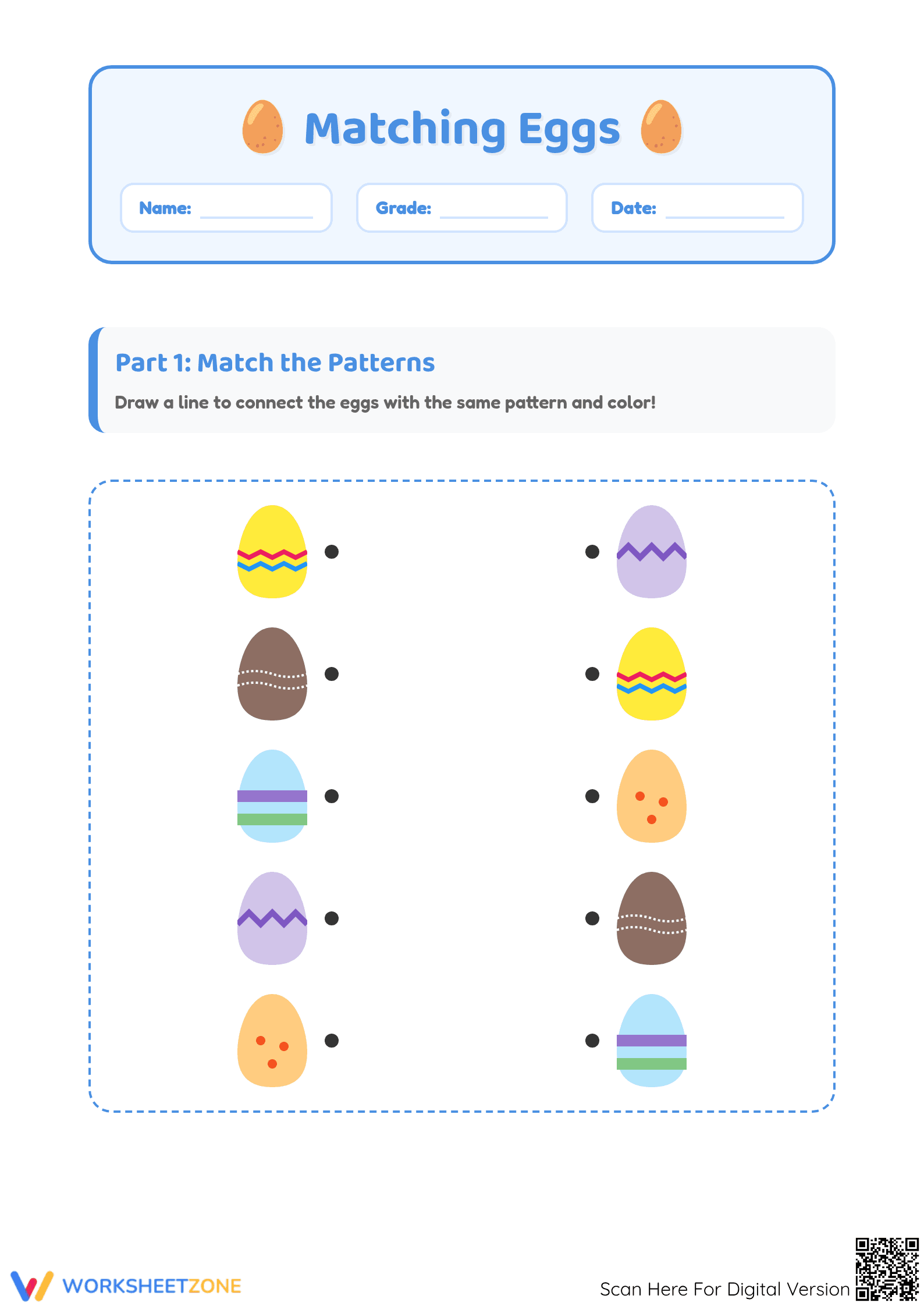
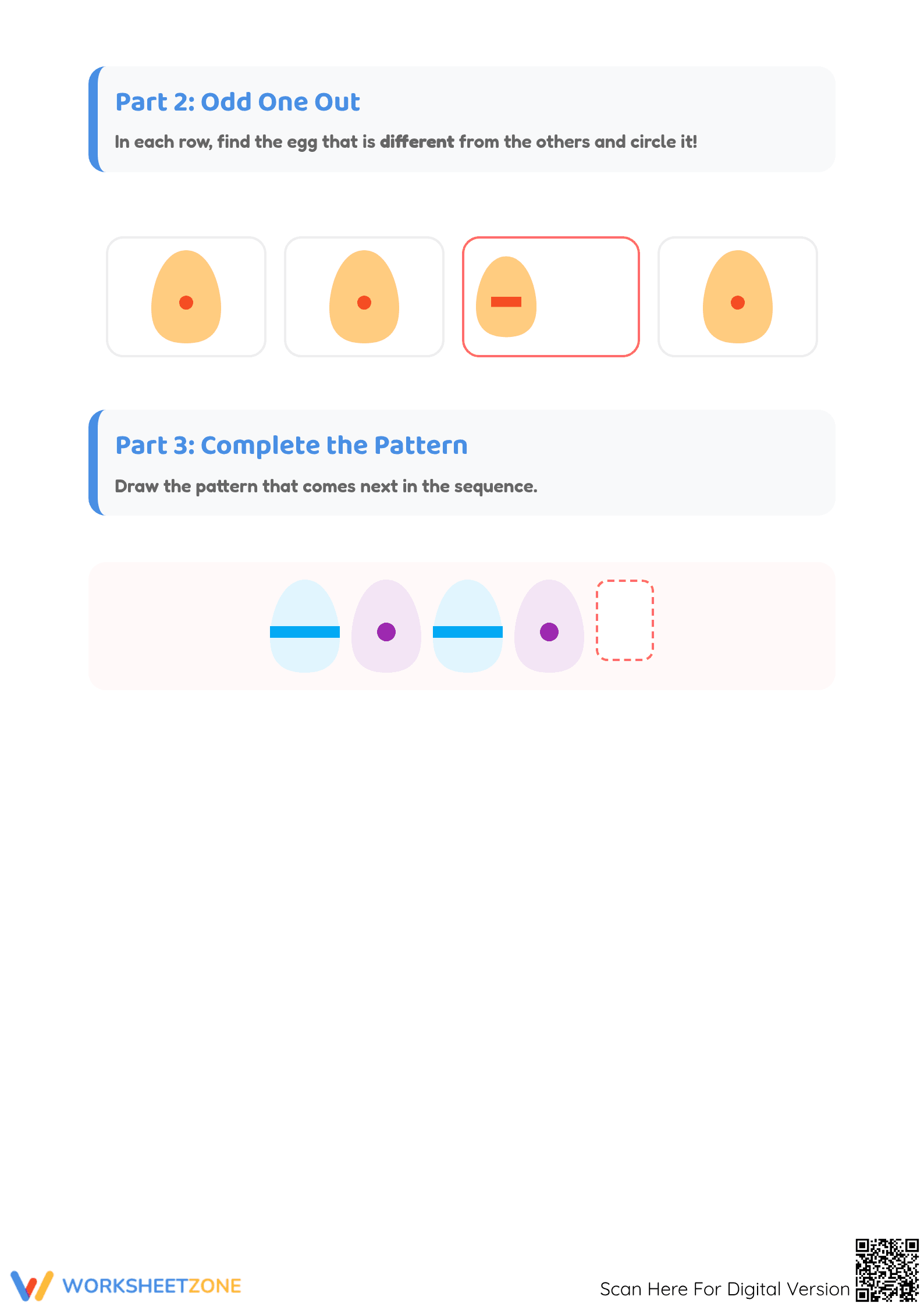
This two-page PDF resource features three distinct activity sections designed for young learners. Part 1 requires students to match five pairs of colorful eggs by observing pattern and color details. Part 2 presents a visual discrimination task where students must find the "odd one out" in a row of similar items. Part 3 introduces early algebraic thinking through a simple sequence completion task. A full answer key is included to facilitate rapid grading and self-correction.
Zero-Prep Workflow: This resource is designed for immediate classroom implementation. Educators can print the 2-page document in under 30 seconds and distribute it to students without any additional setup. Reviewing student work takes less than 60 seconds using the provided answer key. The total teacher preparation time is under 2 minutes, making it an ideal choice for emergency sub plans or quick transitional activities between lessons.
Standards Alignment: This resource is aligned to K.G.B.4. The standard states that students should: "Analyze and compare two- and three-dimensional shapes, in different sizes and orientations, using informal language to describe their similarities, differences, parts." This worksheet specifically targets the foundational ability to notice specific attributes like color, dots, and stripes that define "same" versus "different." Both standard codes can be copied directly into lesson plans, IEP goals, or district curriculum mapping tools.
How to Use It: Use this worksheet as a warm-up activity during a unit on patterns or as a seasonal holiday-themed learning center. It works effectively as a formative assessment tool to observe how students distinguish fine visual details. Educators can use the completion of these tasks to identify students who may need additional support with visual tracking. The expected completion time for most students is 10 to 15 minutes.
Who It's For: This resource is ideal for Preschool and Kindergarten students, including those requiring extra support with fine motor skills or visual processing. It is specifically designed for students working on foundational cognitive skills. The worksheet pairs naturally with hands-on manipulatives like pattern blocks or attribute links to reinforce abstract concepts through concrete exploration and direct instruction.
The use of visual matching tasks is essential for early cognitive development and geometric reasoning. According to EdReports (2024), high-quality early childhood resources must emphasize the identification of attributes and the comparison of objects to build mathematical fluency. This worksheet addresses these needs by presenting structured tasks that require students to observe color, shape, and pattern orientation. By moving from simple matching to sequence completion (ABAB patterns), students transition from basic identification to predictive logic. The inclusion of an answer key ensures that educators can provide immediate feedback, which is critical for correcting misconceptions in visual processing. This resource aligns with standard K.G.B.4, supporting the development of comparative language and observational skills that are predictive of later success in complex geometry and algebraic thinking.


