


























Views
Downloads


Grade K Shape Hunt — Printable No-Prep Worksheet
Paste this activity's link or code into your existing LMS (Google Classroom, Canvas, Teams, Schoology, Moodle, etc.).
Students can open and work on the activity right away, with no student login required.
You'll still be able to track student progress and results from your teacher account.
This worksheet invites young learners to identify and count various geometric shapes within a vibrant "Shape Hunt" scene. Students practice shape recognition and one-to-one correspondence while building early geometry skills. It provides a fun, engaging way to master foundational math concepts through visual exploration and recording data.
At a Glance
- Grade: Kindergarten · Subject: Math
- Standard:
CCSS.MATH.CONTENT.K.G.A.2— Identify and name geometric shapes correctly regardless of their orientation- Skill Focus: Shape recognition and counting
- Format: 2 pages · 8 problems · Answer key included · PDF
- Best For: Early geometry and counting practice
- Time: 15–20 minutes
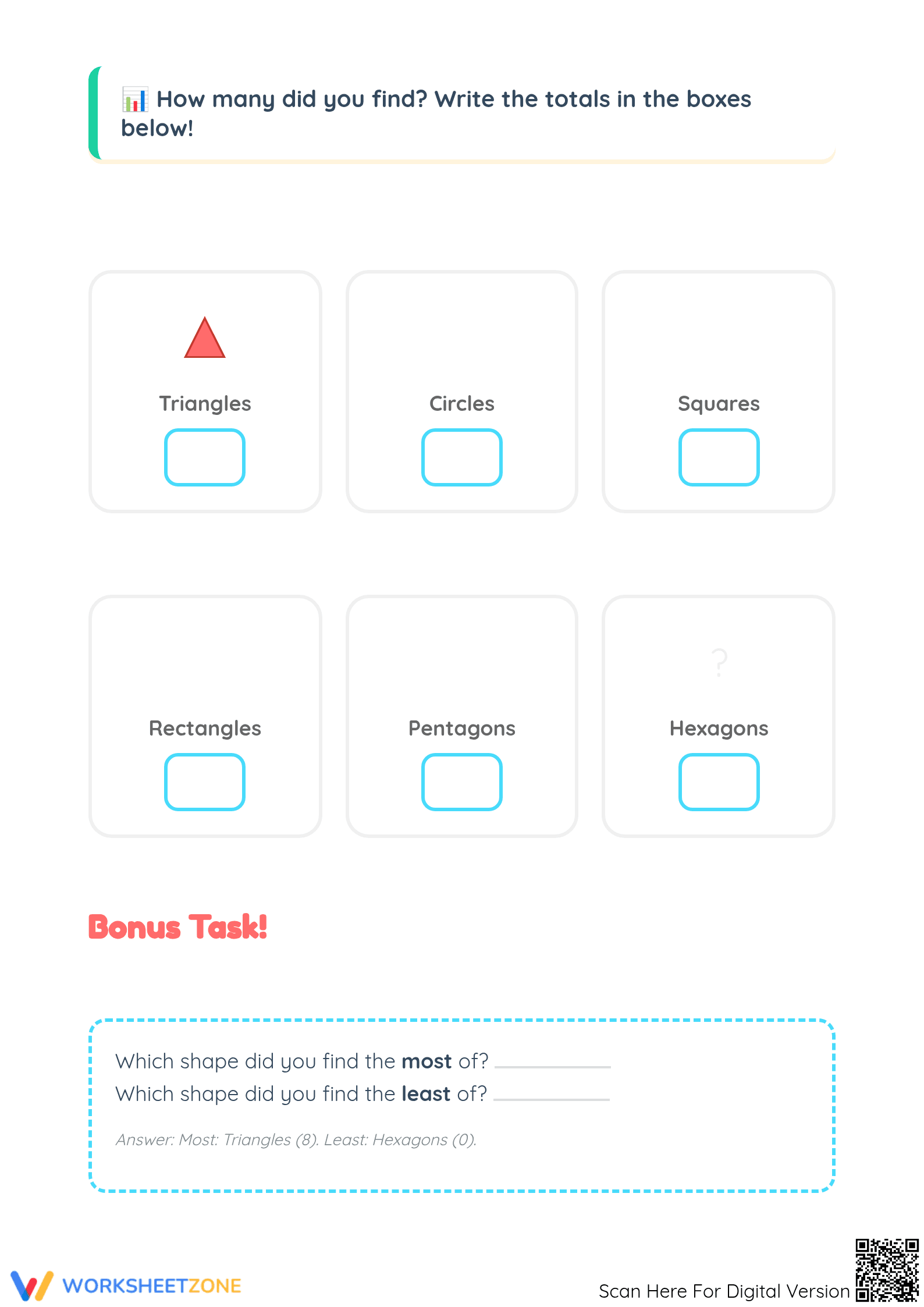
This 2-page PDF features a colorful illustration packed with hidden triangles, squares, circles, rectangles, and pentagons. The second page provides dedicated recording boxes for each shape category, along with a bonus task to identify "most" and "least." A clear answer key is integrated into the bottom of the second page for immediate feedback and grading ease.
Zero-Prep Workflow
- Step 1: Print the two-page PDF in color or high-quality grayscale (under 1 minute).
- Step 2: Distribute to students for independent practice, morning work, or small-group rotations (30 seconds).
- Step 3: Review the embedded answer key with the class or have students self-check their totals (30 seconds).
Total teacher preparation is under 2 minutes, making it an ideal choice for emergency sub plans or last-minute instructional gaps.
Standards Alignment
The primary focus is `CCSS.MATH.CONTENT.K.G.A.2`, which requires students to correctly name shapes regardless of their orientation or overall size. Additionally, it supports `CCSS.MATH.CONTENT.K.CC.B.5` by asking students to count objects in a scattered arrangement. Both standard codes can be copied directly into lesson plans, IEP goals, or district curriculum mapping tools.
How to Use It
Use this as a warm-up activity during your geometry unit to assess prior knowledge of shape names. During direct instruction, project the first page and count the shapes together as a class. For formative assessment, observe students as they record their totals to identify those who may struggle with shape discrimination or counting accuracy. It works excellently as a quiet center activity.
Who It's For
This resource is designed for Kindergarten students but also serves as an excellent review for Grade 1. It is perfect for visual learners who benefit from finding patterns in complex images. Pair this worksheet with physical pattern blocks or a classroom shape scavenger hunt to reinforce concepts across multiple modalities and ensure students can generalize their shape recognition skills.
According to the EdReports 2024 analysis, high-quality instructional materials in early mathematics must balance procedural fluency with conceptual understanding. This worksheet achieves that balance by grounding the counting task in a rich visual context that requires active shape identification. By requiring students to identify "most" and "least," it moves beyond simple rote counting into the analytical territory described in the RAND AIRS 2024 report on foundational math skills. The inclusion of the CCSS.MATH.CONTENT.K.G.A.2 standard ensures that the activity remains focused on grade-level expectations while providing the necessary visual scaffolds for young learners. Research suggests that integrated shape recognition and counting tasks help solidify the connection between spatial reasoning and numerical literacy, providing a robust foundation for more complex geometric concepts in later grades. Educators can rely on these structured visual challenges to bridge the gap between abstract geometry and concrete observation in the early childhood classroom.


