


























Views
Downloads
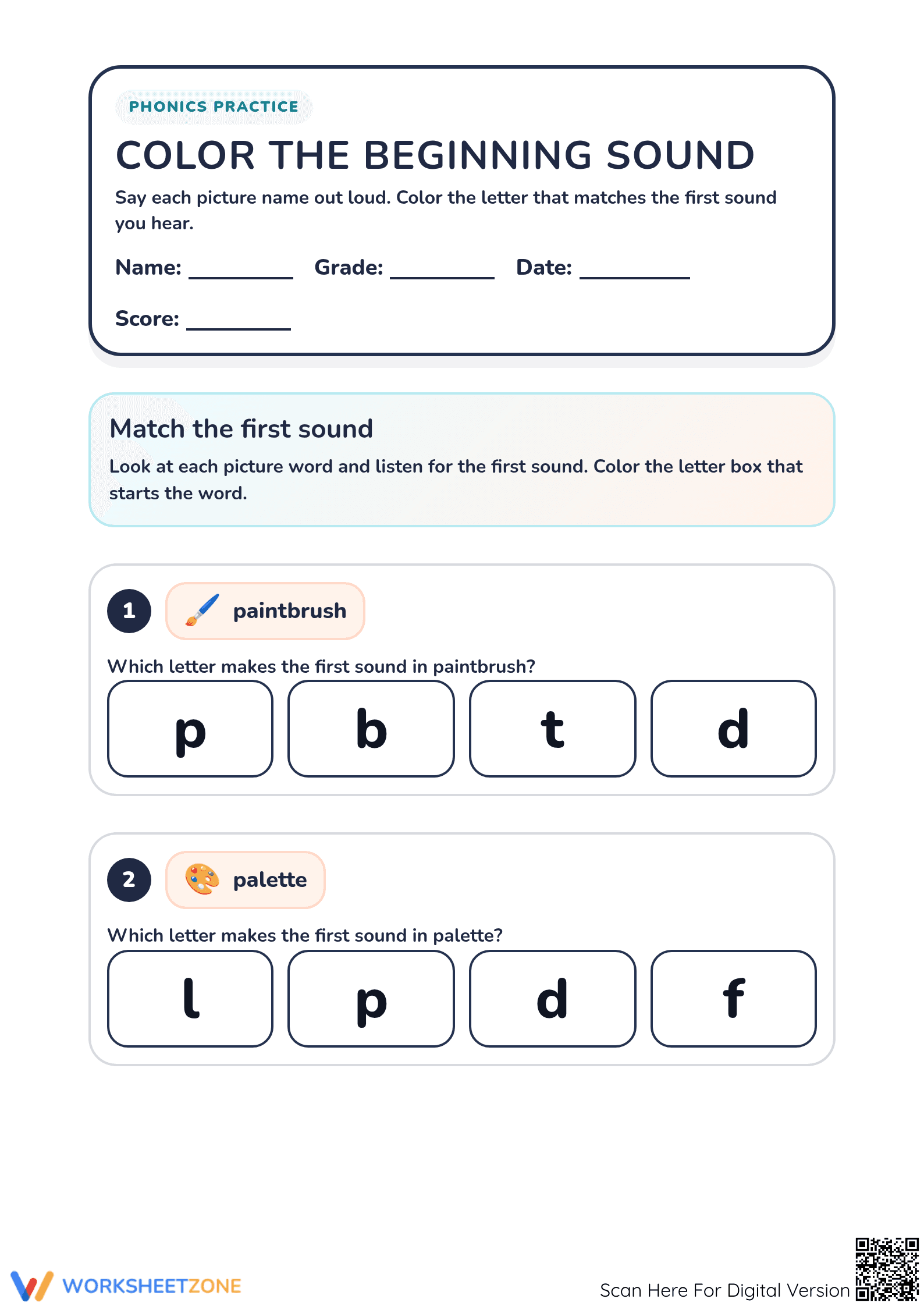


Printable Kindergarten Beginning Sounds | No-Prep Worksheet
Paste this activity's link or code into your existing LMS (Google Classroom, Canvas, Teams, Schoology, Moodle, etc.).
Students can open and work on the activity right away, with no student login required.
You'll still be able to track student progress and results from your teacher account.
This Kindergarten beginning sounds worksheet provides targeted practice for early readers to identify initial phonemes in common words. Students look at vibrant images like a paintbrush and palette, then select the corresponding letter from a choice of four. This activity builds the essential phonological awareness required for decoding and successful literacy development.
At a Glance
- Grade: Kindergarten · Subject: ELA Phonics
- Standard:
CCSS.ELA-LITERACY.RF.K.3.A— Produce the primary sound for each consonant and demonstrate letter-sound correspondences- Skill Focus: Initial Phoneme Identification
- Format: 2 pages · 5 problems · Answer key included · PDF
- Best For: Literacy centers and independent practice
- Time: 10–15 minutes
This two-page PDF includes five structured exercises designed to reinforce letter-sound recognition. Each problem features a clear image label and a corresponding question asking students to identify the starting letter. The layout uses large, easy-to-read font styles and distinct letter boxes, making it accessible for young learners still developing fine motor skills.
Teachers can implement this resource in under two minutes. Simply print the two-page document for each student and distribute it along with crayons or colored pencils. The intuitive design allows students to start immediately with minimal instruction, making it an ideal choice for emergency sub plans or quiet transitions between literacy blocks.
The primary alignment is CCSS.ELA-LITERACY.RF.K.3.A, which requires students to demonstrate basic knowledge of one-to-one letter-sound correspondences. This worksheet specifically addresses the production of primary sounds for consonants in the initial position. This standard code can be copied directly into lesson plans, IEP goals, or district curriculum mapping tools.
Use this worksheet during small-group instruction to check for understanding after introducing new consonant sounds. Observe students as they say the word "glue" or "globe" aloud; if they hesitate, it indicates a need for additional oral blending support. It also serves as a perfect formative assessment at the end of a phonics unit.
This resource is tailored for Kindergarten students and Grade 1 learners requiring remediation. It supports English Language Learners (ELL) by pairing visual cues with printed words, helping them build vocabulary while practicing phonemic awareness. This activity pairs naturally with a beginning sounds anchor chart or a letter-of-the-week direct instruction lesson.
Phonological awareness is the strongest predictor of later reading success, as highlighted by Fisher & Frey (2014) in their research on gradual release of responsibility. This worksheet aligns with CCSS.ELA-LITERACY.RF.K.3.A by forcing students to isolate the initial phoneme and map it to a specific grapheme. By engaging in "Color the Beginning Sound" activities, students move from simple auditory recognition to concrete letter-sound association. According to the RAND AIRS 2024 report on early literacy, consistent practice with discrete phonemic tasks reduces the likelihood of future reading difficulties. This 5-task sequence provides the repetitive, high-frequency engagement necessary for students to achieve automaticity in consonant sound production. It serves as a foundational step toward decoding CVC words and fluency. Educators can reliably use this data-backed approach to ensure students meet the rigorous demands of state and national standards for early phonics development.


