


























Views
Downloads

Essential Beginning Sounds Worksheet | Kindergarten ELA
Paste this activity's link or code into your existing LMS (Google Classroom, Canvas, Teams, Schoology, Moodle, etc.).
Students can open and work on the activity right away, with no student login required.
You'll still be able to track student progress and results from your teacher account.
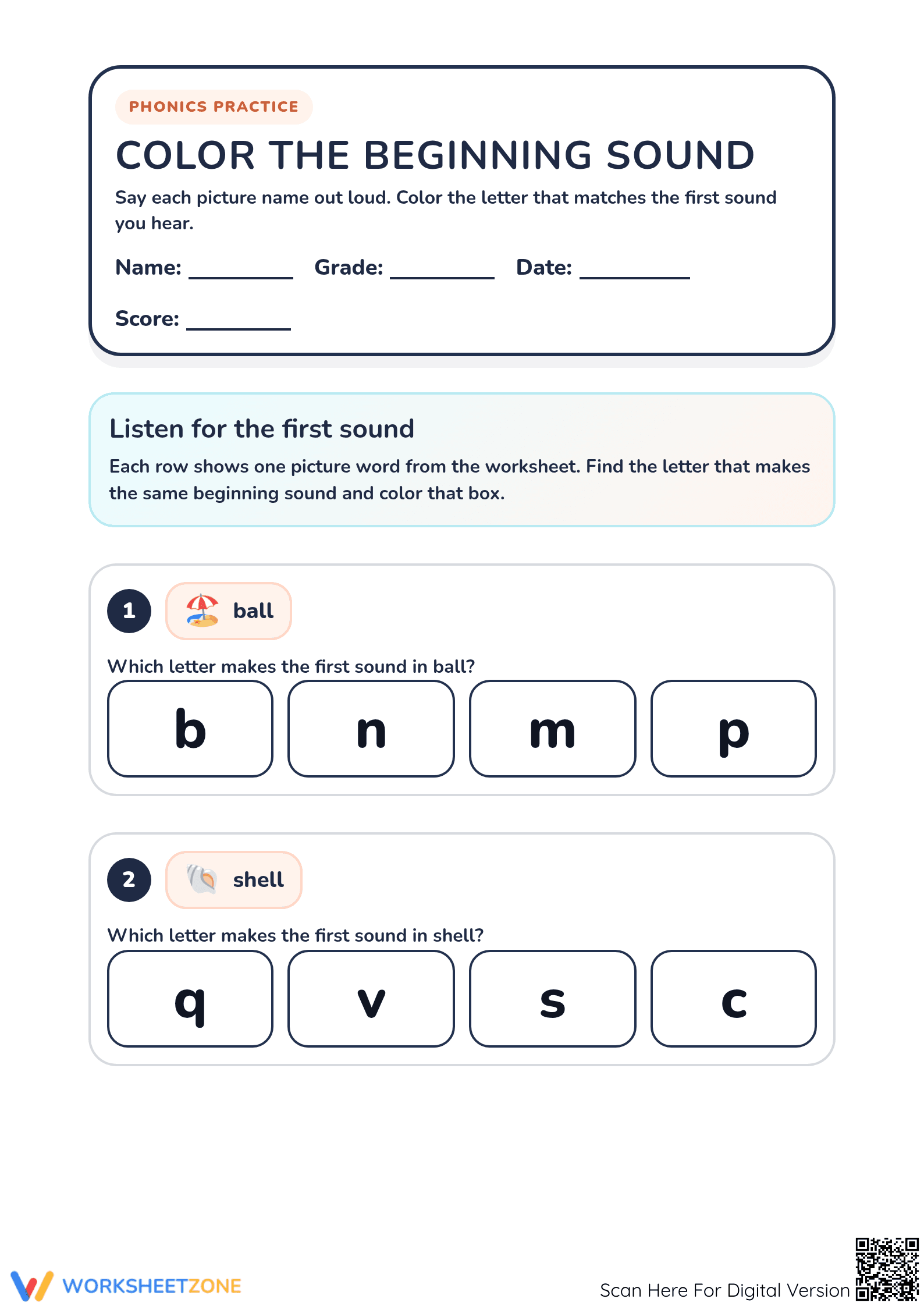
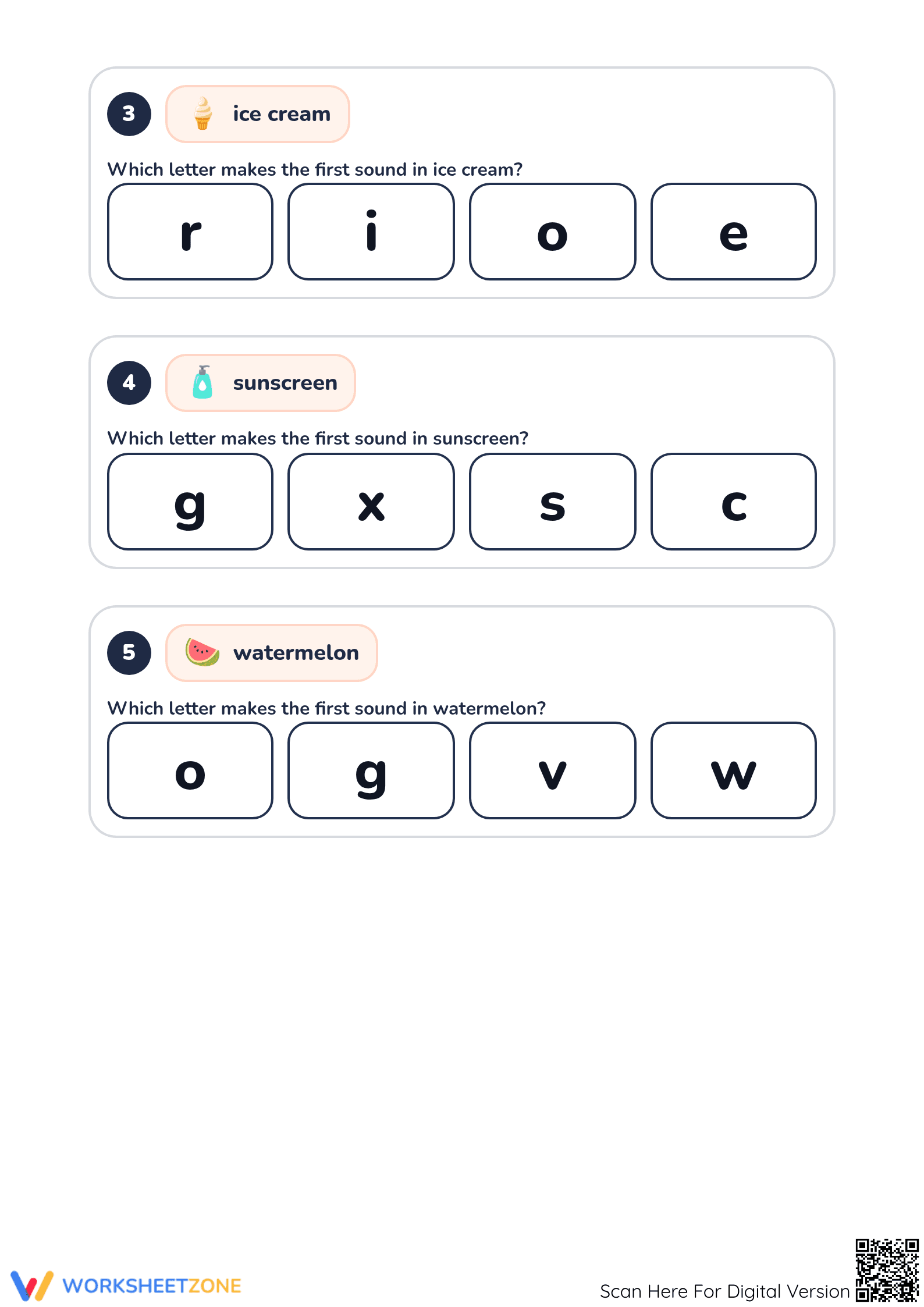
This printable phonics worksheet helps young learners master initial sound recognition through engaging visual cues. Students identify the first letter of common summer-themed words like ball and watermelon, reinforcing the critical connection between spoken phonemes and written graphemes. This activity builds the foundational decoding skills necessary for early reading fluency and phonemic awareness.
At a Glance
- Grade: Kindergarten · Subject: ELA
- Standard:
CCSS.ELA-LITERACY.RF.K.3.A— Identify one-to-one letter-sound correspondences for consonants and vowels in simple words- Skill Focus: Initial Phoneme Isolation
- Format: 2 pages · 5 problems · Answer key included · PDF
- Best For: Independent phonics centers or quick assessments
- Time: 10–15 minutes
This two-page resource features five distinct phonics tasks, each focused on a specific vocabulary word represented by a clear illustration. The worksheet provides a choice of four letters per word, encouraging students to discriminate between similar-sounding or visually distinct graphemes. A dedicated scoring section and teacher-ready layout ensure that progress monitoring is efficient and straightforward for busy educators.
This resource is designed for immediate classroom integration with a total prep time of under two minutes. Simply print the two-page PDF, distribute to your literacy small groups, and let students work independently as you rotate for observations. The clear, self-explanatory instructions make it an ideal choice for emergency sub plans or "morning work" routines that require zero teacher intervention.
The primary standard addressed is `CCSS.ELA-LITERACY.RF.K.3.A`, which requires students to demonstrate basic knowledge of one-to-one letter-sound correspondences by producing the primary sound for each consonant. Additionally, it supports `CCSS.ELA-LITERACY.RF.1.2.C` by asking learners to isolate initial sounds in spoken words. Both standard codes can be copied directly into lesson plans or district curriculum mapping tools.
Use this worksheet as a formative assessment after introducing initial consonants during direct instruction. Observe if students "mouth" the words to isolate the first sound, which is a key indicator of phonemic development. Alternatively, assign it as a summer-themed review activity to prevent "summer slide" and keep foundational skills sharp. Total completion time typically ranges between 10 and 15 minutes.
This activity is tailored for Preschool, Kindergarten, and Grade 1 students who are beginning their phonics journey. It is particularly effective for English Language Learners who benefit from the visual-to-word associations. Pair this worksheet with alphabet anchor charts or a recorded reading of a phonics-based picture book to provide a comprehensive multisensory learning experience for your diverse classroom population.
Mastery of initial phoneme isolation is a prerequisite for successful decoding and orthographic mapping. Research by Fisher & Frey (2014) emphasizes the importance of guided practice where students explicitly link auditory signals to visual symbols. This worksheet aligns with `CCSS.ELA-LITERACY.RF.K.3.A`, providing structured practice in identifying letter-sound correspondences. According to the RAND AIRS 2024 report, high-quality supplemental materials that focus on discrete phonological skills significantly improve literacy outcomes in early childhood settings. By providing 5 targeted problems across 2 pages, this resource offers the "just-right" amount of practice for students to demonstrate proficiency without cognitive overload. This evidence-based approach ensures that students develop the automaticity required for subsequent stages of reading development, such as blending and segmenting more complex cvc words.


