


























Views
Downloads

Essential Beginning Sounds Phonics Worksheet | Grade K-1
Paste this activity's link or code into your existing LMS (Google Classroom, Canvas, Teams, Schoology, Moodle, etc.).
Students can open and work on the activity right away, with no student login required.
You'll still be able to track student progress and results from your teacher account.
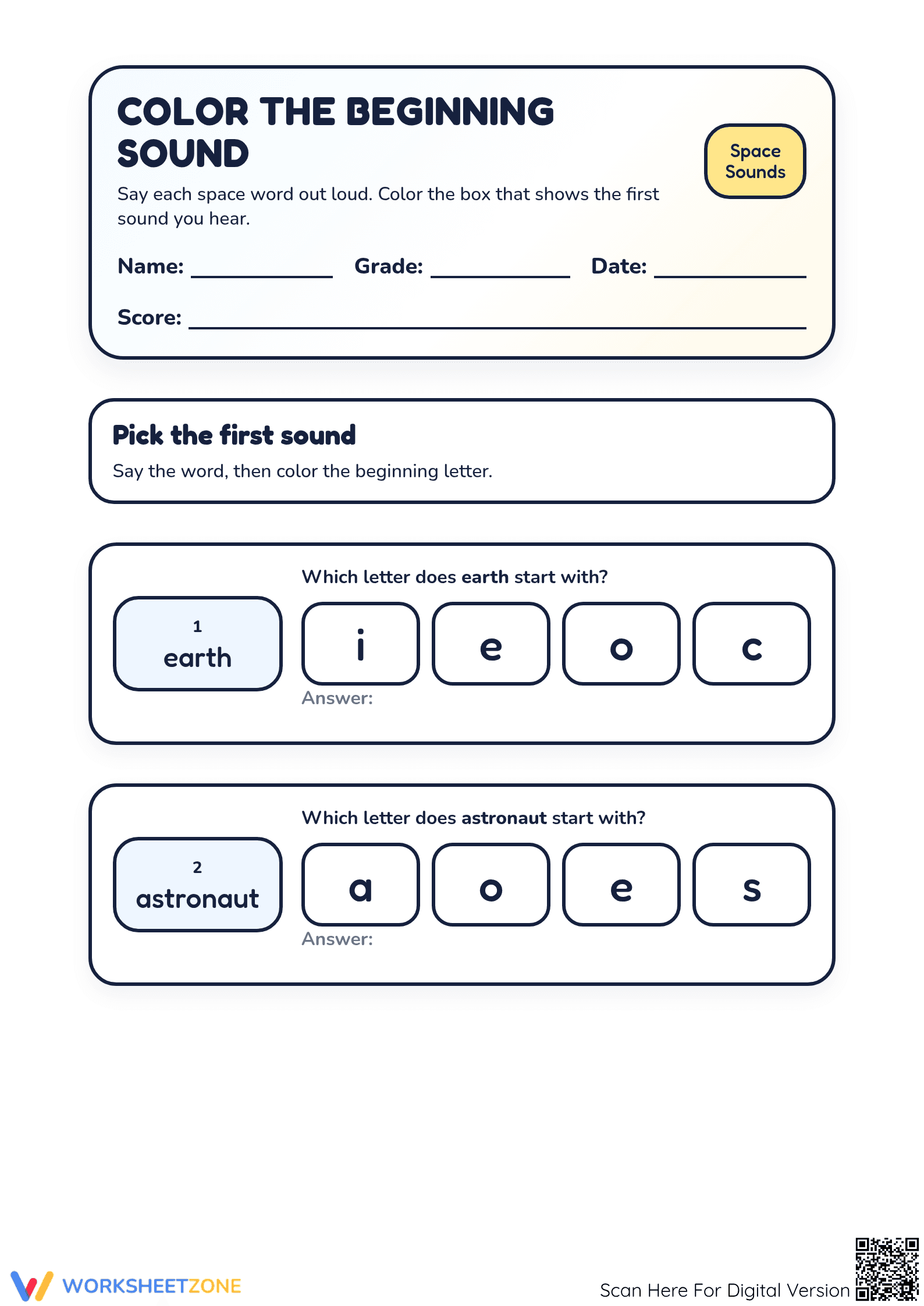
Practice identifying initial phonemes with this engaging space-themed phonics activity. Students develop critical letter-sound correspondence by isolating the beginning sound of common space-related words like "astronaut" and "comet." This targeted practice strengthens foundational reading skills and prepares young learners for successful decoding and word recognition in early elementary grades.
At a Glance
- Grade: Preschool–1 · Subject: ELA Phonics
- Standard:
CCSS.ELA-LITERACY.RF.K.3.A— Identify one-to-one letter-sound correspondences by producing the primary sound for consonants- Skill Focus: Initial Phoneme Isolation
- Format: 3 pages · 8 problems · Answer key included · PDF
- Best For: Literacy centers and independent practice
- Time: 10–15 minutes
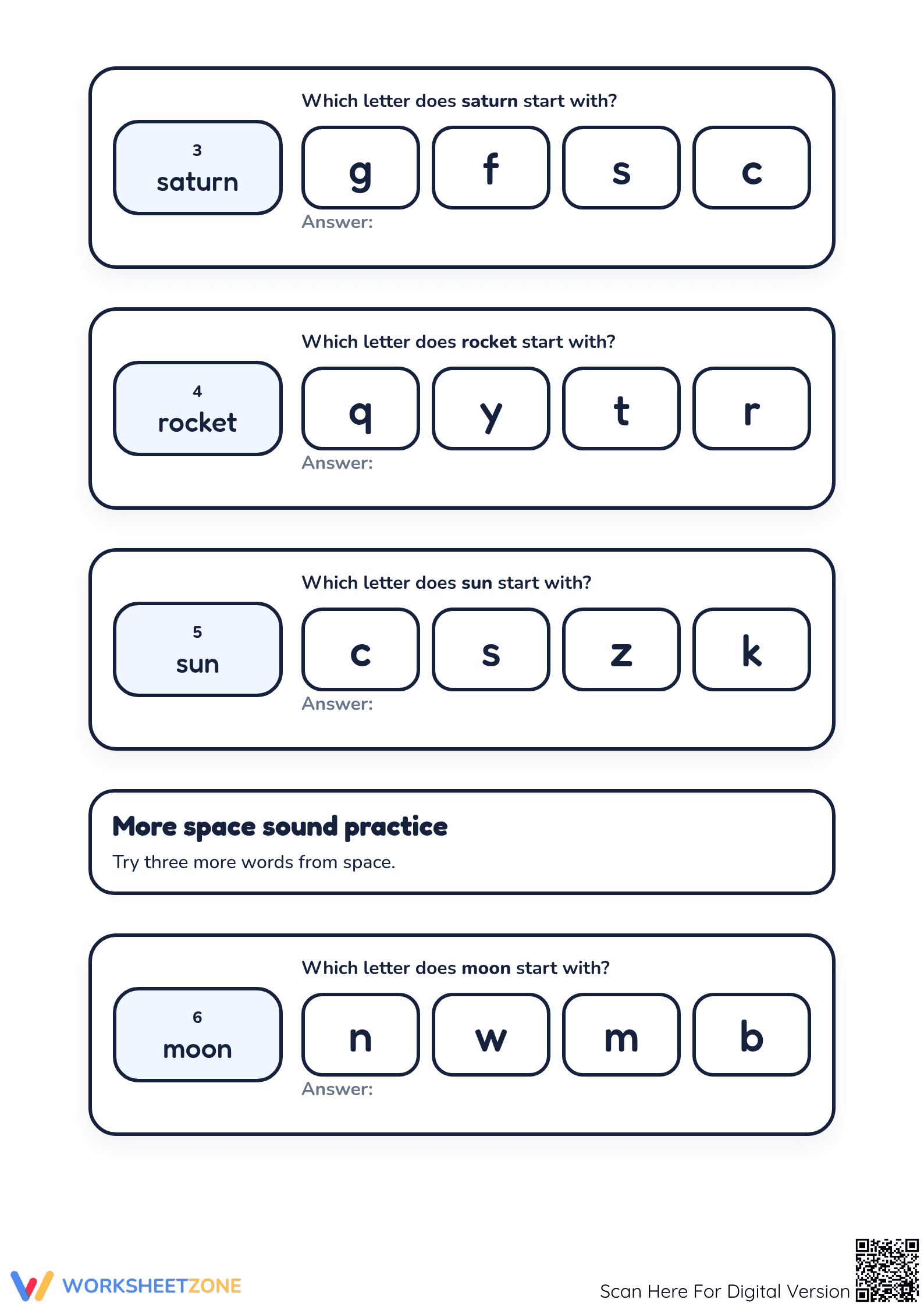
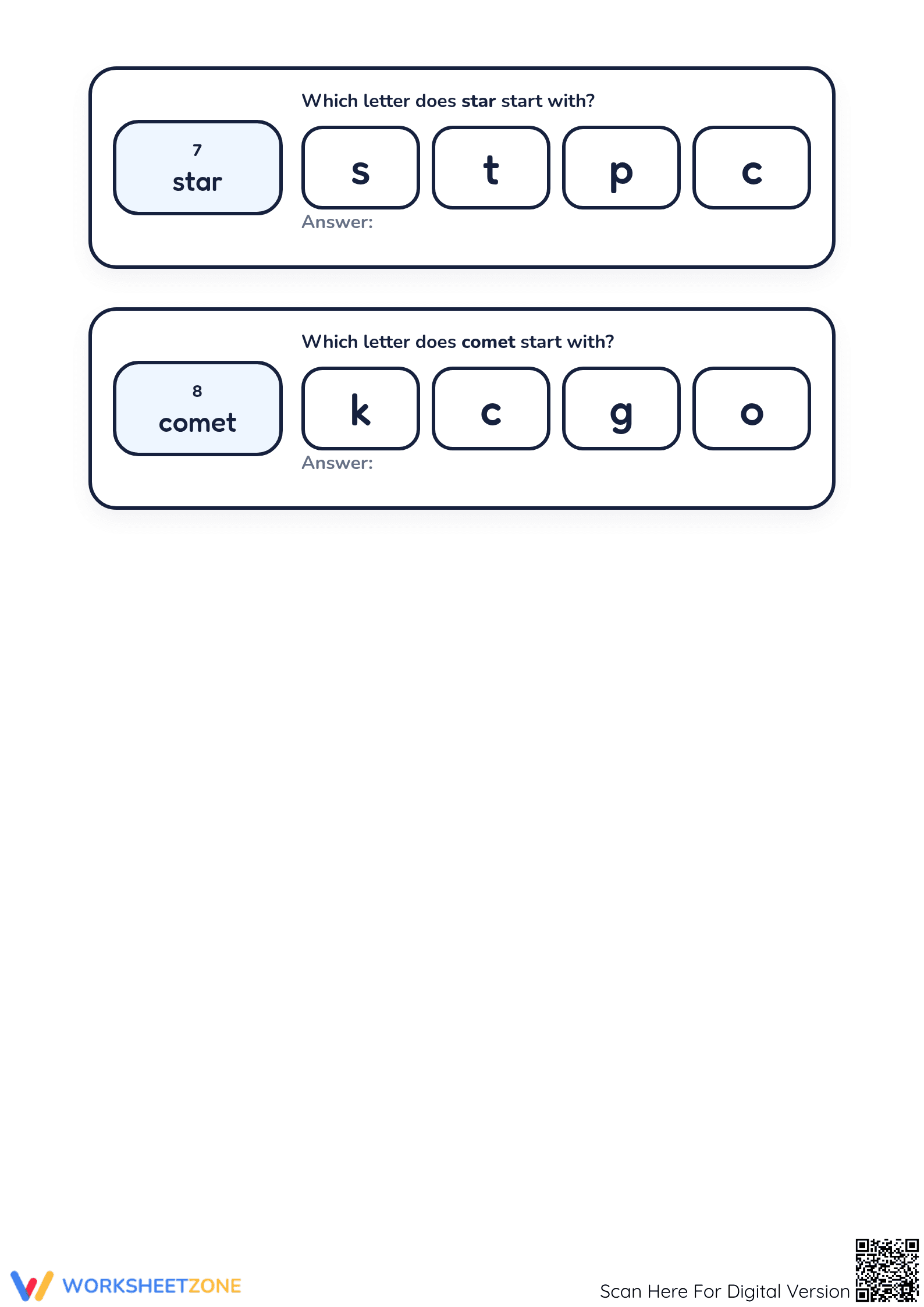
This three-page printable resource features eight distinct vocabulary terms related to space science. Each problem presents a clear image and word label, followed by four multiple-choice letter options. Students are prompted to say the word aloud, isolate the beginning sound, and color the box containing the correct corresponding letter. A comprehensive answer key is included for quick verification.
The worksheet follows a structured skill progression to ensure student success.
- Guided practice: Tasks 1-2 introduce the concept with familiar vowels and consonants, allowing for teacher modeling of the "say, listen, identify" workflow.
- Supported practice: Tasks 3-6 provide additional repetitions with varied consonants, helping students build confidence through consistent formatting and visual cues.
- Independent practice: The final tasks require students to apply their phonemic awareness to less common words like "comet," demonstrating mastery of initial sound isolation.
This gradual-release approach facilitates a transition from direct instruction to independent application through focused repetition.
The primary focus of this worksheet is CCSS.ELA-LITERACY.RF.K.3.A: "Demonstrate basic knowledge of one-to-one letter-sound correspondences by producing the primary sound or many of the most frequent sounds for each consonant." It also supports CCSS.ELA-LITERACY.RF.1.2.C by requiring students to isolate and pronounce initial phonemes in spoken single-syllable words. Both standard codes can be copied directly into lesson plans, IEP goals, or district curriculum mapping tools.
For an effective instructional moment, use this worksheet during the portion of a phonics lesson after teaching a specific set of letters. It serves as an excellent formative-assessment tool; observe whether students are correctly articulating the word before selecting a letter. Expected completion time is 10 to 15 minutes, making it an ideal choice for morning work or a quick literacy center rotation.
This resource is designed for preschool, kindergarten, and first-grade students who are developing foundational phonemic awareness. It is particularly beneficial for visual learners who thrive on combined image-text associations. Naturally pair this activity with a space-themed picture book or an anchor chart displaying the alphabet to provide additional scaffolding for students who are still mastering letter recognition.
Foundational literacy instruction depends on the development of phonemic awareness, specifically the ability to isolate initial sounds as practiced in this space-themed resource. Aligned to CCSS.ELA-LITERACY.RF.K.3.A, this worksheet focuses on the plain-English skill of identifying letter-sound correspondences, a critical precursor to decoding. According to research from Fisher & Frey (2014) on the gradual release of responsibility, structured practice that moves from guided to independent application is essential for student mastery of complex phonics concepts. By providing eight targeted tasks with clear visual supports, this resource ensures students engage deeply with the sounds of language. Such systematic instruction is a hallmark of high-quality literacy programs and directly addresses the phonics gap often seen in early childhood education. This PDF resource provides the necessary repetition for students to internalize these sounds, facilitating a smoother transition to reading fluent text.


