


























Views
Downloads

Printable Beginning Sounds Worksheet | Kindergarten Phonics
Paste this activity's link or code into your existing LMS (Google Classroom, Canvas, Teams, Schoology, Moodle, etc.).
Students can open and work on the activity right away, with no student login required.
You'll still be able to track student progress and results from your teacher account.
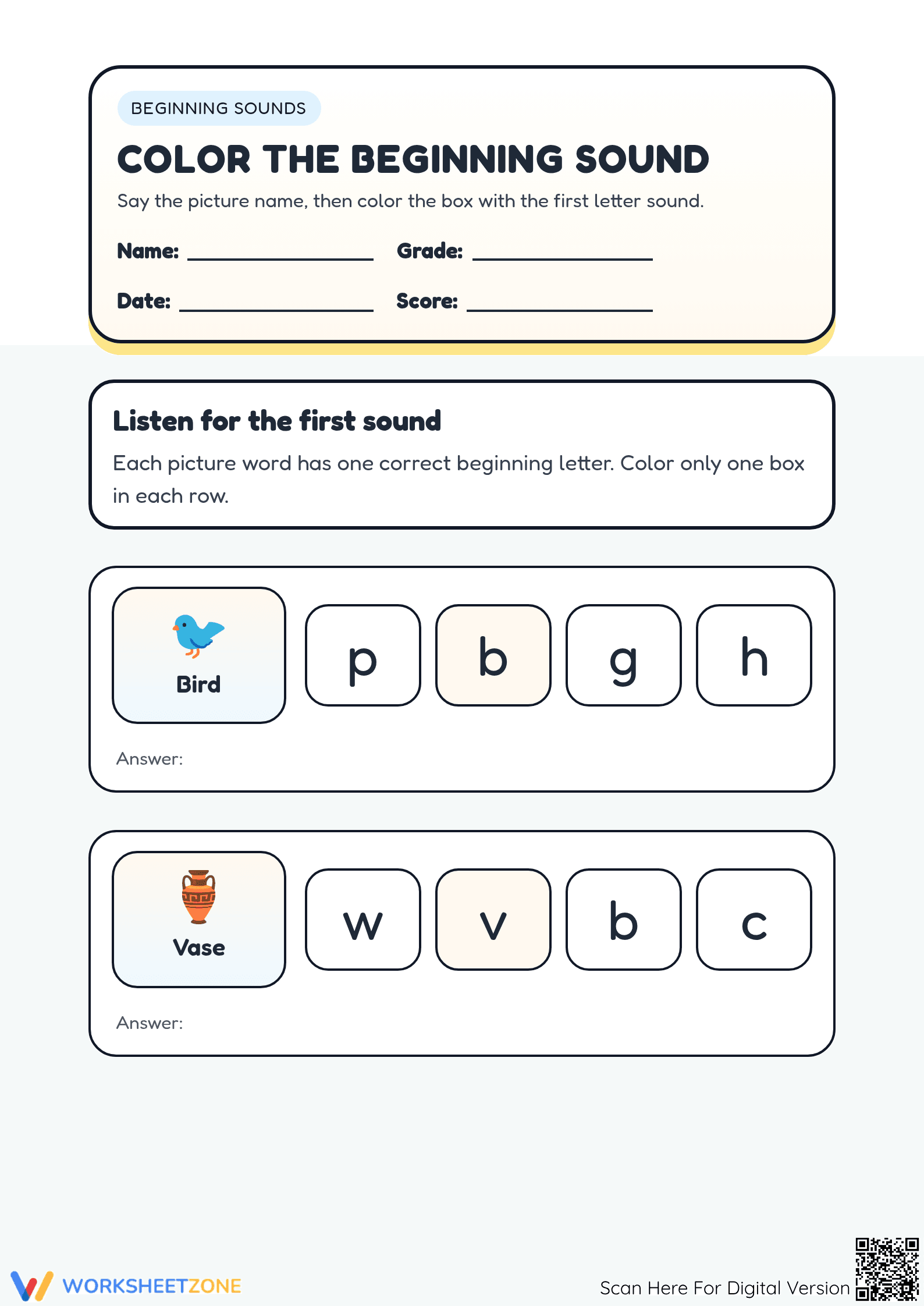
This Kindergarten phonics worksheet helps students master initial phoneme identification through an engaging coloring activity. By connecting visual images to their corresponding beginning letters, learners build the foundational decoding skills necessary for early literacy success. Students say the name of common objects like birds and vases to isolate and identify the specific first letter sound effectively.
At a Glance
- Grade: Kindergarten · Subject: ELA Phonics
- Standard:
CCSS.ELA-LITERACY.RF.K.3.A— Produce the primary sound for each consonant in one-to-one letter-sound correspondences- Skill Focus: Initial Phoneme Isolation
- Format: 2 pages · 5 problems · Answer key included · PDF
- Best For: Independent morning work or literacy centers
- Time: 10–15 minutes
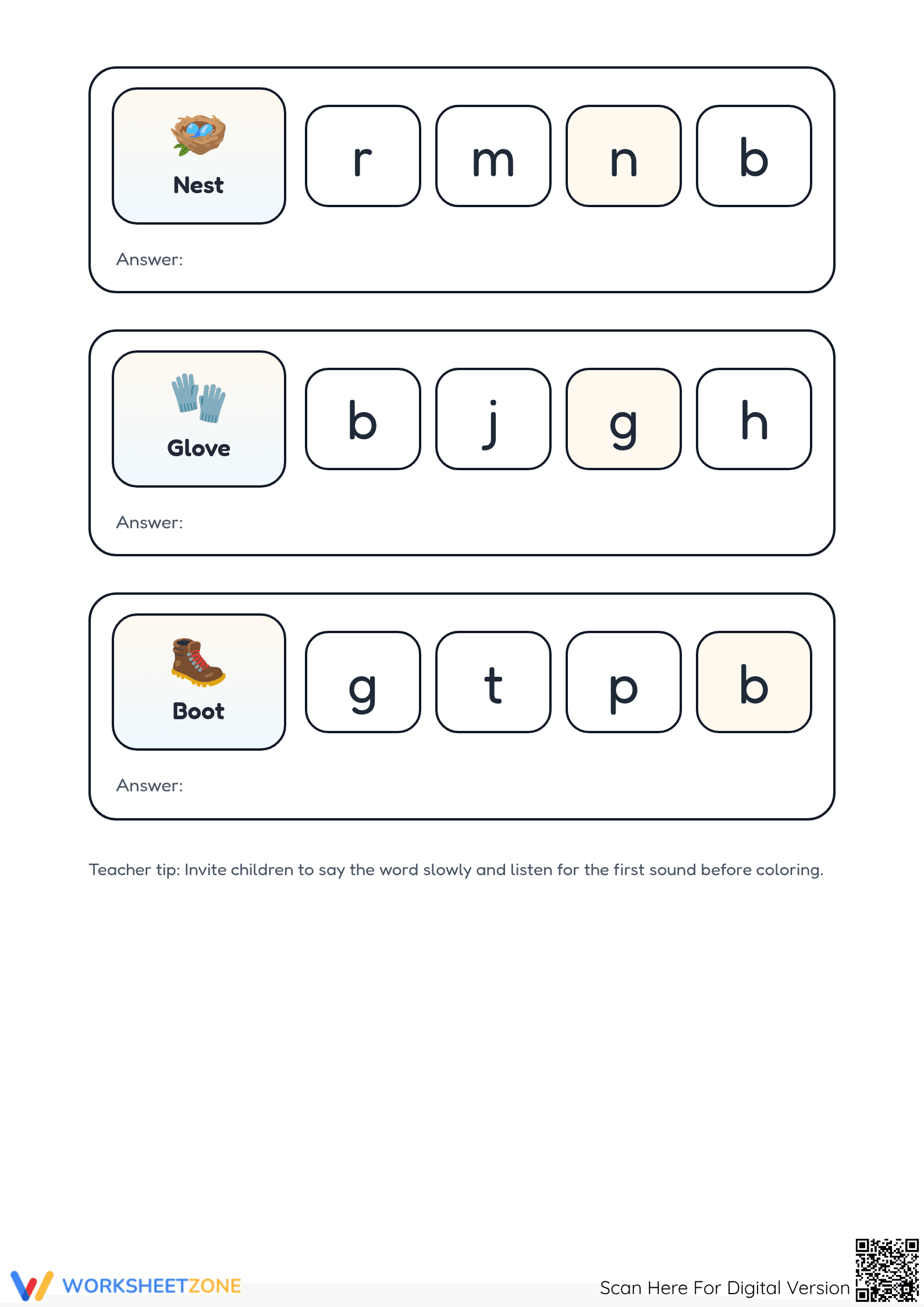
This two-page resource features high-quality illustrations of familiar objects including a bird, vase, nest, glove, and boot. Each problem row presents a central image flanked by four letter choices, requiring students to discriminate between similar-sounding consonants. The layout is clean and spacious, including dedicated fields for student name, date, and score. A comprehensive answer key is provided for rapid grading and immediate feedback.
Zero-Prep Workflow
- Print (30 seconds): Select the pages and hit print; the black-and-white design is optimized for high-volume copying without wasting toner.
- Distribute (1 minute): Hand out the sheets with a simple verbal instruction to "Say it, then color it" to get students working immediately.
- Review (1 minute): Use the included answer key to quickly verify student accuracy during the activity or after collection for grading.
Total teacher preparation time is less than two minutes, making this an ideal choice for emergency sub plans or last-minute literacy rotations.
Standards Alignment
The primary alignment for this activity is CCSS.ELA-LITERACY.RF.K.3.A, which focuses on demonstrating basic knowledge of one-to-one letter-sound correspondences by producing the primary sound for each consonant. Supporting this is CCSS.ELA-LITERACY.RF.K.1.D, recognizing and naming all lowercase letters of the alphabet. Both standard codes can be copied directly into lesson plans, IEP goals, or district curriculum mapping tools.
How to Use It
Deploy this worksheet during the "You Do" phase of a gradual release model following a direct instruction lesson on consonants. It also serves as an excellent formative assessment tool; observe students as they whisper the names of the objects to themselves to check for correct phoneme isolation. Expected completion time ranges from ten to fifteen minutes depending on the student's current proficiency level.
Who It's For
This resource is designed for Preschool, Kindergarten, and Grade 1 students who are beginning their journey into phonetic decoding and letter recognition. It is particularly effective for English Language Learners (ELL) due to its heavy reliance on visual cues and familiar vocabulary. Pair this activity with a physical alphabet anchor chart or a short read-aloud passage featuring the target sounds for a complete lesson.
The identification of initial phonemes is a critical predictor of later reading proficiency, as noted in the RAND AIRS 2024 analysis of early literacy interventions. This worksheet directly addresses CCSS.ELA-LITERACY.RF.K.3.A by requiring students to produce the primary sound for consonants through a visual-to-phoneme matching task. By isolating the beginning sound of familiar words like "bird" or "nest," learners strengthen their phonological awareness and letter-sound correspondence. Research by Fisher & Frey (2014) emphasizes the importance of providing students with frequent, low-stakes practice opportunities to consolidate these foundational skills. This printable resource offers a structured, zero-prep environment for such practice, ensuring that students can independently apply their phonetic knowledge. The inclusion of an answer key facilitates immediate feedback, which is essential for correcting early misconceptions in pronunciation and letter identification. This high-leverage instructional tool supports a comprehensive approach to phonics instruction within any primary classroom.


