




























Views
Downloads
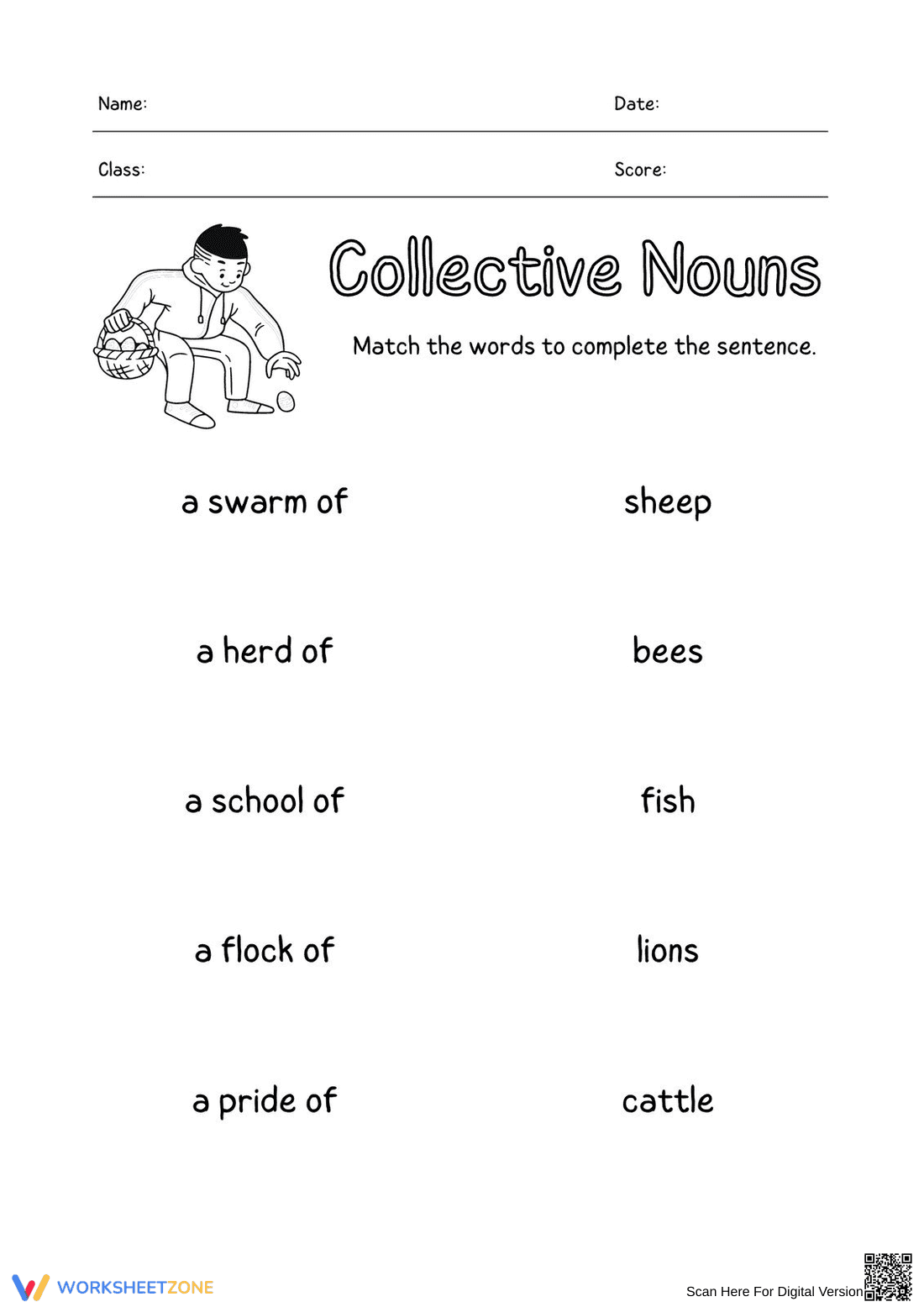

Collective Nouns Matching Worksheet | Grade 2 Printable

Paste this activity's link or code into your existing LMS (Google Classroom, Canvas, Teams, Schoology, Moodle, etc.).
Students can open and work on the activity right away, with no student login required.
You'll still be able to track student progress and results from your teacher account.
This Grade 2 grammar worksheet provides focused practice with collective nouns, helping students understand how specific words describe groups of animals. By matching collective terms to their corresponding plural nouns, young learners build vocabulary and strengthen their foundational language skills for more descriptive writing.
At a Glance
- Grade: 2 · Subject: ELA
- Standard:
CCSS.ELA-LITERACY.L.2.1.A— Use collective nouns to describe groups.- Skill Focus: Matching collective nouns
- Format: 1 page · 5 problems · Answer key included · PDF
- Best For: Independent practice or morning work
- Time: 5–10 minutes
This single-page printable features a straightforward matching activity designed for early readers. Students draw lines connecting five collective noun phrases on the left (such as "a swarm of" or "a pride of") to the correct animal on the right. The clean layout minimizes visual distractions, while the included answer key ensures quick grading for teachers or easy self-checking for students.
Zero-Prep Workflow
- Print (1 minute): The black-and-white design is optimized for standard printers, requiring no special ink or paper.
- Distribute (1 minute): Hand out the single page during morning work, literacy centers, or as a quick grammar check.
- Review (3 minutes): Use the provided answer key to grade submissions rapidly or project it on the board for whole-class review.
With a total teacher prep time of under two minutes, this resource is highly suitable for emergency sub plans or last-minute schedule changes.
Standards Alignment
This activity is directly aligned to CCSS.ELA-LITERACY.L.2.1.A, which requires students to use collective nouns (e.g., group). By isolating this specific grammar rule, the worksheet ensures targeted skill development. Both standard codes can be copied directly into lesson plans, IEP goals, or district curriculum mapping tools.
How to Use It
Deploy this worksheet during literacy centers after a brief direct instruction lesson on animal groups. It serves as an excellent independent task while the teacher works with small reading groups. Alternatively, use it as a formative assessment tool at the end of a grammar week. As students complete the 5 matching problems, observe whether they rely on guessing or if they can confidently pair terms like "herd" with "cattle." Expected completion time ranges from 5 to 10 minutes.
Who It's For
This resource is primarily designed for second-grade students mastering basic grammar conventions. The clear, large text and simple matching format make it accessible for English Language Learners (ELLs) who are building their vocabulary of animal terms. For differentiation, pair this worksheet with a visual anchor chart displaying pictures of animal groups to support students who need extra scaffolding.
Mastering grammar conventions like those outlined in CCSS.ELA-LITERACY.L.2.1.A requires targeted, repeated exposure to vocabulary in context. When students practice how to use collective nouns to describe groups, they develop a more nuanced understanding of the English language, which directly impacts their reading comprehension and writing fluency. According to Fisher & Frey (2014), providing students with brief, focused practice opportunities allows for the consolidation of new vocabulary without causing cognitive overload. This matching activity applies that principle by isolating five specific collective nouns, ensuring learners can process and retain the terminology effectively. By integrating this targeted practice into daily routines, educators can build stronger foundational language skills that support broader literacy goals across the curriculum. This approach ensures that young learners gain the confidence needed to apply these descriptive terms in their own independent writing tasks.


