


























Views
Plays


Philippine Law & Contracts Quiz | College Printable
Paste this activity's link or code into your existing LMS (Google Classroom, Canvas, Teams, Schoology, Moodle, etc.).
Students can open and work on the activity right away, with no student login required.
You'll still be able to track student progress and results from your teacher account.
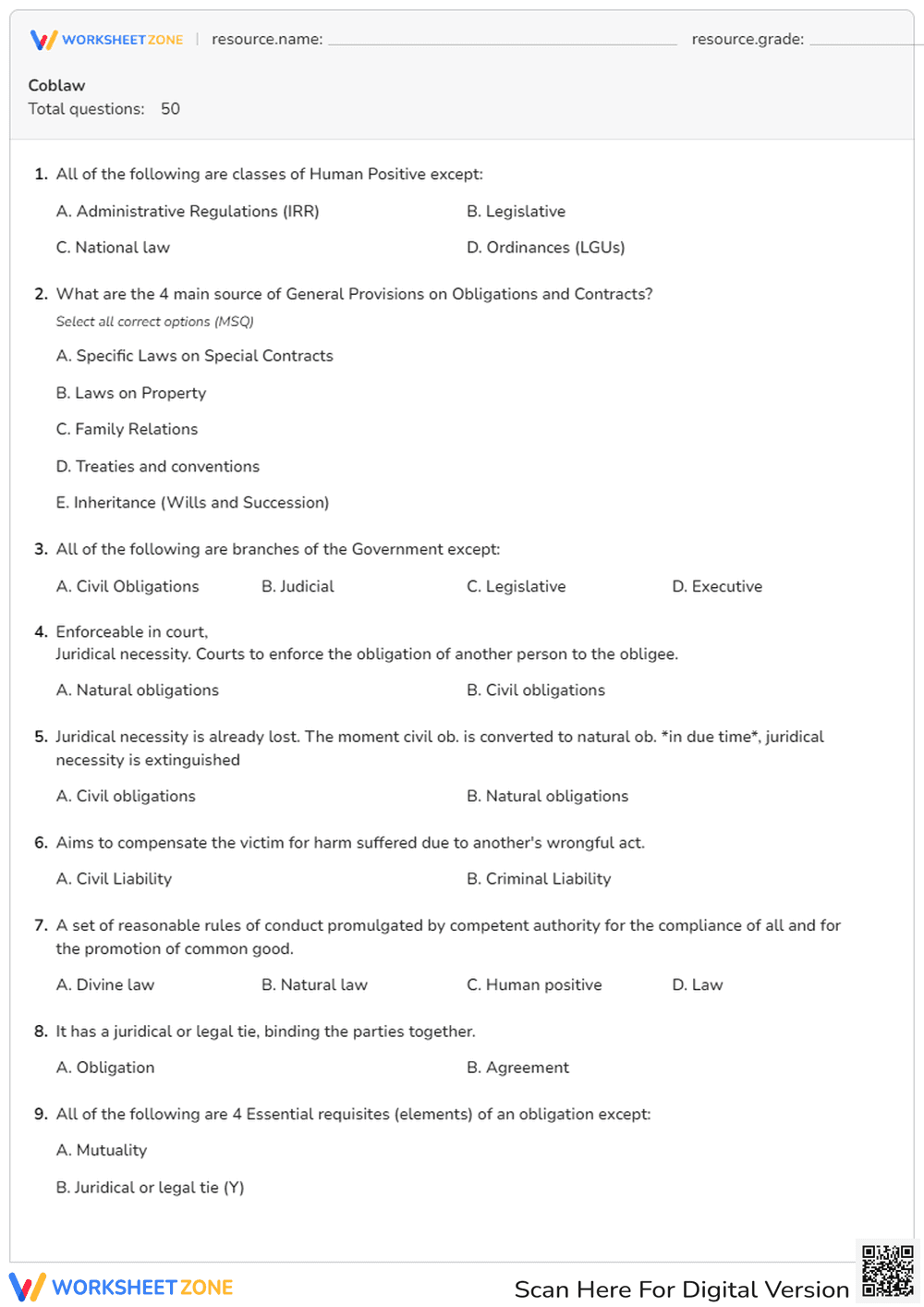
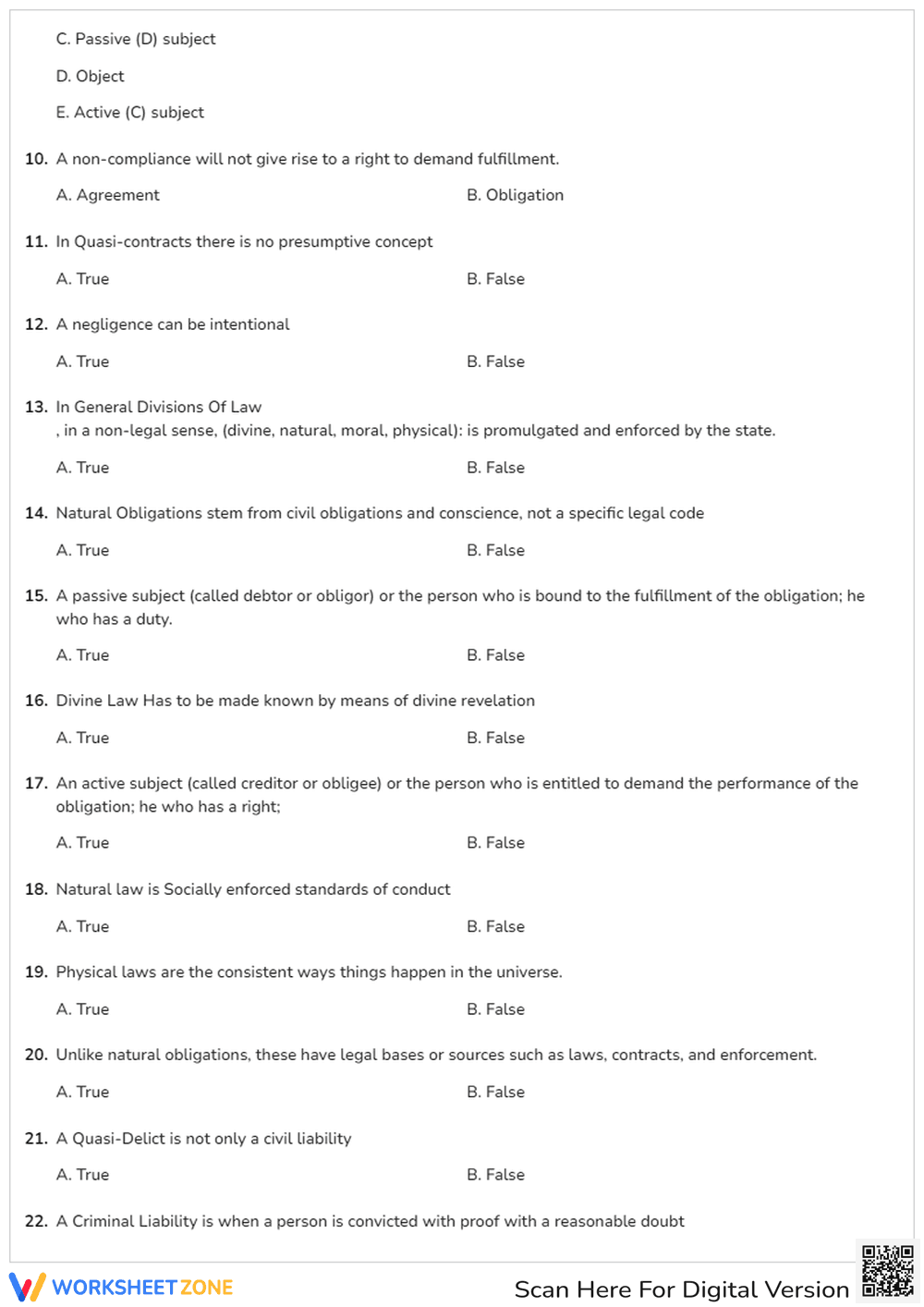
This comprehensive Philippine law quiz evaluates student understanding of obligations, contracts, and civil liability. Designed for college-level legal studies, the assessment challenges learners to differentiate between natural and civil obligations, identify sources of law, and apply legal definitions to specific scenarios to ensure foundational mastery.
At a Glance
- Grade: College · Subject: Legal Studies
- Standard:
D2.Civ.3.9-12— Analyze the impact of constitutions and laws- Skill Focus: Philippine Obligations and Contracts
- Format: 4 pages · 50 problems · Answer key included · PDF
- Best For: Summative assessment or exam review
- Time: 45–60 minutes
This robust assessment features 50 targeted questions divided into multiple-choice and true/false formats. Spanning four pages, the quiz covers essential legal concepts including human positive law, quasi-delicts, civil fruits, and the essential requisites of an obligation. A complete answer key is included to streamline grading and provide immediate feedback on complex legal terminology.
Zero-Prep Workflow
- Print (1 minute): Simply download the PDF and print the four-page assessment. The clean layout ensures readability for all students.
- Distribute (1 minute): Hand out the quiz during a scheduled exam period or as a comprehensive take-home review assignment.
- Review (5 minutes): Use the included answer key to quickly grade submissions or facilitate a whole-class review session to clarify common misconceptions about civil liability.
With under two minutes of total teacher prep time, this resource is an ideal solution for busy professors or as a reliable emergency sub plan for a teaching assistant.
Standards Alignment
This resource aligns with D2.Civ.3.9-12: Analyze the impact of constitutions, laws, treaties, and international agreements on the maintenance of national and international order. By evaluating specific Philippine legal codes and contract principles, students demonstrate a practical understanding of how civil laws govern societal interactions. Both standard codes can be copied directly into lesson plans, IEP goals, or district curriculum mapping tools.
How to Use It
Deploy this 50-question quiz as a summative assessment after completing a unit on the Philippine Civil Code. It serves as an excellent midterm examination or a rigorous study guide for final exams. During administration, observe which specific legal definitions (such as the difference between generic and specific property) cause the most hesitation, using this formative data to guide subsequent review lectures. Expected completion time is 45 to 60 minutes.
Who It's For
This worksheet is designed for college students enrolled in introductory law, business law, or Philippine legal system courses. To support diverse learners, professors might allow open-note access for students requiring accommodations, or pair the quiz with a detailed anchor chart outlining the branches of government and sources of law. It pairs perfectly with direct instruction on the Law on Obligations and Contracts.
Integrating rigorous assessments into higher education legal studies is essential for ensuring students can accurately analyze the impact of constitutions and laws (D2.Civ.3.9-12). According to Fisher & Frey (2014), frequent and structured evaluations of domain-specific vocabulary significantly improve long-term retention of complex concepts. This 50-question quiz provides the necessary repetition and varied question formats to solidify understanding of Philippine obligations and contracts. By challenging students to distinguish between nuanced legal terms like quasi-contracts and quasi-delicts, educators can effectively measure foundational legal literacy. Utilizing comprehensive, print-ready assessments allows instructors to maximize instructional time while maintaining high academic standards. Consistent exposure to formal legal phrasing prepares students for advanced coursework and professional licensure examinations, ensuring they possess the critical analytical skills required in the legal field.


