


























Views
Downloads
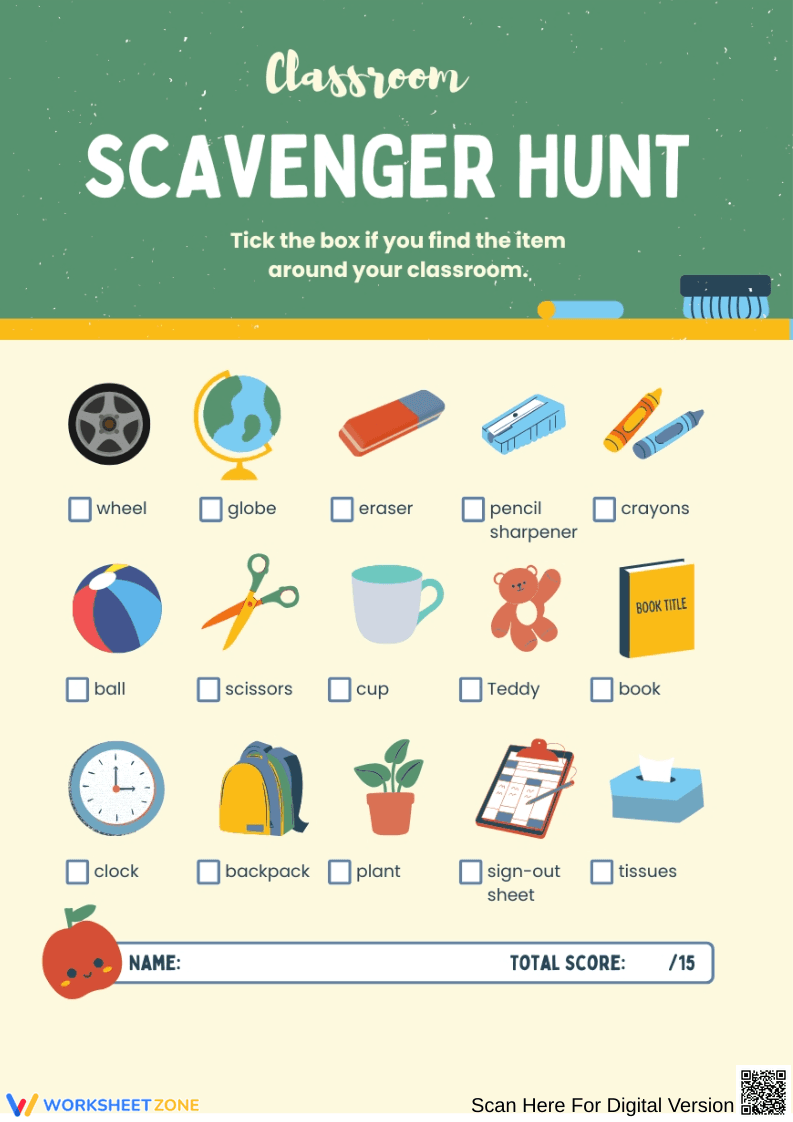

Classroom Scavenger Hunt | Printable Grade 1 Activity
Paste this activity's link or code into your existing LMS (Google Classroom, Canvas, Teams, Schoology, Moodle, etc.).
Students can open and work on the activity right away, with no student login required.
You'll still be able to track student progress and results from your teacher account.
This classroom scavenger hunt worksheet helps early elementary students build foundational vocabulary and spatial awareness by locating common objects around the room. By connecting printed words and images to physical items, learners actively practice visual scanning, reading comprehension, and following directions in a highly engaging, movement-based activity.
At a Glance
- Grade: 1 · Subject: Communication Skills
- Standard:
CCSS.ELA-LITERACY.L.1.5.C— Identify real-life connections between words and their use.- Skill Focus: Vocabulary recognition and visual scanning
- Format: 1 page · 15 problems · No answer key needed · PDF
- Best For: Back-to-school orientation or brain breaks
- Time: 15–20 minutes
This single-page resource features a highly visual layout containing 15 distinct target items commonly found in educational settings, such as a globe, scissors, clock, and backpack. Each item includes a clear illustration paired with its text label and a checkbox. A scoring section at the bottom allows students to tally their total finds out of 15, providing a simple metric for task completion.
Zero-Prep Workflow
- Print (1 minute): Generate copies. The graphics print clearly in color or grayscale.
- Distribute (1 minute): Hand out sheets with clipboards. No additional setup required.
- Review (2 minutes): Read through the 15 items together, then let students begin.
With total preparation time under two minutes, this activity is an ideal option for substitute plans.
This activity aligns with CCSS.ELA-LITERACY.L.1.5.C: "Identify real-life connections between words and their use (e.g., note places at home that are cozy)." It also supports early communication skills by encouraging students to ask peers or teachers for help locating specific items. Both standard codes can be copied directly into lesson plans, IEP goals, or district curriculum mapping tools.
Deploy this worksheet during the first week of school to help students familiarize themselves with their environment. It serves as an excellent icebreaker that gets children moving. Alternatively, use it as a structured brain break after direct instruction. Teachers can conduct formative assessments by observing which children easily decode labels versus relying solely on visual cues. Expect the activity to take 15 to 20 minutes.
This resource is primarily designed for first and second-grade students, though it is highly effective for English Language Learners (ELLs) and students receiving special education services who benefit from visual supports. The dual coding of text and imagery provides natural differentiation for emerging readers. Pair this activity with a direct instruction lesson on classroom rules or an anchor chart detailing where community supplies are stored.
Connecting vocabulary acquisition to physical movement significantly enhances retention for early elementary learners. This worksheet targets CCSS.ELA-LITERACY.L.1.5.C, requiring students to identify real-life connections between words and their use. According to a recent EdReports 2024 analysis of foundational literacy practices, integrating multisensory experiences—such as visually scanning a room to locate a physical object that matches a printed label—strengthens neural pathways associated with reading comprehension and spatial awareness. By moving around the classroom to find items like a globe or a pencil sharpener, students transition from passive decoding to active application. This physical engagement not only reinforces the target vocabulary but also builds essential executive functioning skills, including sustained attention and task completion. Utilizing structured, visually supported tasks ensures that all learners can successfully participate.


