


























Views
Downloads
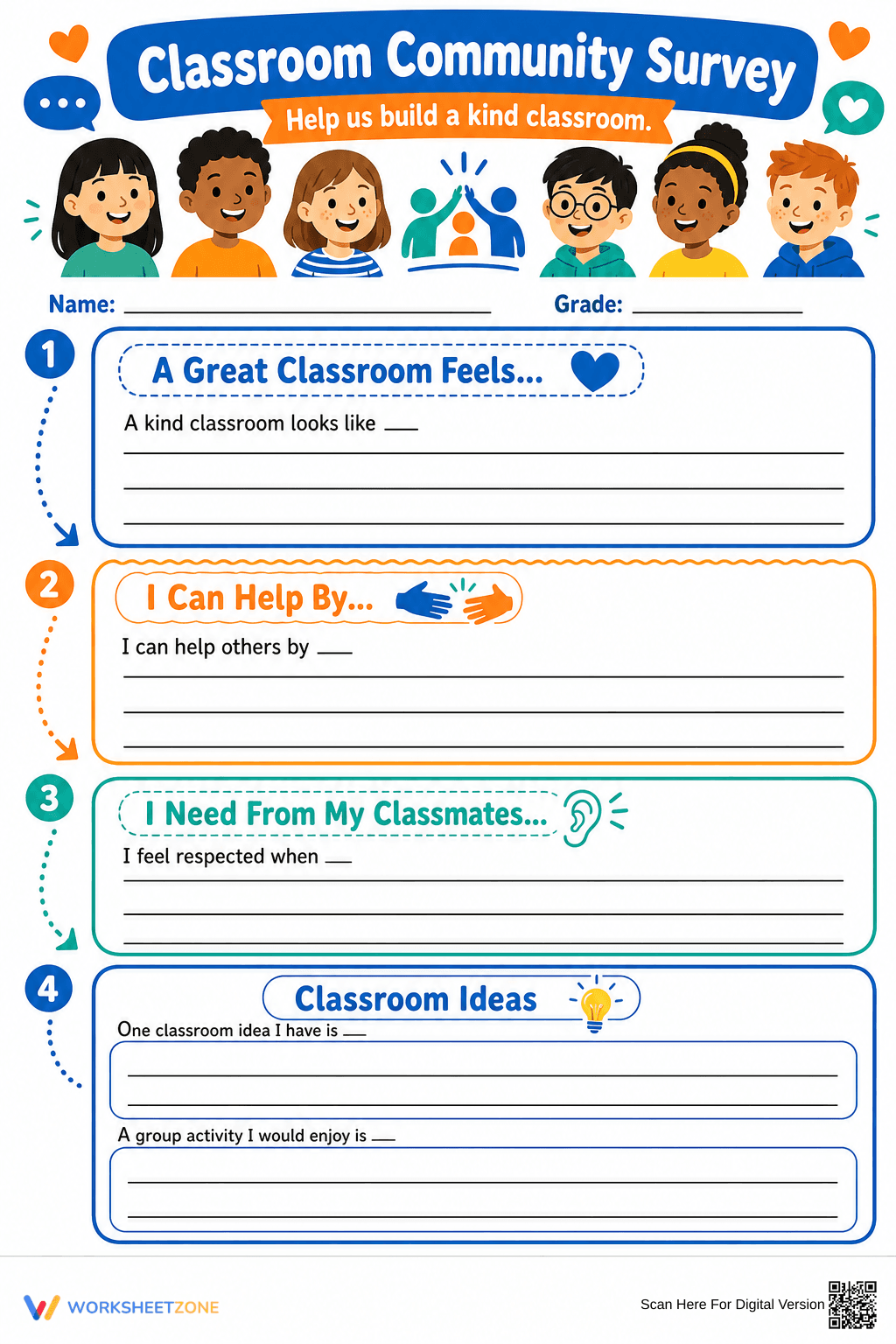

Classroom Community Survey | Grade 4 Essential
Paste this activity's link or code into your existing LMS (Google Classroom, Canvas, Teams, Schoology, Moodle, etc.).
Students can open and work on the activity right away, with no student login required.
You'll still be able to track student progress and results from your teacher account.
This Grade 4 Classroom Community Survey helps educators establish a positive, inclusive environment through student voice. By inviting students to reflect on kindness, respect, and collaboration, this worksheet provides actionable insights into the social-emotional needs of your cohort. It serves as a foundational tool for building a supportive and student-centered classroom culture from day one.
At a Glance
- Grade: 4 · Subject: Social Emotional Learning
- Standard:
CCSS.ELA-LITERACY.SL.4.1— Engage in collaborative discussions and express personal ideas clearly for community building.- Skill Focus: Community Building & Empathy
- Format: 1 page · 5 problems · No answer key needed · PDF
- Best For: Back-to-school or community reset
- Time: 15–20 minutes
This single-page PDF features a visually engaging "community map" layout with four distinct activity areas. It includes five open-ended writing prompts designed to elicit thoughtful responses about classroom climate and peer interactions. The clean design uses rounded frames and friendly icons—like hearts and lightbulbs—to create a non-threatening space for student expression. No sample answers are provided to ensure authentic student input.
Zero-Prep Workflow:
- Print: Select the "Fit to Page" setting and print enough copies for your class in under 1 minute.
- Distribute: Hand out the surveys during a morning meeting or SEL block; no additional materials are required.
- Review: Collect and read responses in approximately 10 minutes to identify common themes and individual student needs.
This resource is an ideal sub-plan filler or a quick activity for the first week of school, requiring less than 2 minutes of total teacher preparation.
Standards Alignment
This resource aligns with `CCSS.ELA-LITERACY.SL.4.1`, which requires students to engage effectively in a range of collaborative discussions, building on others' ideas and expressing their own clearly. By articulating their needs and ideas for the classroom, students practice the foundational communication skills necessary for group success. This standard code can be copied directly into lesson plans, IEP goals, or district curriculum mapping tools.
How to Use It
Use this survey during the first week of school as a formative assessment of your classroom's social dynamics. Observe which students struggle to define "respect" or "kindness" to identify those who may need additional SEL support. Alternatively, use it mid-year as a community reset after a long break to realign student expectations and gather fresh ideas for group activities. Completion typically takes 15 to 20 minutes.
Who It's For
This worksheet is designed for general education students in Grades 3–6, but it is particularly effective for English Language Learners and students with IEPs due to the clear, scaffolded prompts. It pairs naturally with a classroom anchor chart on community norms or a read-aloud book about empathy and kindness.
According to Fisher & Frey (2014), establishing a positive classroom climate through student voice is a critical component of effective instructional frameworks. This Classroom Community Survey addresses `CCSS.ELA-LITERACY.SL.4.1` by providing a structured medium for students to express their perspectives on social interactions and collaborative environments. Research from the RAND AIRS 2024 report suggests that when students feel their ideas are valued—as encouraged by the "Classroom Ideas" section of this 1-page PDF—engagement and academic persistence increase significantly. By utilizing these 5 targeted prompts, teachers can gather qualitative data to inform differentiated social-emotional instruction. This tool bridges the gap between individual reflection and collective goal-setting, ensuring that the kind classroom mentioned in the subtitle becomes a measurable reality rather than an abstract concept.


