


























Views
Plays

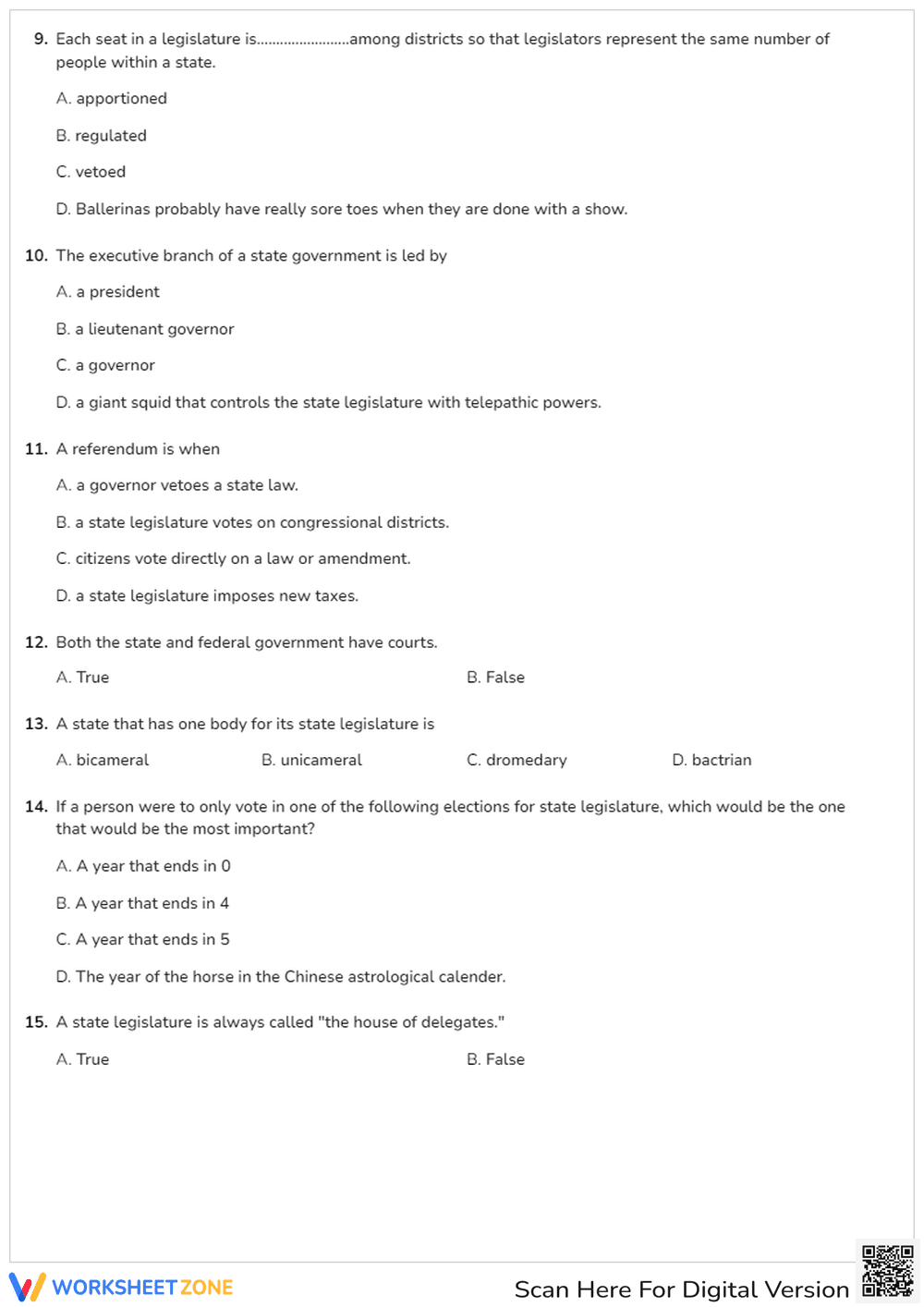

State Government Quiz | Printable Grade 5 Civics
Paste this activity's link or code into your existing LMS (Google Classroom, Canvas, Teams, Schoology, Moodle, etc.).
Students can open and work on the activity right away, with no student login required.
You'll still be able to track student progress and results from your teacher account.
This ready-to-use civics worksheet helps students understand the fundamental structures of state government. By completing this focused quiz, learners will identify the roles of the legislature, governor, and state courts while exploring key concepts like bicameral systems and referendums.
At a Glance
- Grade: 5 · Subject: Social Studies
- Standard:
D2.Civ.1.3-5— Distinguish the responsibilities and powers of government officials.- Skill Focus: State Government Structures
- Format: 2 pages · 15 problems · Answer key included · PDF
- Best For: Formative assessment or independent practice
- Time: 15–20 minutes
Inside this resource, educators will find a comprehensive two-page assessment featuring 15 multiple-choice and true/false questions. The task types are designed to test both vocabulary retention and conceptual understanding of state-level civics. Students will encounter questions about legislative apportionment, the executive branch, and the differences between state and federal authority. A complete answer key is provided to ensure quick and accurate grading.
- Print (1 minute): Simply download the PDF and print copies for your class. No special formatting or additional materials are required.
- Distribute (1 minute): Hand out the two-page quiz as a standalone assignment, bell-ringer, or end-of-unit review.
- Review (3 minutes): Use the included answer key to quickly grade submissions or facilitate a whole-class review session.
Total teacher prep time is under two minutes, making this an excellent option for emergency sub plans or last-minute schedule changes.
Aligned to D2.Civ.1.3-5, this worksheet ensures students can distinguish the responsibilities and powers of government officials at various levels and branches of government. It also supports broader social studies frameworks by reinforcing the balance of power between local, state, and federal entities. Both standard codes can be copied directly into lesson plans, IEP goals, or district curriculum mapping tools.
This assessment works perfectly as a summative quiz after direct instruction on state government structures. Alternatively, use it as a pre-assessment before starting a new civics unit to gauge baseline knowledge. While students work, teachers can circulate and observe which specific concepts—such as gerrymandering or bicameral legislatures—might need reteaching. Expect students to complete the assignment within 15 to 20 minutes.
This resource is designed for upper elementary and middle school students in grades 4 through 6. The straightforward multiple-choice format provides built-in scaffolding for learners who benefit from structured options rather than open-ended writing tasks. It pairs exceptionally well with a direct instruction lesson on the U.S. Constitution or a reading passage about the three branches of government.
Integrating structured assessments aligned to D2.Civ.1.3-5 helps students effectively distinguish the responsibilities and powers of government officials. According to Fisher & Frey (2014), utilizing targeted formative assessments with clear, immediate feedback significantly improves long-term retention of complex academic vocabulary and civic concepts. When students regularly practice identifying the roles of the legislature, governor, and state courts through focused multiple-choice tasks, they build a stronger foundational understanding of how local and state policies impact their daily lives. This consistent exposure to civic structures not only reinforces core social studies standards but also promotes active, informed citizenship. By evaluating these specific competencies, educators can accurately measure student mastery and adjust subsequent instruction to address any lingering misconceptions about state versus federal authority.


