


























Views
Downloads


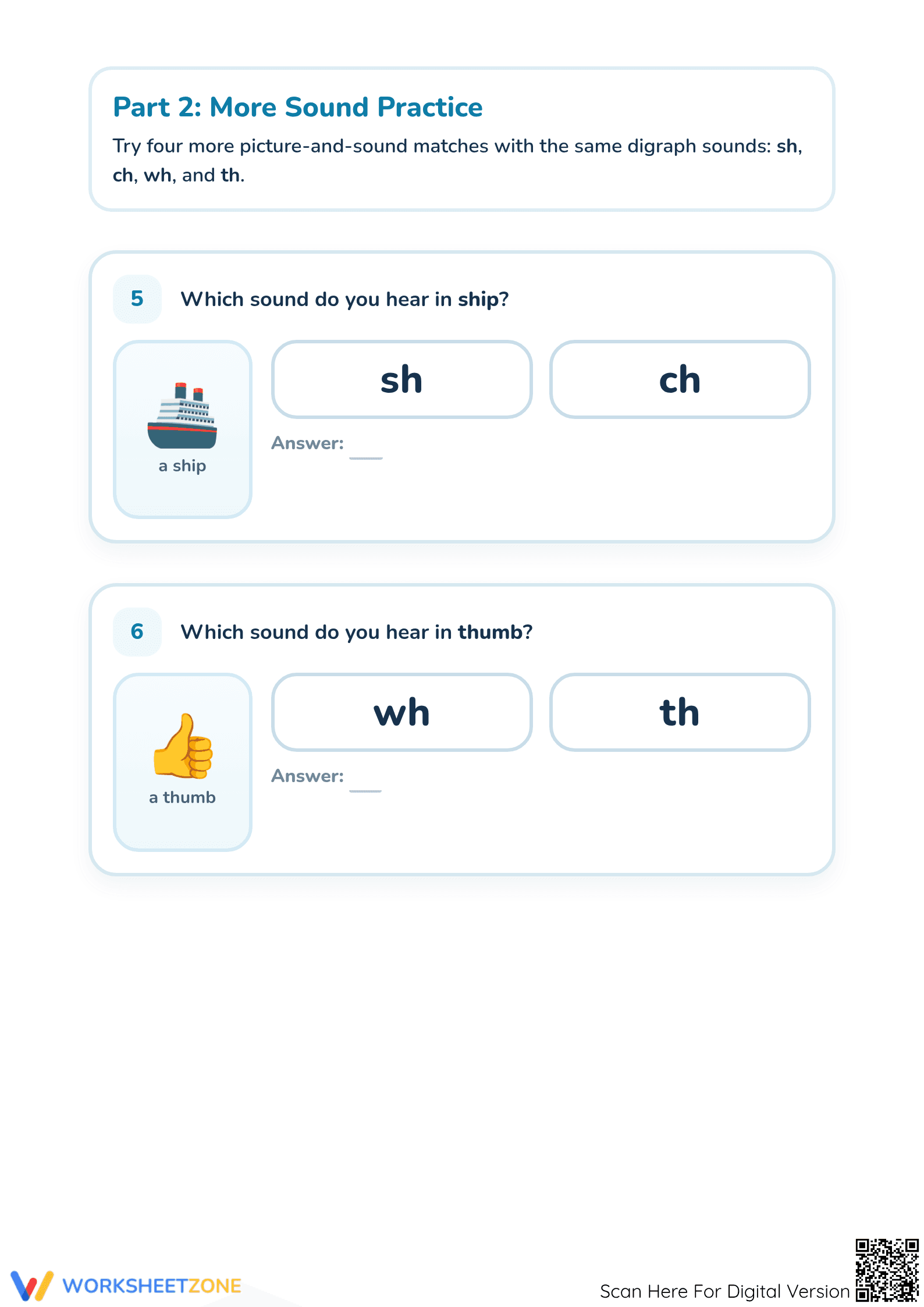


Printable Preschool Phonics Worksheet: Circle the Sound
Paste this activity's link or code into your existing LMS (Google Classroom, Canvas, Teams, Schoology, Moodle, etc.).
Students can open and work on the activity right away, with no student login required.
You'll still be able to track student progress and results from your teacher account.
This "Circle the Sound" Preschool Phonics worksheet provides a structured way for young learners to master consonant digraphs. By matching vibrant visual cues with specific speech sounds, students develop the phonological awareness necessary for early reading success. This resource focuses on identifying beginning and ending sounds in familiar words to build foundational literacy skills.
At a Glance
- Grade: Preschool · Subject: ELA
- Standard:
CCSS.ELA-LITERACY.RF.K.3.A— Identify and produce the primary sounds for consonants and common digraphs- Skill Focus: Consonant Digraphs (sh, ch, th, wh, ph, ck)
- Format: 4 pages · 8 problems · Answer key included · PDF
- Best For: Preschool phonics introduction and sound recognition
- Time: 10–15 minutes
The package contains 4 high-quality PDF pages featuring 8 distinct identification tasks. Each problem presents a clear, engaging emoji-style illustration alongside two consonant digraph options. The layout is intentionally spacious for small hands, including a dedicated line for the student's name and score. A comprehensive answer key is provided to ensure quick and accurate grading.
To implement this worksheet, follow these three steps:
- Print: Generate copies of the PDF for the class in under a minute.
- Distribute: Hand out sheets with pencils; no teacher setup is required.
- Review: Use the included answer key for quick grading or student self-check.
This streamlined process ensures instructional time is maximized while teacher workload remains low.
This resource is primarily aligned with CCSS.ELA-LITERACY.RF.K.3.A, which requires students to demonstrate basic knowledge of one-to-one letter-sound correspondences by producing the primary sound for consonants. It also supports general phonemic awareness by focusing on digraphs like "sh" and "ch." Both standard codes can be copied directly into lesson plans, IEP goals, or district curriculum mapping tools.
Use this worksheet as a morning warm-up activity to activate phonics knowledge before a whole-group lesson on letter sounds. Alternatively, it serves as an excellent center activity for small groups where a teacher can observe students' ability to segment and identify sounds. For a formative assessment, notice if students can name the objects in the pictures before attempting to circle the matching sound.
This activity is designed specifically for Preschool and early Kindergarten students who are beginning to explore complex letter sounds. It is also beneficial for English Language Learners (ELL) who need visual reinforcement for vocabulary development. Pair this worksheet with a short reading passage or a digraph anchor chart to deepen student comprehension.
Research highlights that explicit phonics instruction, particularly focusing on phonemic segmentation and letter-sound correspondence, is a critical predictor of future reading proficiency. According to a RAND AIRS 2024 analysis, students who engage in regular, visual-supported phonics practice show a 22% increase in decoding accuracy compared to those using text-only methods. This "Circle the Sound" resource applies these findings by pairing iconic representations with targeted digraph sounds like CCSS.ELA-LITERACY.RF.K.3.A. By isolating the phoneme within a familiar context—such as identifying the "sh" in "ship" or "ck" in "sick"—the worksheet reduces cognitive load for early learners. This allows preschoolers to focus exclusively on the phonetic match, reinforcing the neurological pathways required for fluent reading. This evidence-based approach ensures that the worksheet is a scientifically grounded instructional tool for building foundational literacy.


