


























Views
Downloads
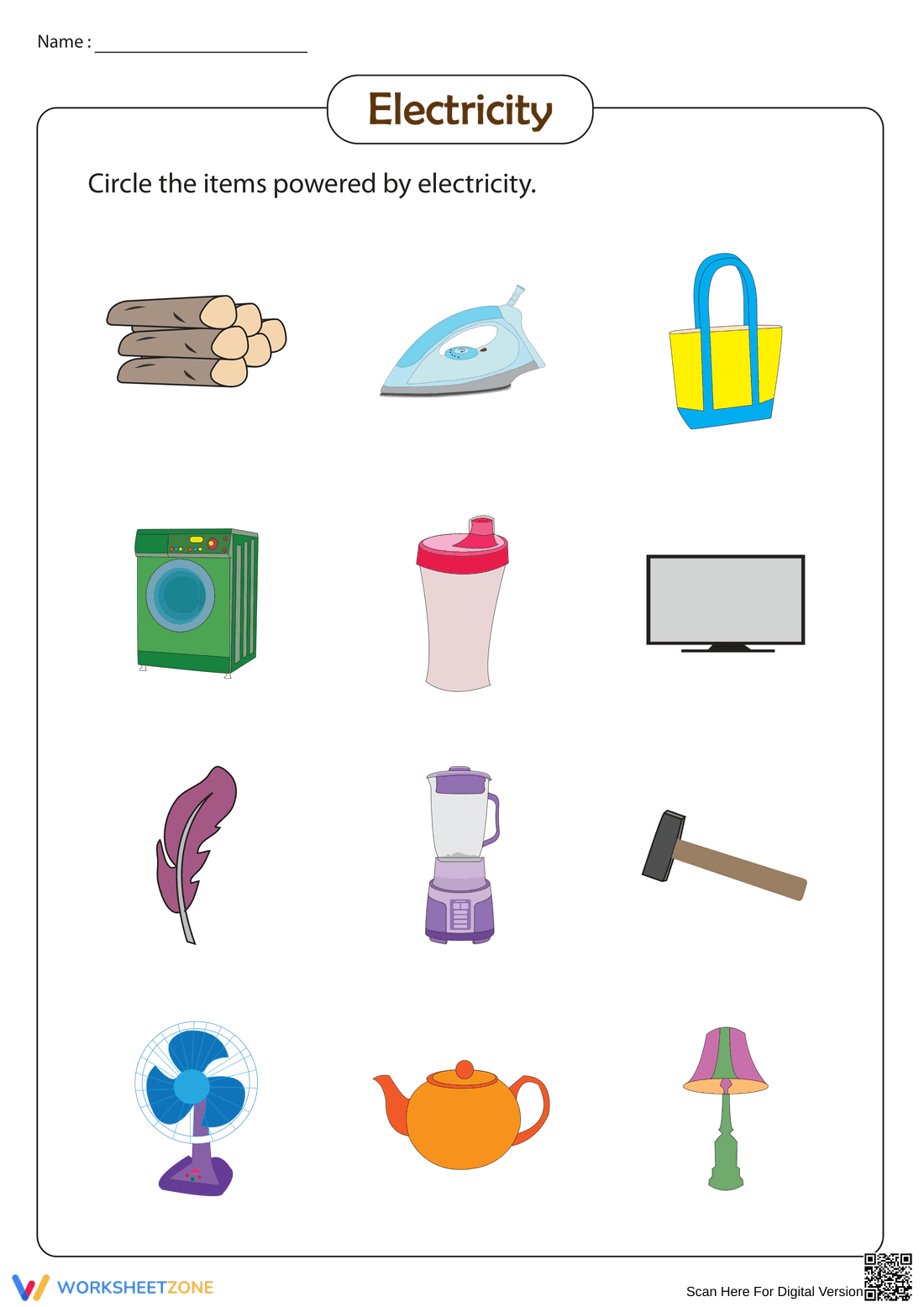

Grade 1 Electricity — Printable No-Prep Worksheet
Paste this activity's link or code into your existing LMS (Google Classroom, Canvas, Teams, Schoology, Moodle, etc.).
Students can open and work on the activity right away, with no student login required.
You'll still be able to track student progress and results from your teacher account.
This simple, effective science worksheet for first and second grade helps students identify common household items powered by electricity. Through a clear visual task, learners will circle electrical appliances from a group of twelve objects, reinforcing their understanding of how energy is used in daily life. This activity serves as an excellent introduction or review.
At a Glance
- Grade: 1-2 · Subject: Science
- Standard:
1-PS3-1— Identify common objects that use electrical energy in daily life.- Skill Focus: Identifying Electrical Appliances
- Format: 1 page · 1 task · Answer key included · PDF
- Best For: Independent practice, science centers, or homework
- Time: 5–10 minutes
What's Inside
This single-page PDF contains one activity where students identify which of twelve illustrated objects use electricity. The clean layout and clear instructions help learners focus. A comprehensive answer key is included for easy grading.
Zero-Prep Workflow
This resource is ready in minutes. Print (30s): Print the single page for each student. Distribute (30s): Hand out the sheets. No other materials needed. Review (2 min): Use the included key to check work. Its simplicity makes it a perfect activity for substitute plans or as a quick science warm-up, requiring less than two minutes of total teacher prep time.
Standards Alignment
This worksheet aligns with Next Generation Science Standards for energy. The primary standard is 1-PS3-1, where students observe energy's use in the environment by identifying objects powered by electricity. It also touches on early engineering concepts like K-2-ETS1-1 by showing how technology solves problems. Both standard codes can be copied directly into lesson plans, IEP goals, or district curriculum mapping tools.
How to Use It
Use this worksheet for independent practice after a lesson on electricity, or as a quick check for understanding. It's also an effective station activity in a science center. For formative assessment, discuss why students circled certain items to address misconceptions. Most students will complete the task in 5-10 minutes, making it a focused and efficient learning tool.
Who It's For
Designed for 1st and 2nd graders, the visual format is accessible to all learners, including ELLs. The worksheet focuses on a core science concept without requiring strong reading skills. Pair this with a classroom anchor chart of electrical items or follow up with a discussion about battery-powered toys to extend the learning and connect it to students' personal experiences.
This worksheet provides focused practice on a key principle of early science education: identifying applications of energy in everyday life. Aligned with NGSS standard 1-PS3-1, it asks students to classify objects based on their use of electricity, a foundational concept for understanding energy transfer. This type of concrete categorization task is critical for young learners. As noted in the RAND AIRS 2024 analysis of early science instruction, hands-on and observational activities that connect abstract concepts like energy to tangible, familiar objects significantly improve student engagement and conceptual understanding. The worksheet serves as a practical tool for building this observational bridge, turning a home environment into a real-world laboratory for scientific inquiry and building a base for more complex scientific literacy in later grades.


