


























Views
Downloads

Essential Beginning Sounds Worksheet | Kindergarten ELA
Paste this activity's link or code into your existing LMS (Google Classroom, Canvas, Teams, Schoology, Moodle, etc.).
Students can open and work on the activity right away, with no student login required.
You'll still be able to track student progress and results from your teacher account.
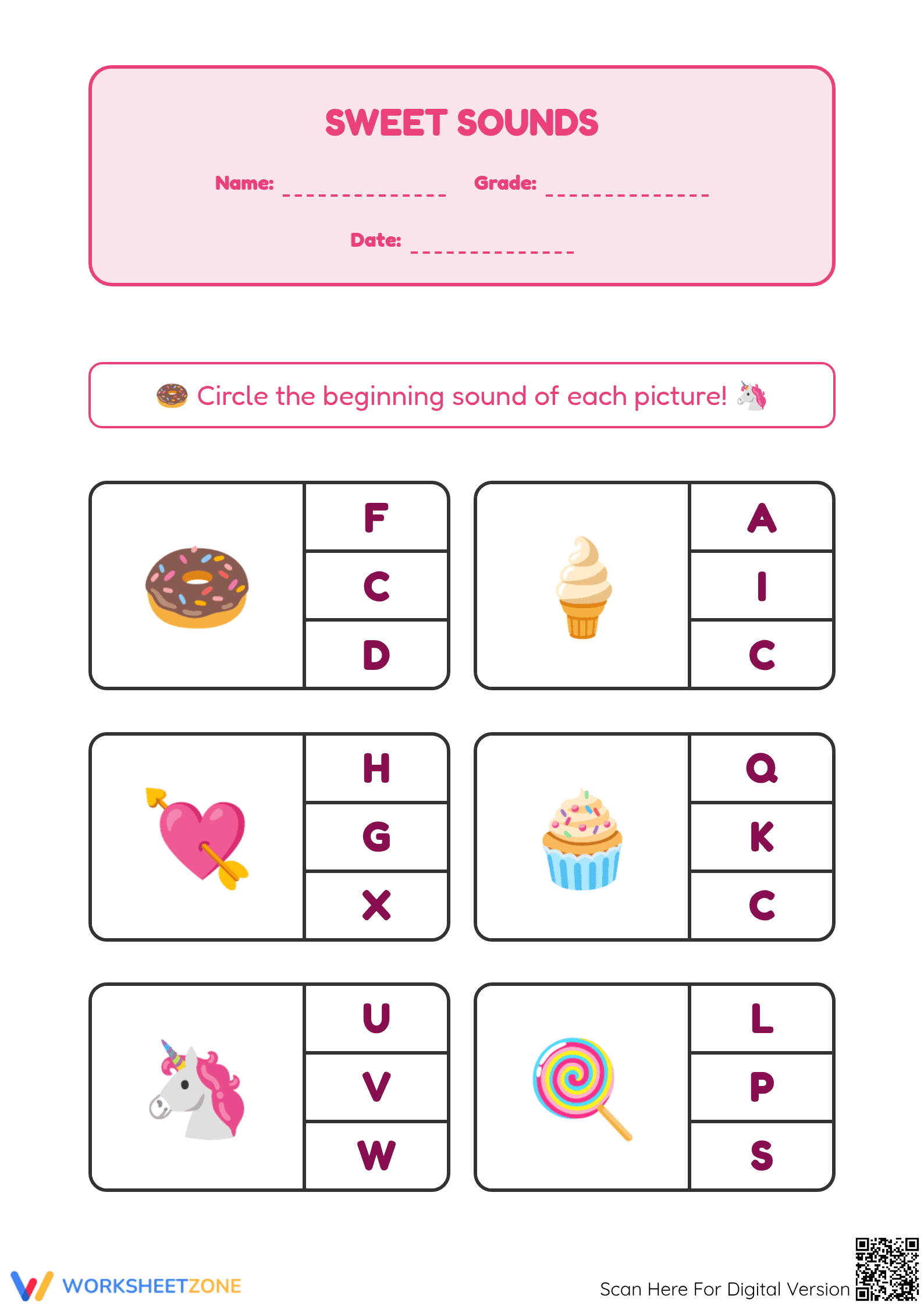
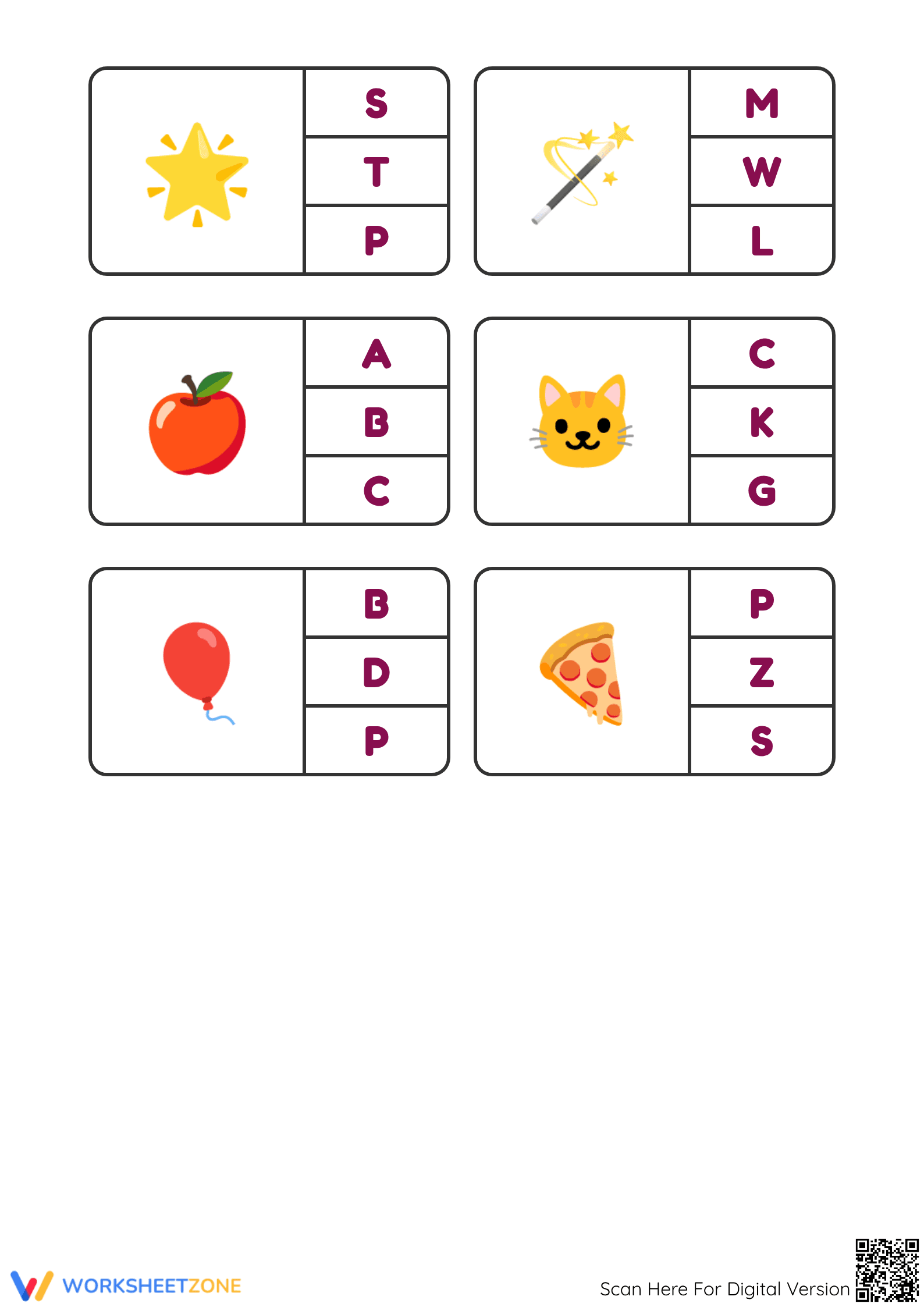
This Kindergarten phonics worksheet helps early learners master initial letter-sound correspondence through engaging visual cues. Students identify 12 different objects and select the correct starting consonant or vowel, building the foundational decoding skills necessary for early reading fluency and phonemic awareness. It provides a clear, structured way to practice letter recognition.
At a Glance
- Grade: Kindergarten · Subject: ELA
- Standard:
CCSS.ELA-LITERACY.RF.K.3.A— Produce the primary sound for each consonant and identify letter-sound correspondences- Skill Focus: Initial letter-sound identification
- Format: 2 pages · 12 problems · Answer key included · PDF
- Best For: Independent phonics practice or morning work
- Time: 10–15 minutes
This resource contains 2 high-quality PDF pages featuring 12 distinct tasks. Each task presents a colorful, recognizable image—such as a donut, apple, or pizza—paired with three letter choices. The layout is clean and distraction-free, including a comprehensive answer key for quick grading or student self-correction. The visual nature of the tasks supports vocabulary development alongside phonics skills.
Zero-Prep Workflow
- Print: Select the two pages and hit print for your entire class (30 seconds).
- Distribute: Hand out to students as a warm-up, literacy center activity, or homework assignment (1 minute).
- Review: Use the included answer key to check for understanding or project it for a whole-class review (1 minute).
This workflow ensures total teacher prep remains under 2 minutes, making it an ideal sub plan or last-minute filler activity.
The primary focus is CCSS.ELA-LITERACY.RF.K.3.A, which requires students to demonstrate basic knowledge of one-to-one letter-sound correspondences. By isolating the initial sound of common nouns, students practice the phonemic segmentation required by RF.K.2.D. Both standard codes can be copied directly into lesson plans, IEP goals, or district curriculum mapping tools.
Assign this worksheet during the independent practice phase of a lesson after introducing specific letter sounds. It serves as an excellent formative assessment; observe if students struggle with specific phonemes like the "u" in unicorn or "c" in cupcake. Completion typically takes 10 to 15 minutes depending on student proficiency.
Designed for Preschool, Kindergarten, and Grade 1 students who are developing alphabetic principle mastery. It provides necessary scaffolding for English Language Learners (ELLs) through visual support. Pair this with a physical alphabet anchor chart to help students cross-reference sounds they find challenging during the activity.
According to the RAND AIRS 2024 report, consistent exposure to isolated phonemic awareness tasks significantly correlates with later reading proficiency in primary grades. This worksheet targets the specific skill of initial sound identification, a critical precursor to blending and segmenting. By utilizing high-frequency vocabulary and clear visual representations, the resource aligns with the Fisher & Frey (2014) framework for scaffolded literacy instruction. The 12-task structure provides sufficient repetition to reinforce letter-sound correspondence without overwhelming early learners. Educators can rely on this CCSS.ELA-LITERACY.RF.K.3.A aligned tool to provide evidence-based practice that supports the development of the phonological loop. Such targeted phonics interventions are essential for closing achievement gaps in early childhood education settings, ensuring students meet foundational literacy benchmarks before transitioning to complex decoding tasks.


