


























Views
Downloads

Beginning Sounds Worksheet | Essential Grade K Phonics
Paste this activity's link or code into your existing LMS (Google Classroom, Canvas, Teams, Schoology, Moodle, etc.).
Students can open and work on the activity right away, with no student login required.
You'll still be able to track student progress and results from your teacher account.
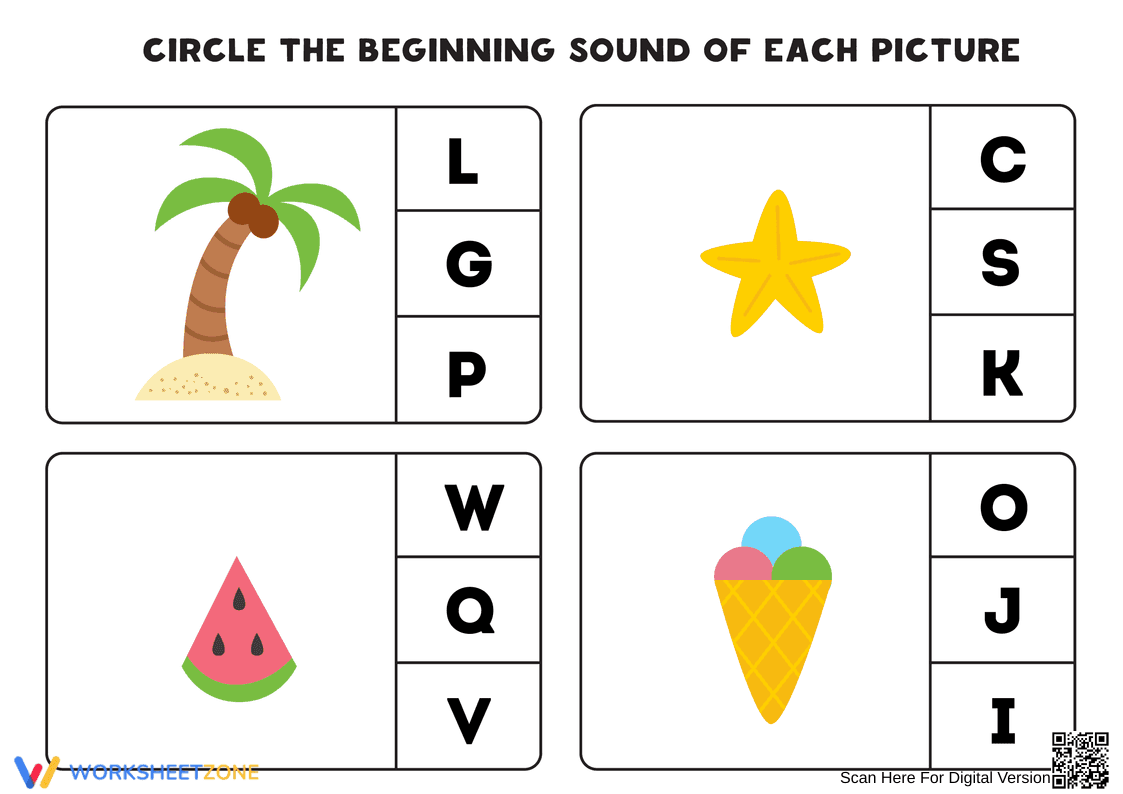
This Kindergarten phonics worksheet helps early learners master initial consonant and vowel sounds through visual identification. By connecting vibrant illustrations to their corresponding letters, students build the foundational phonemic awareness necessary for reading fluency. It provides a clear, focused environment for practicing letter-sound correspondence.
At a Glance
- Grade: Kindergarten · Subject: ELA Phonics
- Standard:
CCSS.ELA-LITERACY.RF.K.3.A— Demonstrate basic knowledge of one-to-one letter-sound correspondences by producing the primary sound- Skill Focus: Initial Sound Identification
- Format: 1 page · 4 problems · Answer key included · PDF
- Best For: Independent morning work or literacy centers
- Time: 5–10 minutes
Inside this single-page PDF, you will find 4 distinct practice blocks. Each block features a high-quality color illustration—including a palm tree, star, watermelon, and ice cream—paired with three uppercase letter options. The clean layout minimizes visual distractions, making it ideal for students who require a focused workspace. A full answer key is provided for quick grading and self-correction.
The zero-prep workflow for this resource is designed for maximum efficiency. First, print the single-page PDF (30 seconds). Next, distribute the sheets to your literacy small group or whole class (1 minute). Finally, review the four answers together using the included key to provide immediate feedback (2 minutes). This makes it an excellent choice for emergency sub plans or transition periods.
This resource aligns with CCSS.ELA-LITERACY.RF.K.3.A, which requires students to demonstrate basic knowledge of one-to-one letter-sound correspondences. It also supports RF.K.2.D by asking students to isolate and pronounce the initial sounds in spoken words. Both standard codes can be copied directly into lesson plans, IEP goals, or district curriculum mapping tools.
Use this worksheet as a formative assessment after a direct instruction lesson on the letters P, S, W, and I. Observe if students can name the object before attempting to circle the letter. It also works well as a "ticket-out-the-door" activity to check for understanding. Expect students to complete the 4 tasks in approximately 5 to 10 minutes depending on their phonemic proficiency.
This worksheet is designed for Preschool, Kindergarten, and early Grade 1 students who are beginning to map sounds to graphemes. It is particularly helpful for English Language Learners (ELLs) who benefit from the clear visual support. Pair this resource with a beginning sounds anchor chart or a tactile alphabet tracing activity for a comprehensive literacy block.
According to the RAND AIRS 2024 report, early exposure to systematic phonics instruction that links visual imagery with letter-sound identification significantly improves long-term reading outcomes. This worksheet targets the CCSS.ELA-LITERACY.RF.K.3.A standard by requiring students to isolate the initial phoneme of a pictured object and select the correct grapheme from a field of three. By focusing on 4 high-frequency beginning sounds, the resource provides the repetitive, low-stakes practice necessary for cognitive retrieval. Research from Fisher & Frey (2014) emphasizes that such scaffolded visual tasks bridge the gap between oral language and written literacy. This printable tool ensures that students develop the phonemic precision required for decoding more complex CVC words in later units. It is a reliable, evidence-based addition to any early childhood literacy curriculum or intervention program.


