


























Views
Downloads


Beginning Sounds Worksheet | Kindergarten ELA Essential
Paste this activity's link or code into your existing LMS (Google Classroom, Canvas, Teams, Schoology, Moodle, etc.).
Students can open and work on the activity right away, with no student login required.
You'll still be able to track student progress and results from your teacher account.
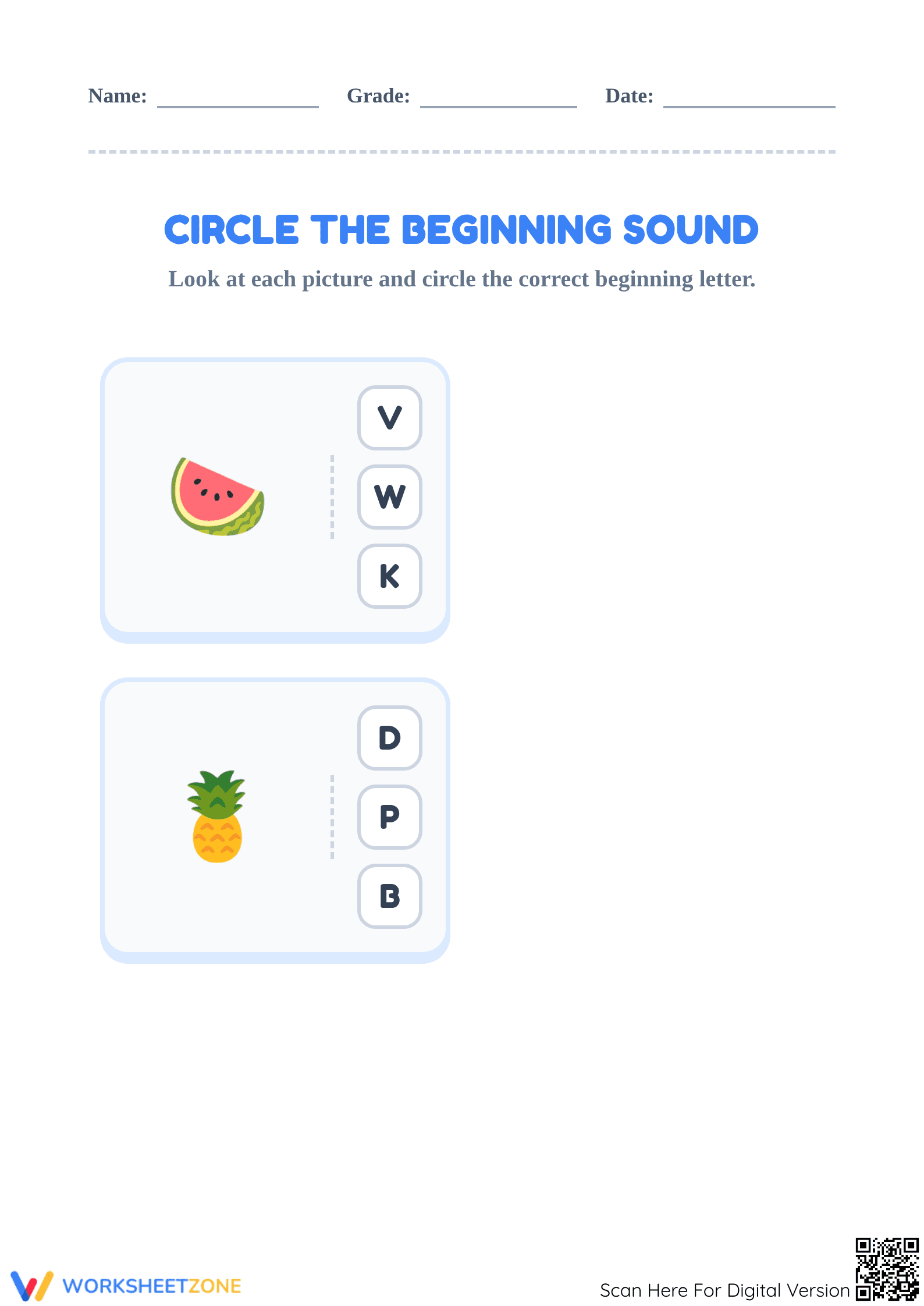
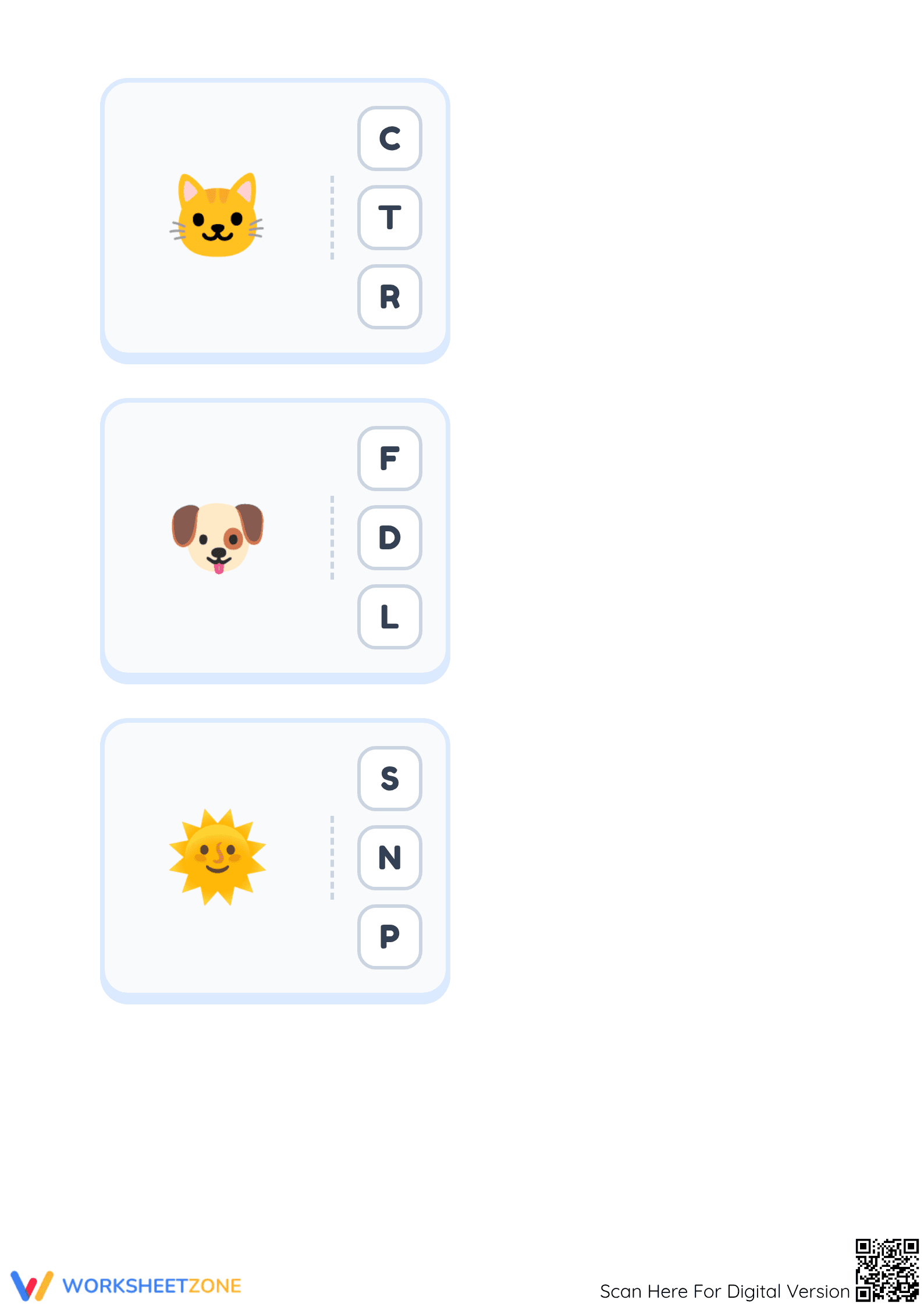
This Kindergarten beginning sounds worksheet helps early learners identify initial phonemes by matching vibrant images to their corresponding letters. Students develop phonological awareness and letter-sound correspondence through 8 engaging visual tasks. By isolating the first sound in common words, children build the foundational decoding skills necessary for early reading success.
At a Glance
- Grade: Kindergarten · Subject: ELA Phonics
- Standard:
CCSS.ELA-LITERACY.RF.K.3.A— Demonstrate basic knowledge of one-to-one letter-sound correspondences by producing the primary sound.- Skill Focus: Initial Phoneme Identification
- Format: 3 pages · 8 problems · Answer key included · PDF
- Best For: Independent phonics practice or morning work
- Time: 10–15 minutes
This comprehensive 3-page PDF includes 8 distinct identification tasks. Each task features a high-quality color illustration (such as a watermelon, pineapple, or cat) paired with three letter choices. The layout is clean and distraction-free, featuring large fonts suitable for small hands. A full answer key is provided for quick grading or student self-correction.
- Print: Select the three pages and hit print (30 seconds).
- Distribute: Hand out to students as a warm-up or literacy center activity (1 minute).
- Review: Use the included answer key to check for phonemic accuracy (1 minute).
Total teacher prep time is under 2 minutes, making this an ideal resource for substitute folders or last-minute lesson supplements.
The primary focus is CCSS.ELA-LITERACY.RF.K.3.A: "Demonstrate basic knowledge of one-to-one letter-sound correspondences by producing the primary sound or many of the most frequent sounds for each consonant." This resource also supports RF.K.2.D by requiring students to isolate the initial phoneme. Both standard codes can be copied directly into lesson plans, IEP goals, or district curriculum mapping tools.
Use this worksheet during the independent practice phase of a gradual release lesson on consonants. After introducing a specific letter sound, assign the relevant page to verify student understanding. It also serves as an effective formative assessment tool; observe if students are sounding out the image name or guessing based on the first letter they see. Completion typically takes 10 to 15 minutes.
This resource is designed for Kindergarten students, though it provides excellent remediation for Grade 1 students struggling with phonemic isolation or enrichment for Preschoolers showing early reading readiness. It pairs naturally with alphabet anchor charts or tactile letter tiles to reinforce the connection between spoken sounds and written symbols.
According to the RAND AIRS 2024 report on early literacy, consistent exposure to letter-sound correspondence tasks is a significant predictor of future reading fluency. This worksheet targets the specific skill of initial phoneme isolation, which is a core component of phonological awareness. By utilizing visual cues to prompt sound production, the resource aligns with evidence-based practices for early childhood education. The inclusion of CCSS.ELA-LITERACY.RF.K.3.A ensures that the 8 tasks provided meet rigorous academic expectations for Kindergarten pronunciation and phonics. Research from Fisher & Frey (2014) emphasizes that such scaffolded visual practice helps bridge the gap between oral language and written literacy. This 3-page set provides the repetitive, focused practice necessary for students to achieve mastery in identifying beginning sounds across various consonant and vowel categories.


