


























Views
Downloads
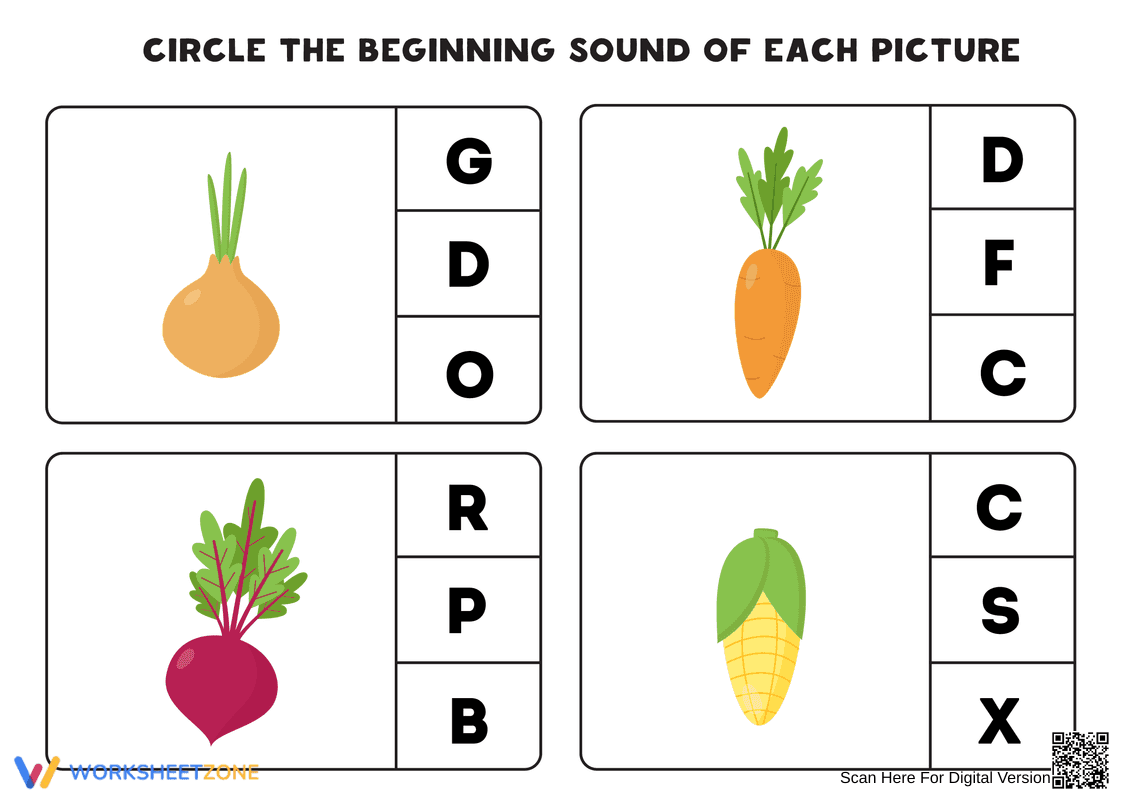

Beginning Sounds Printable Worksheet | Grade K ELA
Paste this activity's link or code into your existing LMS (Google Classroom, Canvas, Teams, Schoology, Moodle, etc.).
Students can open and work on the activity right away, with no student login required.
You'll still be able to track student progress and results from your teacher account.
This foundational phonics worksheet helps early learners master beginning sounds by matching familiar vegetable images to their corresponding initial letters. Students build critical phonological awareness and letter-sound recognition skills as they identify the correct starting consonant for each picture, strengthening their reading readiness.
At a Glance
- Grade: K · Subject: ELA
- Standard:
CCSS.ELA-LITERACY.RF.K.3.A— Match consonant letters to their primary sounds- Skill Focus: Beginning Sounds
- Format: 1 page · 4 problems · Answer key included · PDF
- Best For: Independent practice
- Time: 5–10 minutes
This single-page resource features four clear, engaging illustrations of common vegetables, including an onion, a carrot, a beet, and corn. Next to each image, students are presented with three distinct uppercase letter choices. The straightforward layout minimizes visual clutter, allowing young learners to focus entirely on isolating the initial phoneme and selecting the matching letter. A complete answer key is provided for quick grading.
Zero-Prep Workflow
- Print (1 minute): Simply download the PDF and print the required number of copies. The high-contrast design ensures clear reproduction in black and white.
- Distribute (1 minute): Hand out the sheets along with pencils or crayons. The instructions are intuitive enough for immediate student engagement.
- Review (3 minutes): Quickly check student selections using the provided answer key or review together as a whole class. Total teacher prep time is under two minutes, making this an ideal emergency sub plan.
Standards Alignment
This activity is directly aligned with CCSS.ELA-LITERACY.RF.K.3.A, which requires students to demonstrate basic knowledge of one-to-one letter-sound correspondences by producing the primary sound or many of the most frequent sounds for each consonant. It also supports early vocabulary development. Both standard codes can be copied directly into lesson plans, IEP goals, or district curriculum mapping tools.
How to Use It
Deploy this worksheet during morning work routines to activate prior knowledge before formal phonics instruction begins. Alternatively, use it as a targeted literacy center activity where students can work independently or with a paraprofessional. As a formative assessment tip, observe whether students are whispering the word aloud to isolate the first sound; this indicates they are actively applying phonemic segmentation strategies rather than guessing. Expected completion time ranges from five to ten minutes.
Who It's For
This resource is designed primarily for Kindergarten students developing early literacy skills, but it also serves as excellent remediation for first graders needing phonics reinforcement. For differentiation, teachers can provide a picture dictionary or an alphabet chart for students requiring additional scaffolding. It pairs perfectly with a direct instruction lesson on consonant sounds or a read-aloud focused on farm and garden vocabulary.
Mastering beginning sounds is a critical milestone in early childhood literacy. This worksheet targets CCSS.ELA-LITERACY.RF.K.3.A, requiring students to match consonant letters to their primary sounds. According to Fisher & Frey (2014), providing students with targeted, brief practice opportunities significantly improves their ability to retain foundational phonics rules. When young learners consistently practice isolating initial phonemes and connecting them to visual letter representations, they build the necessary neural pathways for fluent decoding. This specific activity isolates the skill by using familiar vocabulary, reducing cognitive load and allowing the student to focus entirely on the phonetic task. By integrating this evidence-based approach into daily routines, educators can ensure students develop the robust phonological awareness required for future reading success. Regular, focused practice on letter-sound correspondence remains one of the most reliable predictors of early reading proficiency.


