


























Views
Downloads
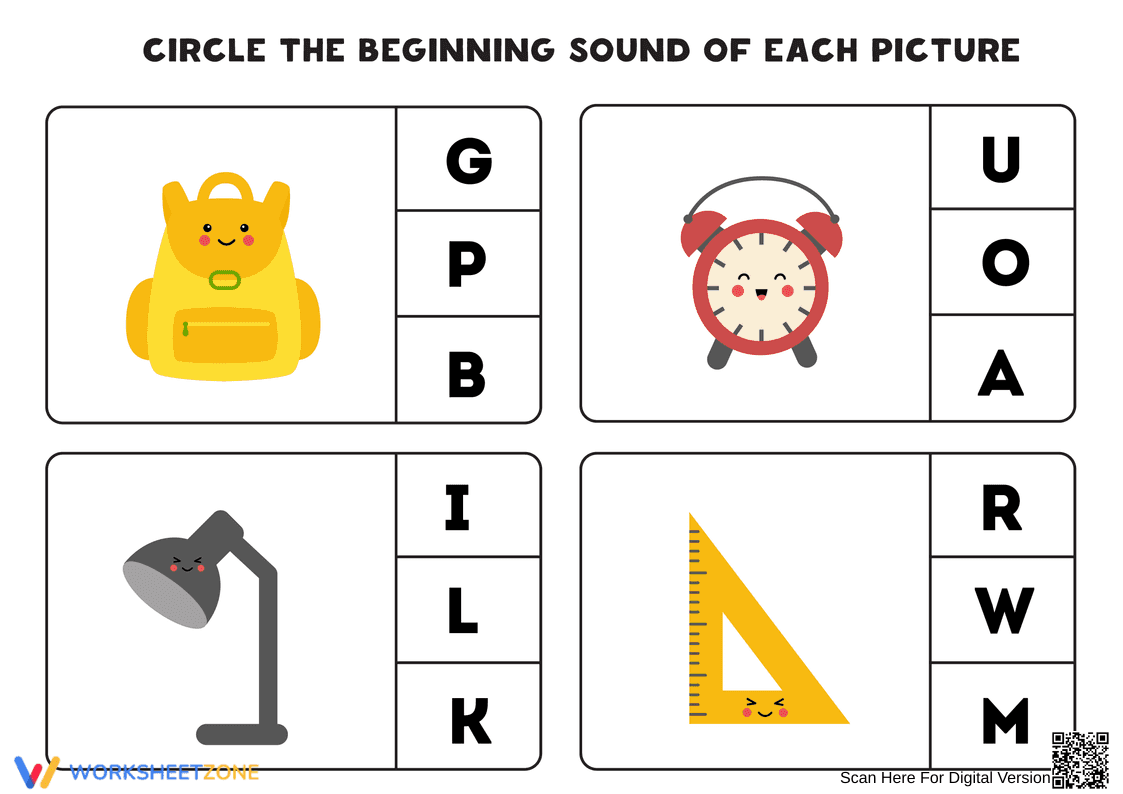

Beginning Sounds Printable | Grade K No-Prep Worksheet
Paste this activity's link or code into your existing LMS (Google Classroom, Canvas, Teams, Schoology, Moodle, etc.).
Students can open and work on the activity right away, with no student login required.
You'll still be able to track student progress and results from your teacher account.
This foundational phonics worksheet helps early readers master initial phonemes by matching everyday objects to their corresponding starting letters. By isolating the first sound in familiar words, students build the critical letter-sound correspondence skills necessary for decoding and fluent reading.
At a Glance
- Grade: K · Subject: ELA
- Standard:
CCSS.ELA-LITERACY.RF.K.3.A— Match primary sounds to specific consonants- Skill Focus: Beginning sounds
- Format: 1 page · 4 problems · Answer key included · PDF
- Best For: Independent practice
- Time: 5–10 minutes
Inside this single-page resource, educators will find four highly visual multiple-choice tasks. Each problem presents a clear, colorful illustration of a recognizable object—such as a backpack or an alarm clock—alongside three uppercase letter options. Students must identify the picture, isolate the initial phoneme, and circle the correct matching letter. A complete answer key is provided to ensure quick and accurate grading.
Zero-Prep Workflow
This resource allows for immediate classroom implementation with under two minutes of teacher preparation.
- Print (1 minute): Download and print the required copies. The high-contrast design ensures clear reproduction.
- Distribute (1 minute): Hand out during morning work or centers. The intuitive layout requires minimal instruction.
- Review (3 minutes): Use the answer key to quickly check responses or conduct a class review.
This self-explanatory activity is highly suitable for emergency sub plans or independent stations.
Standards Alignment
This activity is directly aligned to CCSS.ELA-LITERACY.RF.K.3.A, which requires students to demonstrate basic knowledge of one-to-one letter-sound correspondences by producing the primary sound or many of the most frequent sounds for each consonant. It also supports early phonemic awareness by asking learners to isolate initial sounds in spoken words. Both standard codes can be copied directly into lesson plans, IEP goals, or district curriculum mapping tools.
How to Use It
Deploy this worksheet during morning work to activate prior knowledge before a whole-group phonics lesson. Alternatively, place it in a literacy center for independent reinforcement after direct instruction on specific consonant sounds. As a formative assessment observation tip, watch whether students whisper the word aloud to themselves before selecting a letter; this indicates they are actively isolating the phoneme rather than guessing. Expected completion time ranges from five to ten minutes.
Who It's For
This material is primarily designed for Kindergarten students developing foundational reading skills, though it serves as excellent remediation for first graders who need extra phonics support. For differentiation, teachers can provide a picture dictionary or an alphabet chart for students requiring visual scaffolds. It pairs naturally with a direct instruction lesson on consonant sounds or an interactive read-aloud focusing on alliteration.
Mastering initial phonemes is a critical milestone in early literacy development and a strong predictor of future reading success. According to Fisher & Frey (2014), explicit instruction in letter-sound correspondence significantly accelerates decoding proficiency in young readers. This resource specifically targets CCSS.ELA-LITERACY.RF.K.3.A by requiring learners to match primary sounds to specific consonants. When students systematically practice isolating the first sound in a familiar word and connecting it to its corresponding written symbol, they build the essential neural pathways necessary for fluent reading. The visual supports embedded in these four distinct tasks reduce unnecessary cognitive load, allowing children to focus entirely on phonemic isolation. Regular, targeted practice with beginning sounds ensures that early learners transition smoothly from recognizing individual letters to blending full words, establishing a robust foundation for future academic achievement across all subject areas.


