


























Views
Downloads

Printable Beginning Sounds Worksheet | Grade K-1 ELA
Paste this activity's link or code into your existing LMS (Google Classroom, Canvas, Teams, Schoology, Moodle, etc.).
Students can open and work on the activity right away, with no student login required.
You'll still be able to track student progress and results from your teacher account.
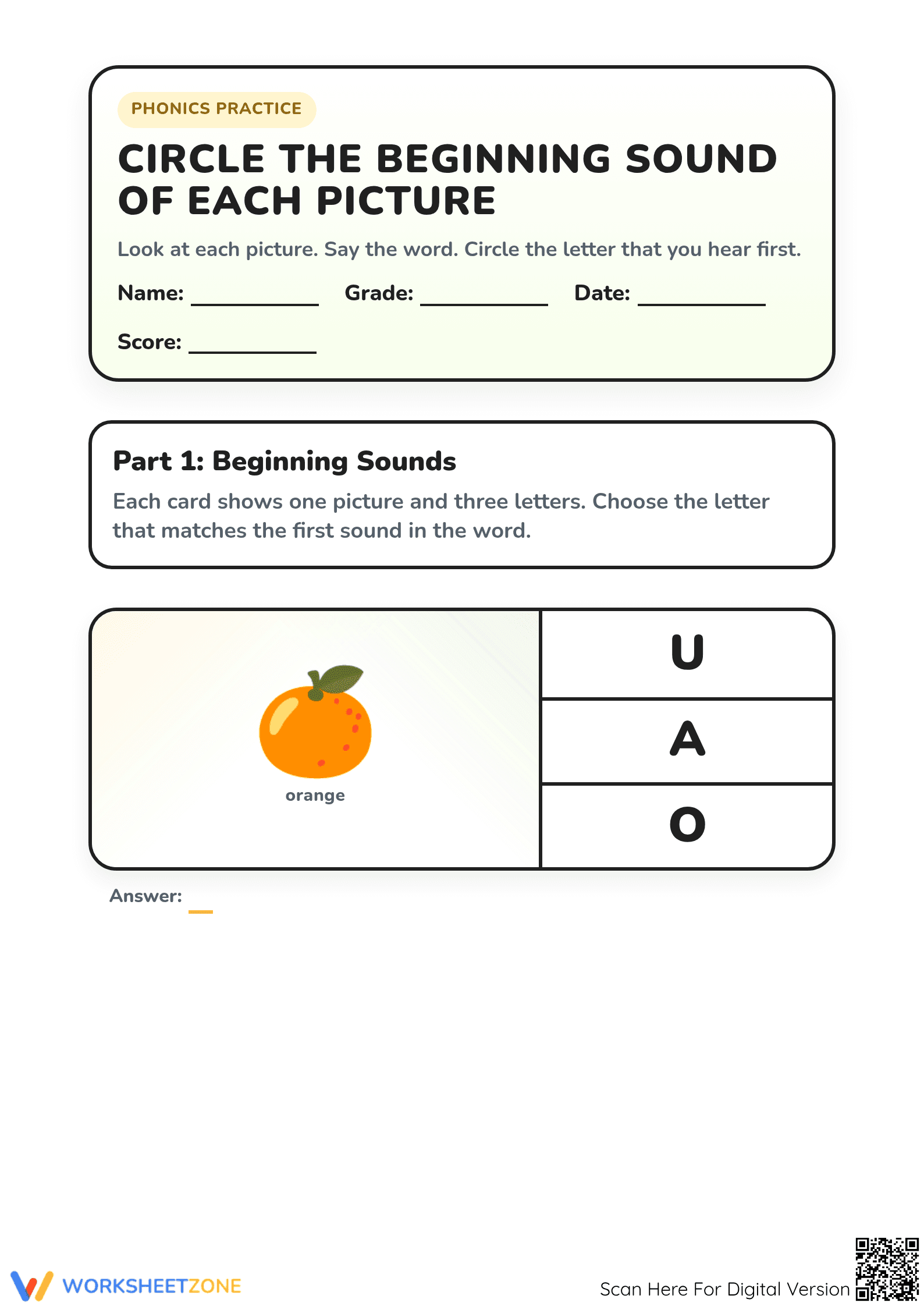
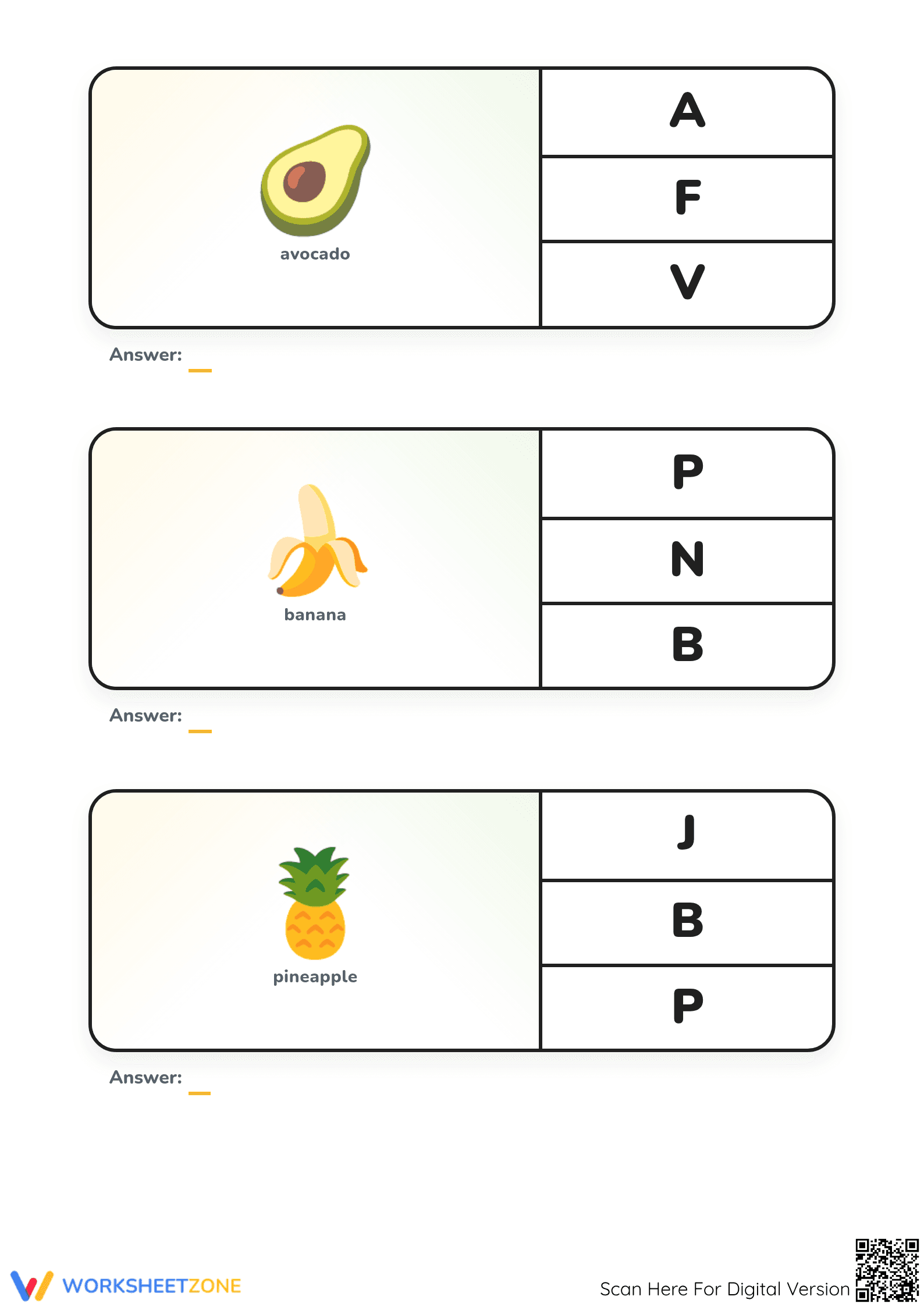
Strengthen early literacy foundations with this targeted beginning sounds worksheet designed for Preschool, Kindergarten, and Grade 1 students. This resource focuses on initial phoneme isolation, requiring learners to look at high-frequency images and identify the corresponding starting letter from a multiple-choice set. It provides an immediate student outcome of improved letter-sound recognition and phonemic awareness.
At a Glance
- Grade: K · Subject: English Language Arts
- Standard:
CCSS.ELA-LITERACY.RF.K.3.A— Demonstrate basic knowledge of one-to-one letter-sound correspondences by producing the primary sound- Skill Focus: Initial letter-sound identification
- Format: 2 pages · 4 problems · Answer key included · PDF
- Best For: Independent phonics practice and morning work
- Time: 5–10 minutes
What's Inside: This 2-page PDF features 4 distinct phonics cards. Each card displays a clear, colorful illustration—such as an orange, avocado, banana, or pineapple—labeled with the word for additional support. Beside each image is a vertical choice of three uppercase letters. A full answer key is provided to ensure easy grading and self-correction opportunities for young learners.
Zero-Prep Workflow: This resource is designed to minimize teacher workload through a three-step process. First, print the two pages (30 seconds). Second, distribute the sheets to students with zero additional instructions needed due to the intuitive layout (1 minute). Third, review student answers using the provided key (under 1 minute). This makes it an ideal choice for emergency sub plans or quick transitions.
Standards Alignment: This resource is primarily aligned to `CCSS.ELA-LITERACY.RF.K.3.A`, which requires students to demonstrate basic knowledge of one-to-one letter-sound correspondences. It also supports `CCSS.ELA-LITERACY.RF.K.1.D` by reinforcing uppercase letter recognition. Both standard codes can be copied directly into lesson plans, IEP goals, or district curriculum mapping tools to verify instructional compliance.
How to Use It: Deploy this worksheet during your phonics center rotation or as a quick "exit ticket" after a lesson on specific consonants and vowels. For a formative assessment observation, watch as students say the word aloud to see if they can isolate the first sound before circling. The expected completion time is roughly 5 to 10 minutes depending on the student's phonological proficiency level.
Who It's For: This resource serves early learners in PreK through Grade 1 who are developing their alphabetic principle. It is particularly useful for students requiring extra support with auditory discrimination. Pair this worksheet with a physical letter-tile activity or a shared reading passage to create a comprehensive phonics lesson that addresses multiple learning modalities.
The mastery of `CCSS.ELA-LITERACY.RF.K.3.A` is a critical milestone in early reading development, as letter-sound correspondence forms the basis for decoding more complex words. According to an EdReports 2024 analysis of foundational skills, systematic and explicit phonics practice involving initial sound isolation significantly improves later reading fluency and spelling accuracy. This worksheet provides the essential repetition needed for students to move from letter recognition to active sound production. By focusing on four distinct items with clear visual cues, the activity reduces cognitive load, allowing students to focus entirely on the phoneme-grapheme connection. Research suggests that high-quality, targeted practice at the kindergarten level prevents future reading difficulties and builds student confidence in their ability to approach unfamiliar texts independently. This 4-task set serves as a reliable evidence-based tool for evaluating student progress toward early literacy mastery goals.


