


























Views
Downloads

Beginning Sounds Worksheet | Essential Kindergarten ELA
Paste this activity's link or code into your existing LMS (Google Classroom, Canvas, Teams, Schoology, Moodle, etc.).
Students can open and work on the activity right away, with no student login required.
You'll still be able to track student progress and results from your teacher account.
Phonemic Awareness Practice
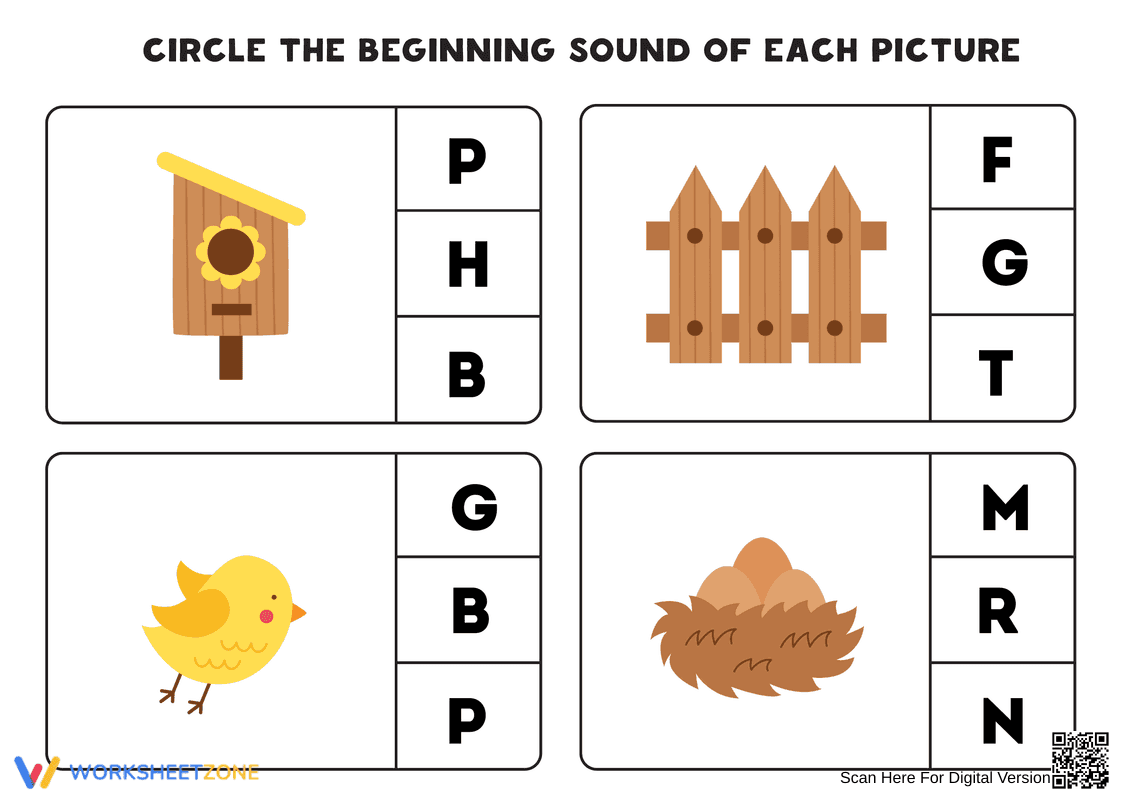
Phonemic awareness is the foundation of literacy. This worksheet helps early learners identify initial sounds by matching vibrant illustrations with their corresponding letters. Students build confidence in letter-sound correspondence through a simple, engaging format that ensures immediate success in early reading development. By isolating the first sound in familiar words, children strengthen their decoding abilities.
At a Glance
- Grade: Kindergarten · Subject: ELA
- Standard:
CCSS.ELA-LITERACY.RF.K.2.D— Isolate and pronounce the initial sounds in spoken words- Skill Focus: Initial Phoneme Identification
- Format: 1 page · 4 problems · Answer key included · PDF
- Best For: Morning work or phonics centers
- Time: 5–10 minutes
What's Inside
This single-page PDF features 4 distinct visual tasks designed for young learners. Each section contains a high-quality illustration—including a birdhouse, fence, chick, and nest—paired with three uppercase letter options. The layout is intentionally spacious to accommodate developing fine motor skills, and a comprehensive answer key is provided for quick grading or student self-correction.
Zero-Prep Workflow
- Print: Select the page and print enough copies for your group in less than 30 seconds.
- Distribute: Hand out the sheets with crayons or pencils; no additional manipulatives are required.
- Review: Use the included answer key to check student work in under 1 minute.
This streamlined process makes the resource an ideal choice for emergency sub plans or transition periods between core lessons.
Standards Alignment
This resource aligns with `CCSS.ELA-LITERACY.RF.K.2.D`: Isolate and pronounce the initial, medial vowel, and final sounds (phonemes) in three-phoneme (consonant-vowel-consonant, or CVC) words. It specifically targets the isolation of the initial phoneme. Both standard codes can be copied directly into lesson plans, IEP goals, or district curriculum mapping tools.
How to Use It
This worksheet is most effective during the independent practice phase of a phonics lesson. After introducing the letters B, F, H, and N, assign this sheet to verify student understanding. For a formative assessment, observe students as they work; if a child struggles, ask them to say the name of the picture slowly to hear the first sound before looking at the letter choices. Completion typically takes 5 to 10 minutes.
Who It's For
Designed for Preschool, Kindergarten, and Grade 1 students, this resource supports English Language Learners and students receiving Tier 2 literacy interventions. It pairs naturally with alphabet anchor charts or a direct instruction lesson on consonant sounds. The visual nature of the tasks ensures accessibility for students who are still developing their vocabulary.
According to the RAND AIRS 2024 report, systematic phonics instruction that emphasizes phoneme isolation is a critical predictor of later reading fluency. This worksheet targets CCSS.ELA-LITERACY.RF.K.2.D by requiring students to isolate and identify the initial sound in common objects. By pairing visual stimuli with letter recognition, the resource supports the orthographic mapping process necessary for decoding. Research from Fisher & Frey (2014) suggests that early exposure to these discrete phonological tasks builds the cognitive scaffolding required for complex word blending. This printable resource provides a high-utility tool for educators seeking to implement evidence-based literacy practices in diverse classroom settings. The clear layout and focused task design align with NAEP recommendations for early childhood literacy assessments, ensuring that students develop the foundational skills needed for long-term academic achievement in English Language Arts.


