


























Views
Downloads

Beginning Sounds Worksheet | Grade K Essential
Paste this activity's link or code into your existing LMS (Google Classroom, Canvas, Teams, Schoology, Moodle, etc.).
Students can open and work on the activity right away, with no student login required.
You'll still be able to track student progress and results from your teacher account.
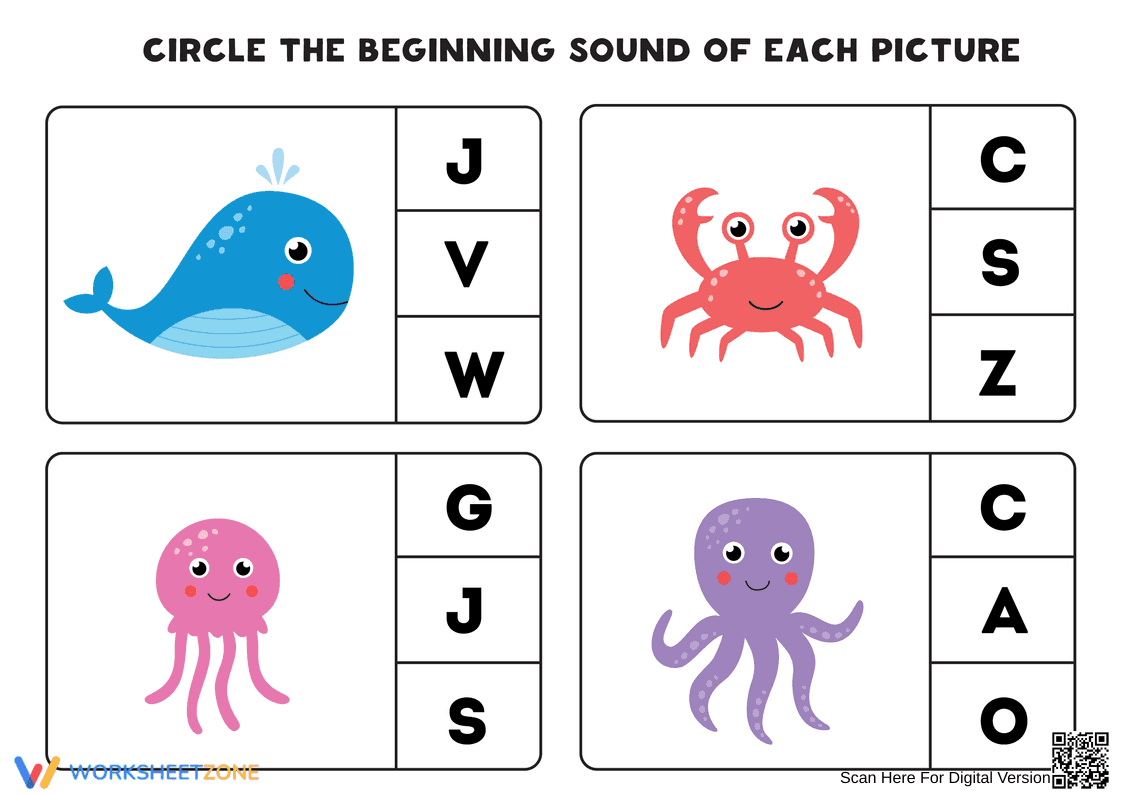
This Kindergarten beginning sounds worksheet helps early learners identify initial phonemes through high-interest visual cues. Students look at common objects and select the correct starting letter from a choice of three, building the foundational decoding skills necessary for early literacy success and phonological awareness. By isolating the first sound, students strengthen their letter-sound correspondence.
At a Glance
- Grade: Kindergarten · Subject: ELA Phonics
- Standard:
CCSS.ELA-LITERACY.RF.K.3.A— Demonstrate basic knowledge of one-to-one letter-sound correspondences by producing the primary sound- Skill Focus: Initial Letter Identification
- Format: 1 page · 4 problems · Answer key included · PDF
- Best For: Independent phonics practice or morning work
- Time: 5–10 minutes
This single-page PDF features four distinct identification tasks. Each task includes a colorful, recognizable illustration—such as a whale, crab, jellyfish, and octopus—paired with three uppercase letter options. The clean layout minimizes visual distractions, making it ideal for students who require clear focal points during independent work. A comprehensive answer key is provided for quick grading and self-correction.
The zero-prep workflow for this resource is designed for maximum efficiency in busy classrooms. First, print the single-page PDF (30 seconds). Second, distribute the sheets to students during your phonics block or as a transition activity (30 seconds). Finally, review the answers as a whole group to provide immediate feedback (1 minute). Total teacher preparation time is under two minutes, making this an excellent choice for emergency sub plans.
This resource is primarily aligned with `CCSS.ELA-LITERACY.RF.K.3.A`, which requires students to demonstrate basic knowledge of one-to-one letter-sound correspondences. It also supports RF.K.1.D by reinforcing alphabet recognition in a functional context. Both standard codes can be copied directly into lesson plans, IEP goals, or district curriculum mapping tools to ensure instructional compliance.
Use this worksheet as a formative assessment after introducing the letters J, V, W, C, S, Z, G, and O. It works effectively during small-group rotations where a teacher can observe a student's mouth formation as they say the word aloud. Expect students to complete the four tasks within 5 to 10 minutes depending on their current phonemic proficiency and familiarity with the vocabulary.
This resource is tailored for Kindergarten students, though it serves as an excellent challenge for Preschoolers or a remedial review for Grade 1 students. It pairs naturally with alphabet anchor charts or picture-word sorting cards. The high-contrast images support English Language Learners (ELL) by providing clear visual context for vocabulary, ensuring that language barriers do not impede phonics mastery.
Research from RAND AIRS 2024 emphasizes that early exposure to phoneme-grapheme mapping is a critical predictor of later reading fluency. This worksheet facilitates that mapping by requiring students to isolate the initial sound of a spoken word and link it to its corresponding written symbol. By focusing on the CCSS.ELA-LITERACY.RF.K.3.A standard, the activity ensures that students are practicing the specific one-to-one correspondences mandated by national literacy frameworks. Systematic practice with initial sounds, as seen in these 4 targeted tasks, helps bridge the gap between oral language and written text. Educators can use this data to identify specific letter-sound gaps before moving into more complex blending and segmenting tasks. This evidence-based approach to phonics instruction provides the repetitive, structured practice necessary for mastery in early childhood settings.


