


























Views
Downloads
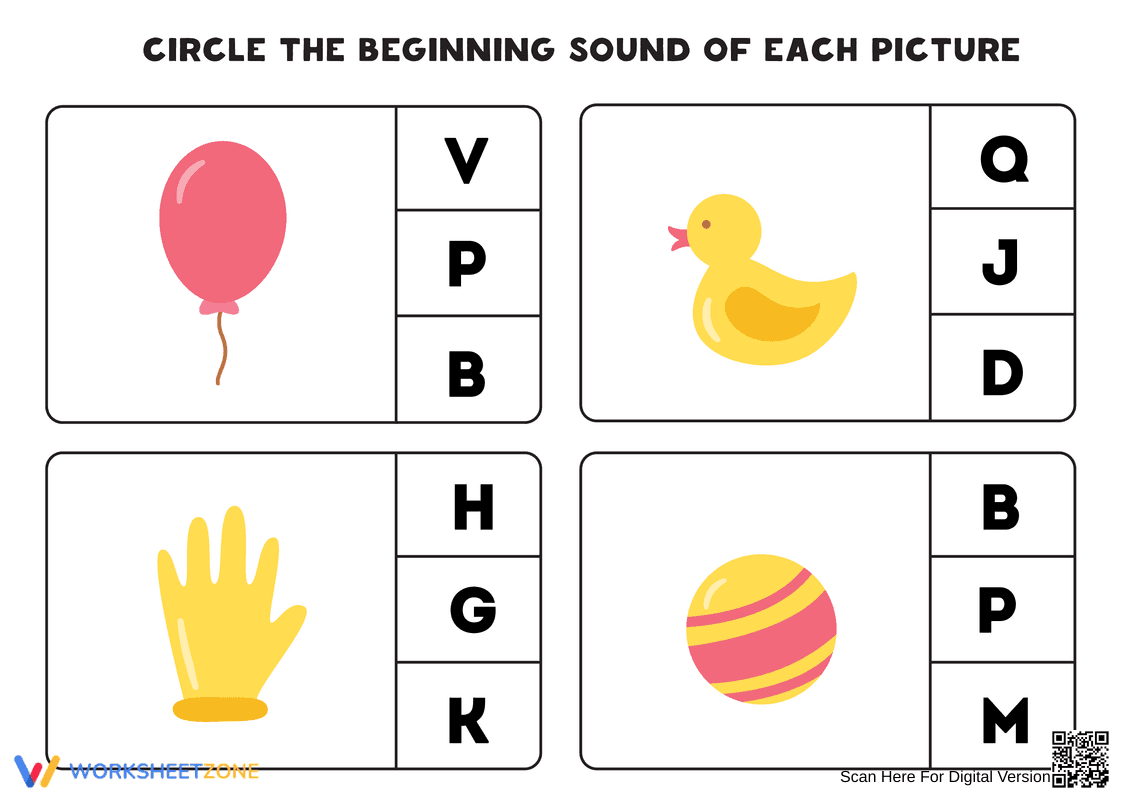

Beginning Sounds Worksheet | Essential Kindergarten Phonics
Paste this activity's link or code into your existing LMS (Google Classroom, Canvas, Teams, Schoology, Moodle, etc.).
Students can open and work on the activity right away, with no student login required.
You'll still be able to track student progress and results from your teacher account.
This Kindergarten phonics worksheet helps young learners master initial sound isolation through visual recognition. Students identify the beginning consonant for four distinct objects, bridging the gap between spoken phonemes and written graphemes. It provides a clear, distraction-free environment for early readers to practice essential phonemic awareness skills effectively.
At a Glance
- Grade: Kindergarten · Subject: ELA Phonics
- Standard:
CCSS.ELA-LITERACY.RF.K.2.D— Isolate and pronounce the initial sounds in three-phoneme words- Skill Focus: Initial Sound Identification
- Format: 1 page · 4 problems · Answer key included · PDF
- Best For: Morning work or quick phonics checks
- Time: 5–10 minutes
Inside this single-page PDF, you will find four large, colorful illustrations: a balloon, a duck, a glove, and a ball. Each image is paired with three letter choices in a vertical column. The clean layout ensures that Preschool and Kindergarten students can focus on the specific task without visual overwhelm. A full answer key is provided for rapid grading.
The zero-prep workflow is designed for busy educators. First, print the single-page PDF (30 seconds). Second, distribute the sheets to students during your phonics block (30 seconds). Finally, review the four answers as a whole group to provide immediate feedback (1 minute). This resource requires less than two minutes of total teacher preparation time and is perfect for emergency sub plans.
This resource aligns with CCSS.ELA-LITERACY.RF.K.2.D, focusing on the isolation and pronunciation of initial sounds. By selecting the correct letter from a field of three, students demonstrate their ability to map sounds to symbols. This standard code can be copied directly into lesson plans, IEP goals, or district curriculum mapping tools.
Use this worksheet as a formative assessment after a direct instruction lesson on consonant sounds. It works exceptionally well during small-group rotations; observe if students say the word aloud before selecting a letter. Expected completion time is 5 to 10 minutes, making it an ideal exit ticket to gauge student readiness for more complex blending tasks.
This worksheet is designed for Preschool, Kindergarten, and Grade 1 students who are developing foundational literacy. It is particularly helpful for English Language Learners (ELLs) who need visual support to connect vocabulary with phonemes. Pair this resource with a physical alphabet anchor chart or a set of letter tiles for tactile reinforcement.
Phonemic awareness, specifically the ability to isolate initial sounds as required by CCSS.ELA-LITERACY.RF.K.2.D, is a primary predictor of future reading success. Research from the RAND AIRS 2024 report emphasizes that structured, visual-to-phoneme mapping activities significantly reduce the time required for students to reach decoding fluency. By providing 4 targeted tasks, this worksheet allows for high-frequency practice without cognitive fatigue. Fisher & Frey (2014) highlight that such check-for-understanding tools are vital in the gradual release of responsibility model, moving students from teacher-led modeling to independent mastery. This resource provides the necessary scaffolding for early learners to build confidence in their phonetic pronunciation. Educators can utilize these data-driven results to justify the inclusion of daily phonics drills in the primary classroom. The clear alignment ensures that instructional time is maximized for core literacy development.


