


























Views
Downloads

Beginning Sounds Printable Worksheet | Grade K ELA
Paste this activity's link or code into your existing LMS (Google Classroom, Canvas, Teams, Schoology, Moodle, etc.).
Students can open and work on the activity right away, with no student login required.
You'll still be able to track student progress and results from your teacher account.
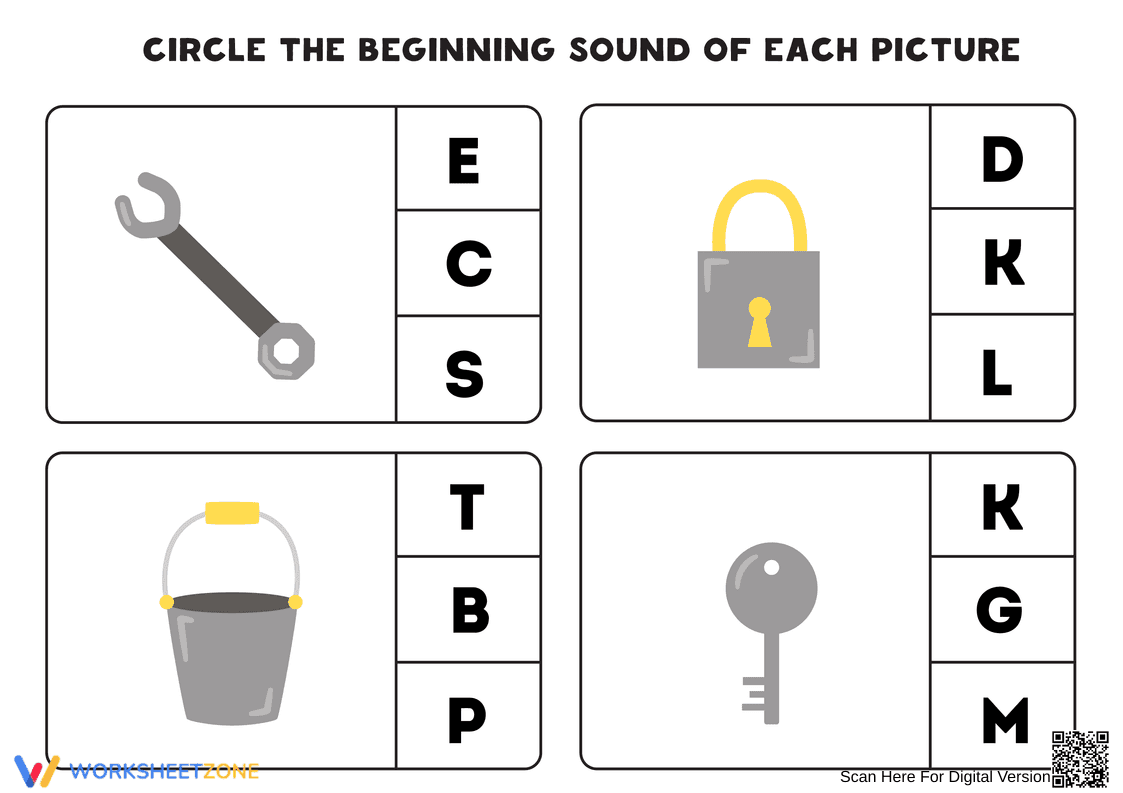
This phonics worksheet helps early readers master initial phonemes by matching everyday objects to their starting letters. Students build foundational decoding skills by identifying the correct beginning sound for four familiar pictures. This targeted practice strengthens letter-sound correspondence, a critical step toward fluent reading and spelling.
At a Glance
- Grade: Kindergarten · Subject: ELA
- Standard:
CCSS.ELA-LITERACY.RF.K.3.A— Match primary sounds to consonants- Skill Focus: Beginning Sounds
- Format: 1 page · 4 problems · Answer key included · PDF
- Best For: Independent practice
- Time: 5–10 minutes
Inside this resource, educators will find a single-page activity featuring four clear, engaging illustrations: a wrench, a lock, a bucket, and a key. Next to each image, students are presented with three uppercase letter options. They must circle the letter that represents the initial sound of the pictured word. A complete answer key is provided to ensure quick and accurate grading.
Designed for immediate classroom implementation:
- Print (1 minute): Generate copies directly from the PDF file. High-contrast design ensures clear printing.
- Distribute (1 minute): Hand out to students; only a pencil is required.
- Review (3 minutes): Quickly check student responses using the provided answer key or review together as a whole class.
With a total teacher prep time of under two minutes, this activity is highly suitable for emergency sub plans, morning work, or spontaneous literacy center rotations.
This worksheet is strictly aligned to CCSS.ELA-LITERACY.RF.K.3.A: "Demonstrate basic knowledge of one-to-one letter-sound correspondences by producing the primary sound or many of the most frequent sounds for each consonant." It also supports early phonological awareness by requiring students to isolate the initial sound in spoken words before matching it to text. Both standard codes can be copied directly into lesson plans, IEP goals, or district curriculum mapping tools.
Use during independent literacy centers after direct instruction. It serves as an excellent quiet activity while the teacher conducts small guided reading groups. Alternatively, use it as a quick morning work assignment to activate prior knowledge as students settle into the classroom. As a formative assessment tip, observe whether students whisper the word aloud before selecting the letter; this indicates they are actively isolating the phoneme rather than guessing. Expected completion time ranges from 5 to 10 minutes.
Designed for Kindergarten students developing phonics skills, it also suits Preschoolers showing reading readiness and First Graders needing intervention. For students requiring additional support, teachers can pre-teach the vocabulary by naming each picture aloud before independent work begins. Pair this worksheet with a classroom alphabet anchor chart to provide a visual reference for students who struggle with letter recognition.
Mastering initial phonemes is a foundational component of early literacy development and reading readiness. According to a 2024 report by EdReports, systematic and explicit phonics instruction that emphasizes letter-sound correspondence significantly improves long-term decoding proficiency in young learners. This worksheet directly addresses CCSS.ELA-LITERACY.RF.K.3.A by requiring students to match primary sounds to consonants. By isolating the beginning sound of familiar objects and connecting it to the correct uppercase letter, early learners bridge the critical gap between spoken language and written text. Consistent practice with these discrete phonological tasks builds the automaticity necessary for fluent reading and spelling. Educators utilizing this resource provide targeted, evidence-based repetition that reinforces core phonetic concepts, ensuring students develop the robust decoding strategies required for future academic success across all subject areas and complex texts.


