


























Views
Downloads
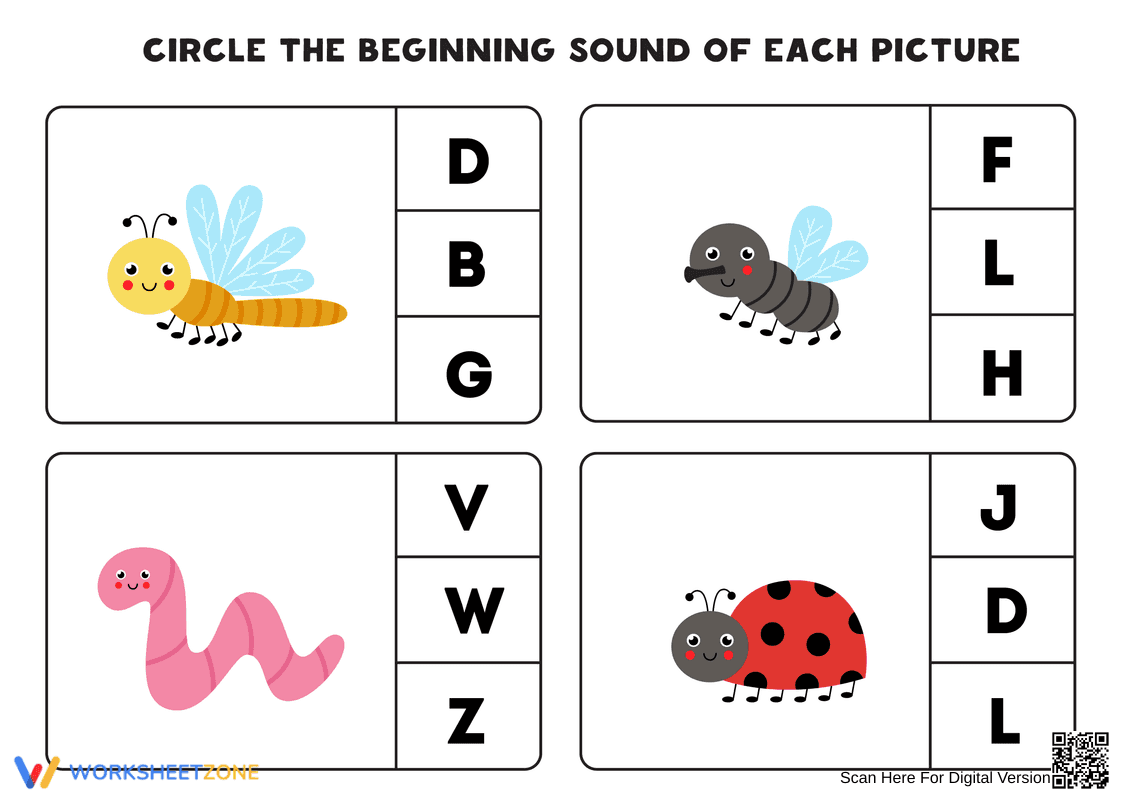

Beginning Sounds Worksheet | Essential Kindergarten Phonics
Paste this activity's link or code into your existing LMS (Google Classroom, Canvas, Teams, Schoology, Moodle, etc.).
Students can open and work on the activity right away, with no student login required.
You'll still be able to track student progress and results from your teacher account.
This essential phonics worksheet helps early learners identify initial letter sounds through high-interest visual cues. By matching pictures like dragonflies and ladybugs to their corresponding starting letters, students build the foundational phonemic awareness necessary for reading fluency. This resource provides immediate practice in letter-sound correspondence for preschool and kindergarten classrooms.
At a Glance
- Grade: Kindergarten · Subject: ELA Phonics
- Standard:
CCSS.ELA-LITERACY.RF.K.3.A— Demonstrate basic knowledge of one-to-one letter-sound correspondences by producing the primary sound- Skill Focus: Initial Phoneme Identification
- Format: 1 page · 4 problems · Answer key included · PDF
- Best For: Independent morning work or literacy centers
- Time: 5–10 minutes
The worksheet features four distinct quadrants, each containing a vibrant illustration and a vertical column of three uppercase letter choices. Students must vocalize the name of the object—such as a worm or a fly—and circle the correct starting letter. The layout is clean and distraction-free, making it ideal for young learners who are still developing fine motor skills and visual tracking abilities.
Zero-Prep Workflow
Teachers can implement this resource in under two minutes. First, print the single-page PDF for your class or small group. Second, distribute the sheets during your phonics block or as a transition activity; the intuitive design requires minimal verbal instruction. Finally, review the answers as a whole group to provide immediate feedback on pronunciation and letter recognition. This streamlined workflow makes it an excellent choice for emergency sub plans.
Standards Alignment
This resource aligns with `CCSS.ELA-LITERACY.RF.K.3.A`, which requires students to demonstrate basic knowledge of one-to-one letter-sound correspondences. By isolating the initial phoneme, students practice the specific decoding skills outlined in the Common Core State Standards for foundational reading. Both standard codes can be copied directly into lesson plans, IEP goals, or district curriculum mapping tools.
How to Use It
Use this worksheet as a formative assessment after a direct instruction lesson on consonant sounds. Observe students as they work to see if they are subvocalizing the words, which indicates they are actively processing the phonemes. It also serves as a quick exit ticket to gauge mastery before moving to more complex vowel sounds. Expected completion time is approximately 7 minutes.
Who It's For
This activity is designed for preschool, kindergarten, and first-grade students who are beginning their literacy journey. It is particularly effective for English Language Learners (ELLs) who benefit from the clear visual-to-text connection. Pair this worksheet with a physical alphabet anchor chart or a set of letter tiles to provide a multi-sensory learning experience.
Research from the RAND AIRS 2024 report emphasizes that early exposure to phonemic isolation tasks is a significant predictor of later reading success. By focusing on the initial sound, this worksheet targets the first step in the phonological awareness hierarchy. Systematic practice with letter-sound correspondence, as seen in this resource, ensures that students move beyond rote memorization toward true decoding proficiency. The use of familiar imagery reduces cognitive load, allowing the brain to focus specifically on the phonemic task. According to NAEP data, students who master these foundational skills in kindergarten are more likely to reach reading benchmarks by the end of third grade. This worksheet provides the structured, repetitive practice required to solidify these neural pathways. The standard code CCSS.ELA-LITERACY.RF.K.3.A represents the specific skill of producing the primary sound for each consonant, a core component of early literacy instruction.


