


























Views
Downloads
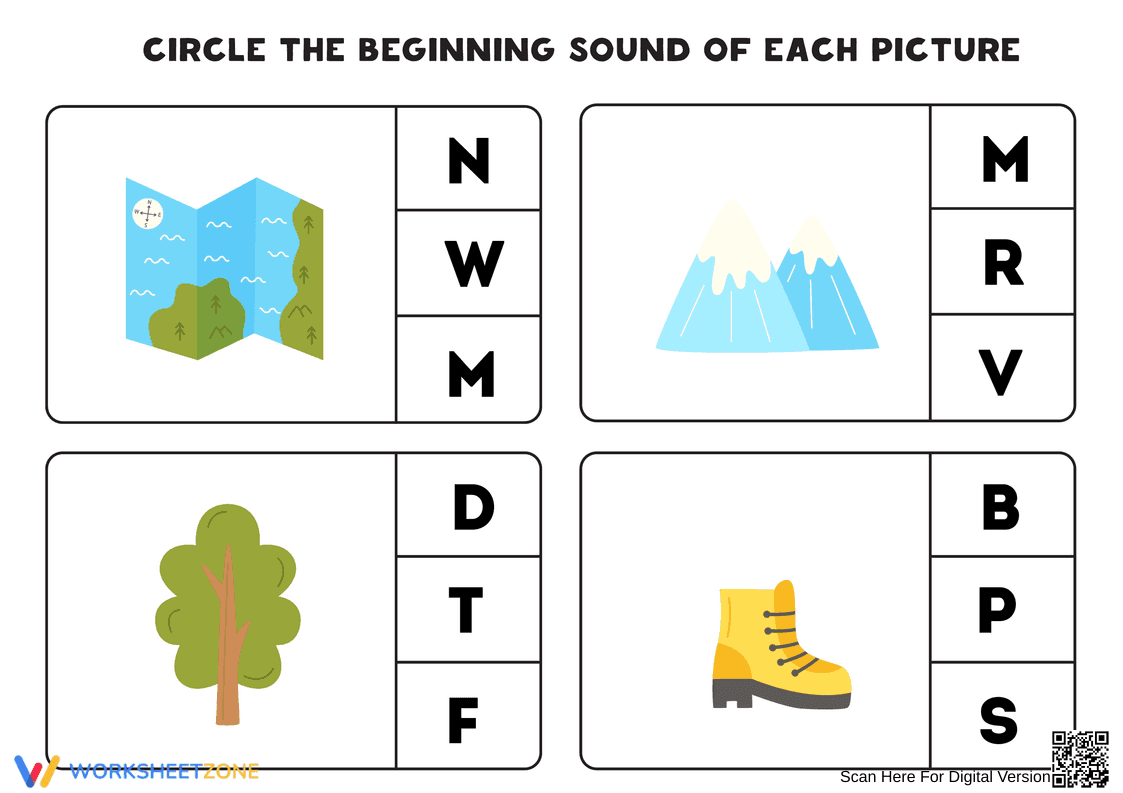

Beginning Sounds Printable Worksheet | Kindergarten ELA
Paste this activity's link or code into your existing LMS (Google Classroom, Canvas, Teams, Schoology, Moodle, etc.).
Students can open and work on the activity right away, with no student login required.
You'll still be able to track student progress and results from your teacher account.
This foundational phonics worksheet helps early readers master initial consonant sounds by matching familiar images to their corresponding starting letters. Students build critical phonemic awareness and letter-sound correspondence skills, setting the stage for decoding and fluent reading. The straightforward visual format ensures young learners can focus entirely on sound isolation.
At a Glance
- Grade: Kindergarten · Subject: ELA
- Standard:
CCSS.ELA-LITERACY.RF.K.3.A— Identify primary sounds for each consonant- Skill Focus: Beginning Sounds
- Format: 1 page · 4 problems · PDF
- Best For: Independent practice
- Time: 5–10 minutes
Inside this single-page resource, educators will find four visual multiple-choice tasks designed for early childhood learners. Each problem features a clear illustration—a map, mountains, a tree, and a boot—paired with three uppercase letter options. Students vocalize the word, isolate the initial phoneme, and circle the correct letter. The uncluttered layout minimizes distractions, making it accessible for preschool and kindergarten students developing literacy skills.
This resource offers a zero-prep workflow, requiring under two minutes of teacher setup. First, print the copies (30 seconds). Second, distribute the pages with crayons (1 minute). Finally, review the instructions by completing the first picture together (30 seconds). Because the directions are intuitive, this activity functions perfectly as an emergency sub plan, morning work, or a quick transition activity between literacy blocks.
This activity is strictly aligned to CCSS.ELA-LITERACY.RF.K.3.A, requiring students to demonstrate basic knowledge of one-to-one letter-sound correspondences by producing the primary sound for each consonant. It also supports early phonemic awareness goals by asking children to isolate initial sounds in spoken words. Both standard codes can be copied directly into lesson plans, IEP goals, or district curriculum mapping tools.
Teachers can deploy this worksheet during small group literacy centers to monitor individual student progress with consonant sounds. Alternatively, it serves as an excellent formative assessment tool after direct instruction on specific letter groups. While students work, observe whether they are whispering the word aloud to hear the initial sound or if they are guessing randomly; this provides immediate data on their phonemic isolation abilities. Expect students to complete the four tasks within a 5 to 10-minute timeframe.
This printable is ideal for preschool, kindergarten, and first-grade students who are currently building their foundational phonics knowledge. It provides necessary repetition for students struggling with letter-sound recall and serves as a confidence-building review for on-level readers. Pair this worksheet with a whole-class alphabet anchor chart or a read-aloud session focusing on alliteration to reinforce the concept of initial sounds in a broader context.
Mastering initial consonant sounds is a critical milestone in early childhood literacy, directly impacting a student's future ability to decode complex texts. This worksheet aligns with CCSS.ELA-LITERACY.RF.K.3.A, ensuring students can identify primary sounds for consonants accurately. According to a comprehensive EdReports 2024 analysis on foundational reading skills, systematic and explicit phonics instruction that includes frequent, low-stakes practice opportunities significantly improves long-term reading fluency. By isolating the beginning sound of familiar vocabulary words, young learners strengthen the neural pathways required for rapid letter-sound retrieval. This targeted practice reduces cognitive load during later blending and segmenting tasks. Providing students with clear, visually supported exercises allows them to build automaticity in phoneme recognition, a skill that research consistently identifies as a primary predictor of reading comprehension success in later elementary grades.


