


























Views
Downloads
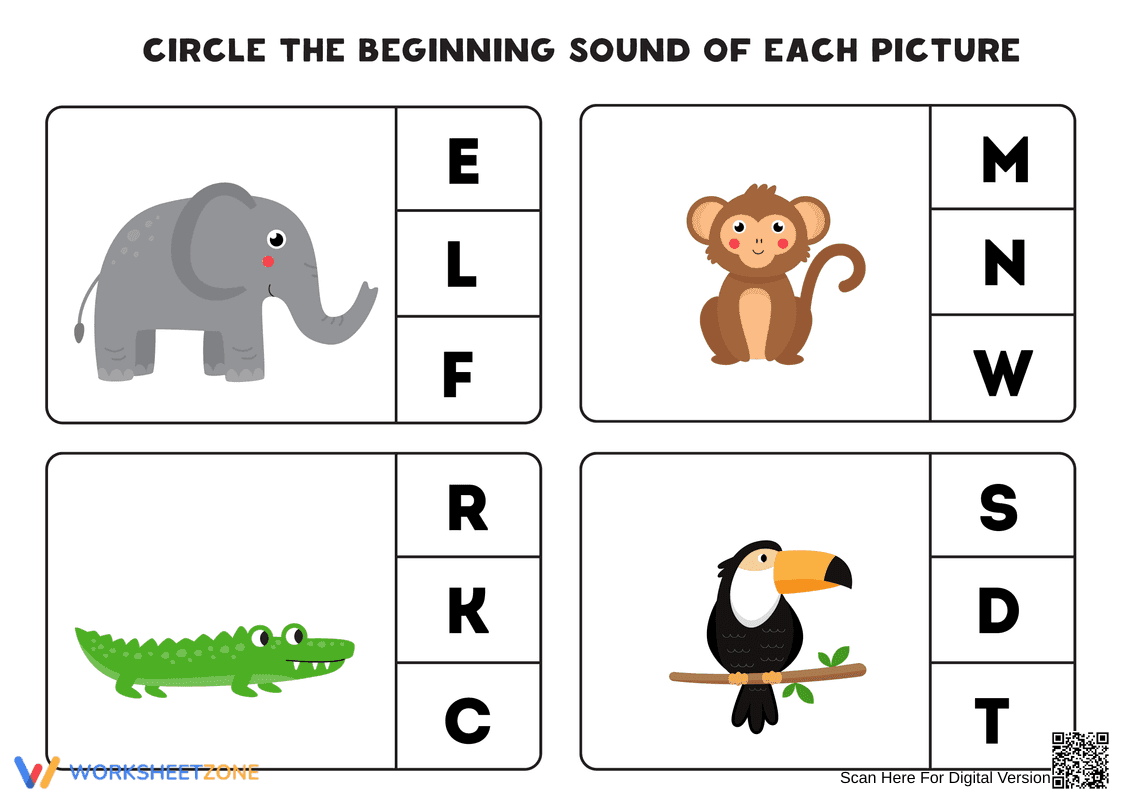

Beginning Sounds Printable Worksheet | Grade K ELA
Paste this activity's link or code into your existing LMS (Google Classroom, Canvas, Teams, Schoology, Moodle, etc.).
Students can open and work on the activity right away, with no student login required.
You'll still be able to track student progress and results from your teacher account.
This foundational phonics worksheet helps early learners isolate and identify beginning sounds in common words. By matching familiar animal illustrations to their corresponding initial letters, students strengthen their letter-sound correspondence skills. This targeted practice builds essential phonemic awareness required for fluent reading and writing development.
At a Glance
- Grade: K · Subject: ELA
- Standard:
CCSS.ELA-LITERACY.RF.K.3.A— Produce the primary sound for each consonant- Skill Focus: Beginning sounds
- Format: 1 page · 4 problems · Answer key included · PDF
- Best For: Independent morning work
- Time: 5–10 minutes
Inside this single-page resource, educators will find four highly visual phonics tasks featuring engaging animal illustrations, including an elephant, monkey, crocodile, and toucan. Next to each image, students are presented with three uppercase letter options. They must vocalize the animal's name and circle the letter that represents the initial phoneme. A complete answer key is provided to ensure rapid grading and immediate feedback.
Zero-Prep Workflow
- Print (1 minute): Download the PDF and print copies for your reading groups. The high-contrast design ensures clear reproduction in black and white.
- Distribute (1 minute): Hand out the sheets during literacy centers or morning work. The visual instructions are self-explanatory for early readers.
- Review (2 minutes): Use the included answer key to quickly check student responses or project it on the board for self-correction.
With total teacher prep time under two minutes, this resource suits emergency sub plans perfectly.
Standards Alignment
This resource is directly aligned to CCSS.ELA-LITERACY.RF.K.3.A: Demonstrate basic knowledge of one-to-one letter-sound correspondences by producing the primary sound or many of the most frequent sounds for each consonant. It also supports early phonemic awareness goals by requiring students to isolate the initial sound in spoken words. Both standard codes can be copied directly into lesson plans, IEP goals, or district curriculum mapping tools.
How to Use It
Deploy this worksheet during independent practice, immediately after direct instruction on consonant sounds. It serves as an effective formative assessment tool; observe whether students are whispering the animal names to themselves to isolate the first sound, which indicates developing phonemic awareness. Alternatively, place it in a literacy center for independent reinforcement. Expected completion time ranges from five to ten minutes, depending on the student's familiarity with the vocabulary.
Who It's For
This material is designed for Kindergarten students mastering alphabet sounds, serving as excellent review for first graders or intervention for preschoolers. For students requiring additional scaffolding, provide an alphabet anchor chart with picture cues to help them match the letters. Pair this worksheet with a read-aloud session focusing on animal vocabulary to activate prior knowledge before independent practice.
Mastering initial phonemes is a critical milestone in early childhood literacy. This resource targets CCSS.ELA-LITERACY.RF.K.3.A, requiring students to produce the primary sound for each consonant. According to a comprehensive EdReports 2024 analysis of foundational reading skills, explicit and systematic instruction in letter-sound correspondence significantly accelerates decoding proficiency in primary grades. When young learners consistently practice isolating beginning sounds using visual cues, they build the neural pathways necessary for fluent word recognition. The structured format minimizes cognitive load, allowing children to focus entirely on phonemic isolation rather than complex instructions. This targeted worksheet provides the exact repetition needed to solidify these connections without overwhelming the student. By integrating clear imagery with focused letter selection, educators can effectively bridge the gap between spoken language and written text, ensuring a robust foundation for future reading comprehension and spelling success.


