


























Views
Downloads

Grade 4 Cinco de Mayo — Printable No-Prep Worksheet
Paste this activity's link or code into your existing LMS (Google Classroom, Canvas, Teams, Schoology, Moodle, etc.).
Students can open and work on the activity right away, with no student login required.
You'll still be able to track student progress and results from your teacher account.
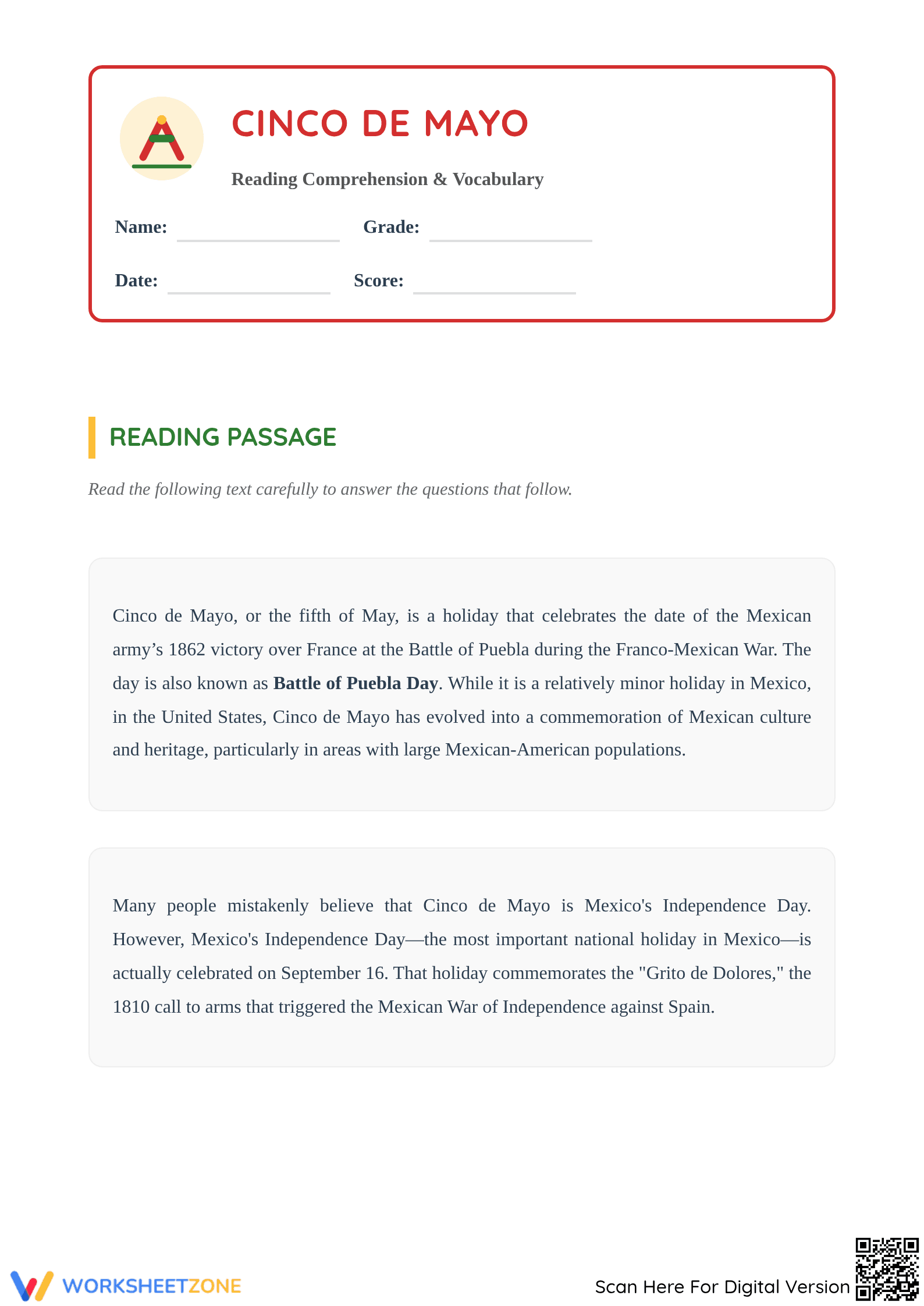
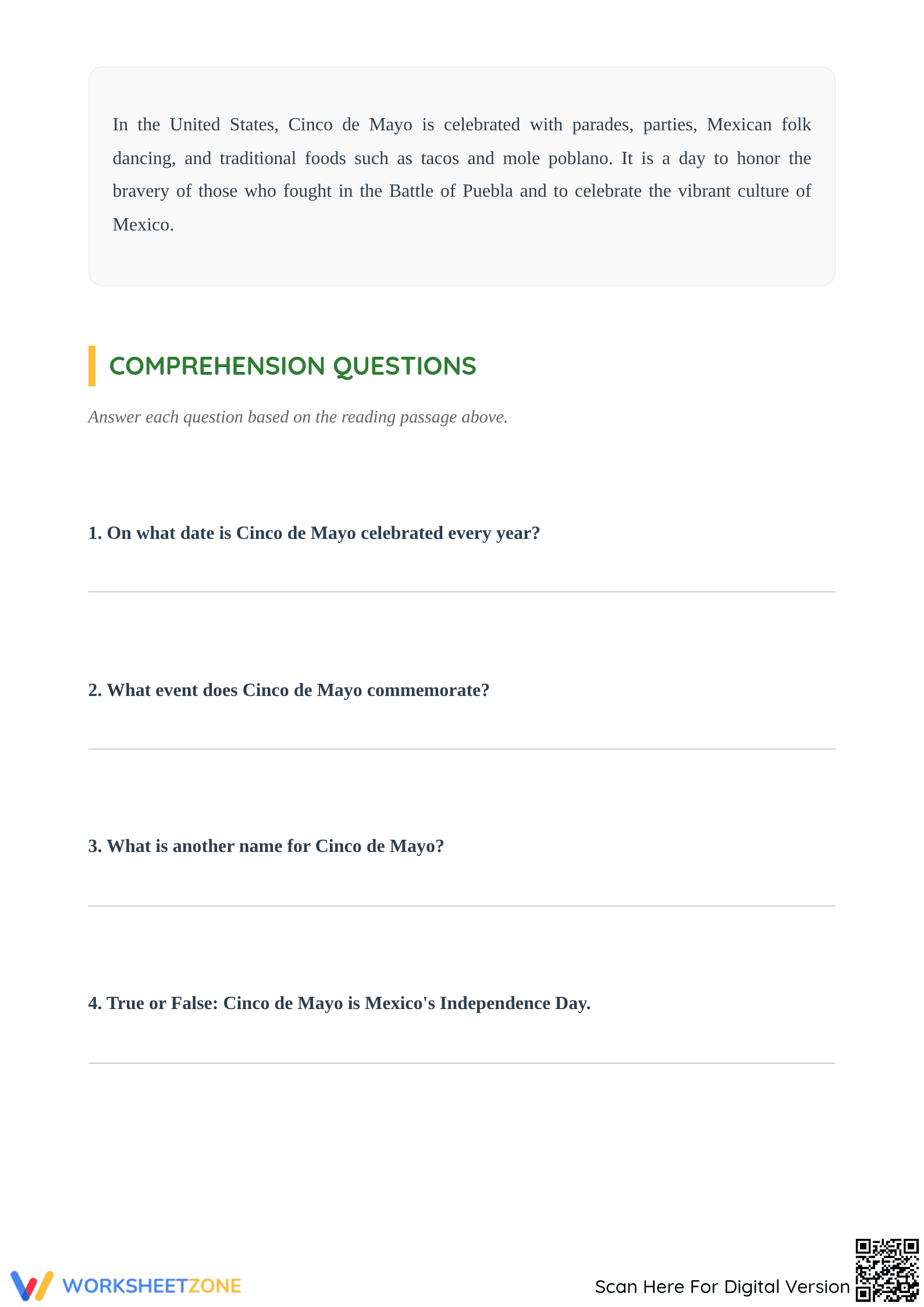
This Grade 4 reading comprehension worksheet helps students build informational text analysis skills while learning about the history and cultural significance of Cinco de Mayo. By reading a short passage and answering targeted questions, learners practice locating text evidence, defining vocabulary in context, and articulating critical thoughts.
At a Glance
- Grade: 4 · Subject: ELA
- Standard:
CCSS.ELA-LITERACY.RI.4.1— Refer to details and examples in a text- Skill Focus: Reading Comprehension & Vocabulary
- Format: 3 pages · 10 problems · Answer key included · PDF
- Best For: Independent practice or sub plans
- Time: 20–30 minutes
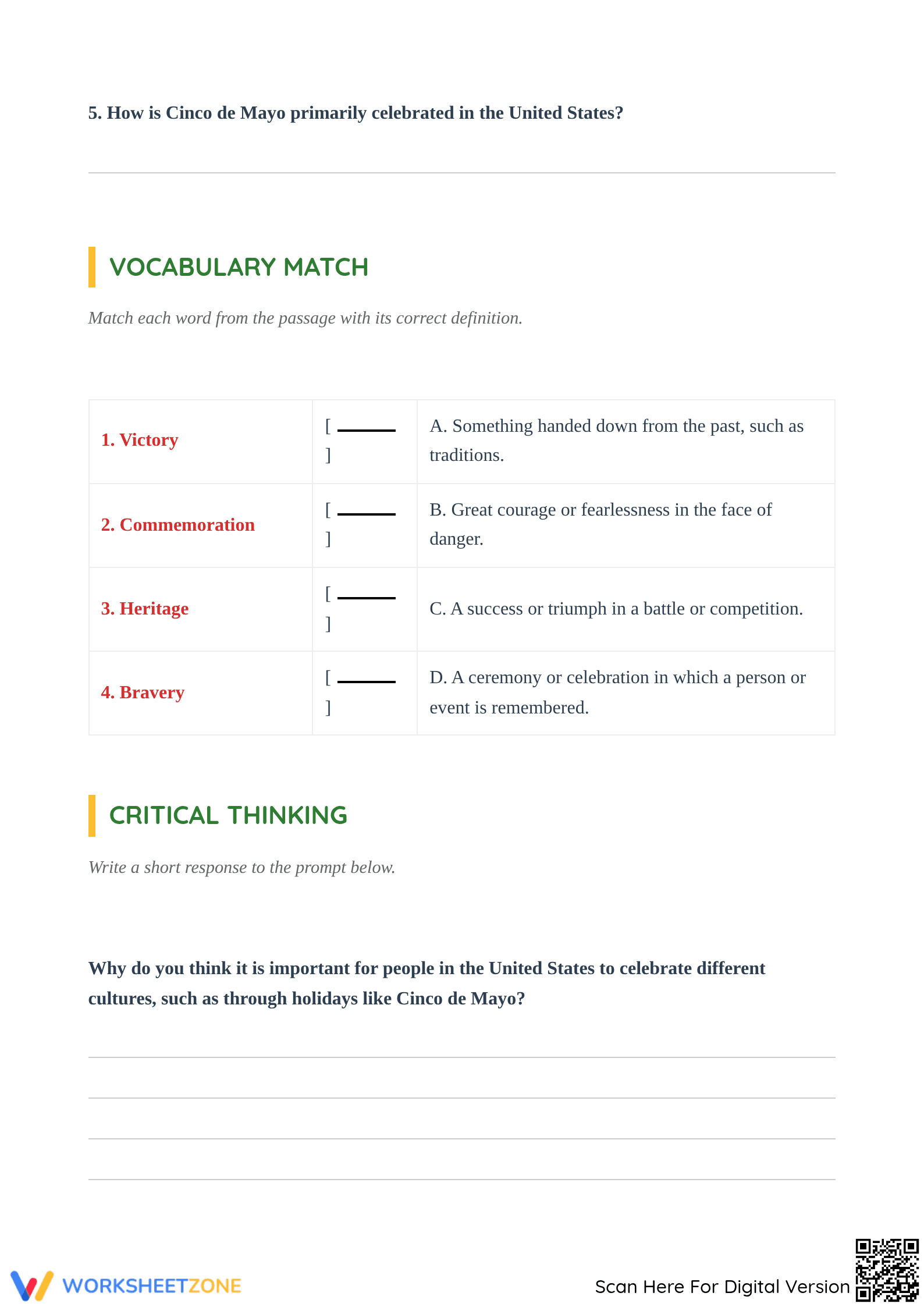
Inside this resource, educators will find a carefully leveled informational passage detailing the origins of Cinco de Mayo and its modern celebrations. The text is followed by five direct comprehension questions, a four-word vocabulary matching section, and one critical thinking writing prompt. A complete answer key is provided to ensure quick and accurate grading.
Zero-Prep Workflow
- Print (1 minute): Simply download the PDF and print the three-page student packet. No special materials or prior background knowledge are required.
- Distribute (1 minute): Hand out the worksheets at the beginning of your ELA block or leave them in a folder for a substitute teacher.
- Review (3 minutes): Use the included answer key to quickly check student responses or guide a whole-class review session.
Total teacher prep time is under two minutes, making this an ideal solution for busy mornings or unexpected absences.
Standards Alignment
This worksheet is tightly aligned to CCSS.ELA-LITERACY.RI.4.1: Refer to details and examples in a text when explaining what the text says explicitly and when drawing inferences from the text. It also supports vocabulary development through context clues. Both standard codes can be copied directly into lesson plans, IEP goals, or district curriculum mapping tools.
How to Use It
Deploy this reading passage during your morning work routine or as a standalone literacy center activity. It works exceptionally well as an independent reading task after a brief whole-class discussion about spring holidays. As students work, teachers can use the critical thinking prompt as a formative assessment to observe how well learners connect historical events to modern cultural celebrations. Expect students to complete the entire packet in 20 to 30 minutes.
Who It's For
This resource is designed for fourth-grade students, though it is highly adaptable for third-grade readers needing a challenge or fifth-grade students requiring review. The clear layout and straightforward questions provide built-in scaffolding for diverse learners. Pair this worksheet with a broader social studies unit on Mexican history or a classroom anchor chart about finding text evidence.
Aligning instructional materials to specific literacy standards like CCSS.ELA-LITERACY.RI.4.1 ensures that students can refer to details and examples in a text effectively. According to a recent EdReports 2024 analysis, providing students with integrated reading and vocabulary tasks significantly improves their ability to comprehend complex informational texts. When learners engage with culturally relevant topics such as Cinco de Mayo, they are more likely to retain domain-specific vocabulary and apply critical thinking skills to real-world contexts. This targeted practice helps bridge the gap between basic recall and deeper analytical reading. By incorporating structured comprehension questions alongside vocabulary matching and writing prompts, educators can foster a more robust understanding of historical events while meeting rigorous academic benchmarks. Consistent exposure to these formatted tasks builds the stamina required for advanced literacy achievement.


