


























Views
Plays
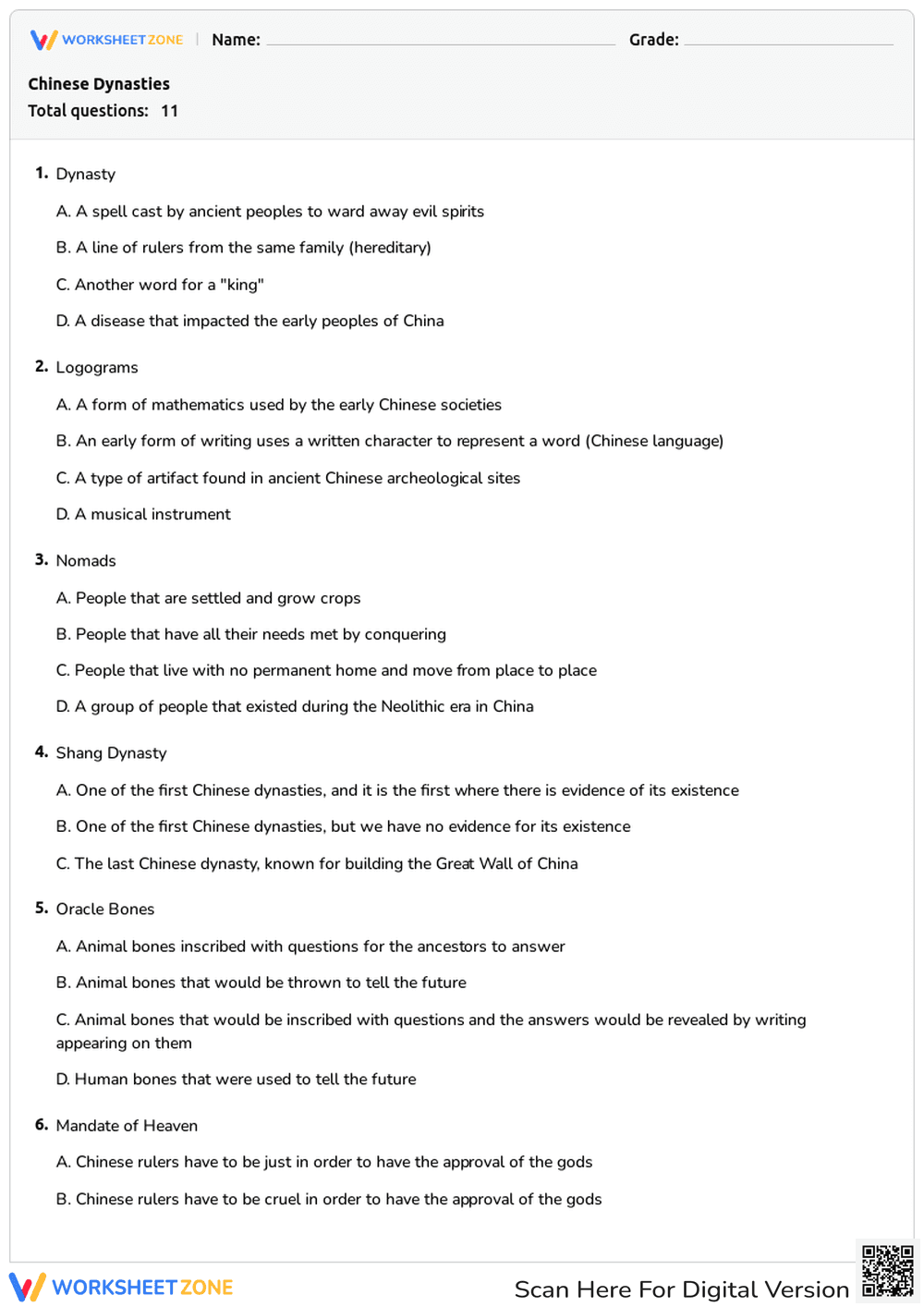
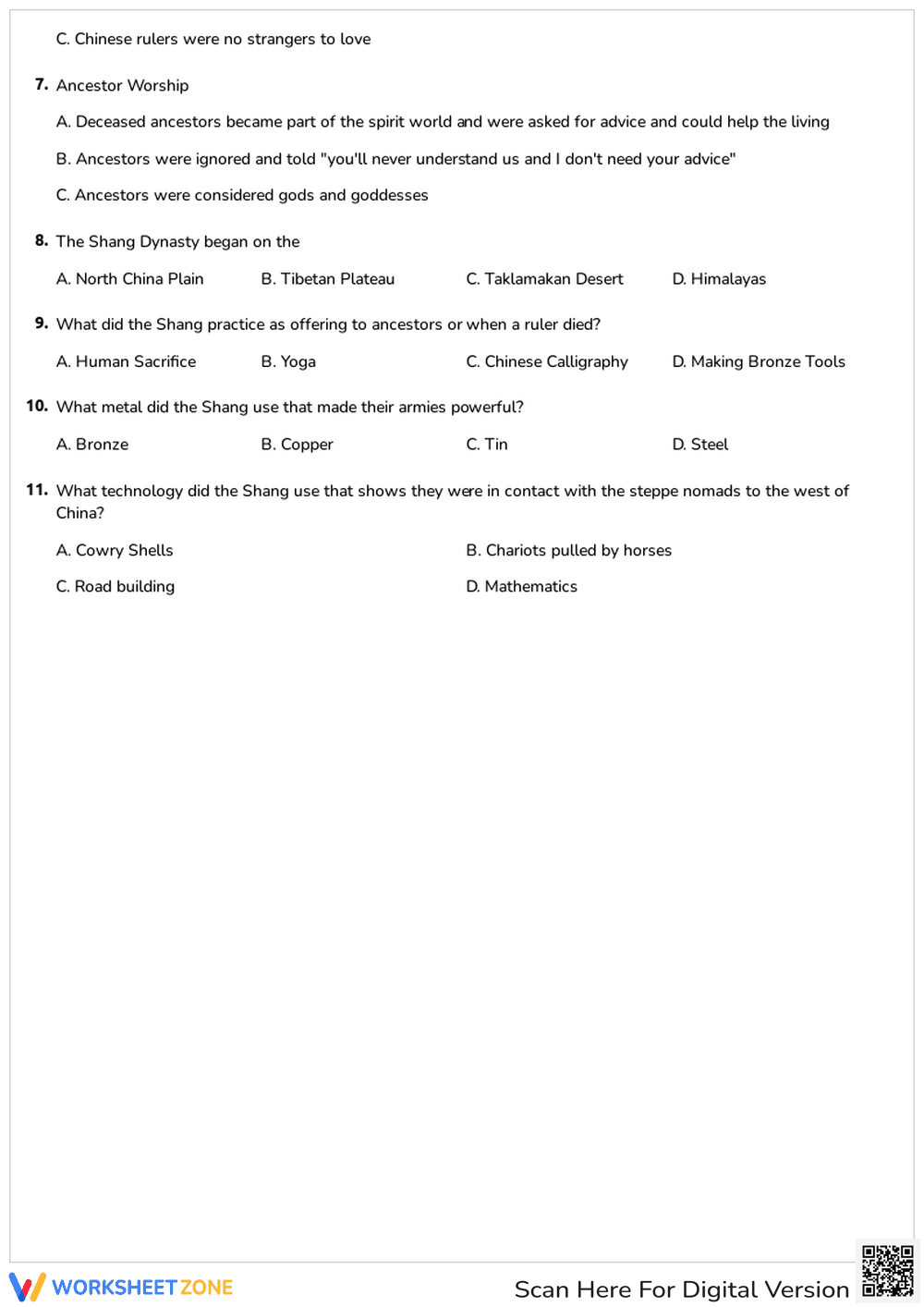

Chinese Dynasties Quiz | Essential Grade 6 ELA
Paste this activity's link or code into your existing LMS (Google Classroom, Canvas, Teams, Schoology, Moodle, etc.).
Students can open and work on the activity right away, with no student login required.
You'll still be able to track student progress and results from your teacher account.
This Grade 6 Chinese Dynasties worksheet provides a focused assessment of essential historical vocabulary and cultural concepts. Students demonstrate their understanding of the Shang Dynasty, social structures, and early writing systems through 11 targeted multiple-choice questions. By identifying key terms like logograms and oracle bones, learners build the domain-specific knowledge required for deep comprehension of ancient civilizations.
At a Glance
- Grade: 6 · Subject: ELA / History
- Standard:
CCSS.ELA-LITERACY.RI.6.4— Determine the meaning of domain-specific words and phrases in a text- Skill Focus: Ancient China Vocabulary
- Format: 2 pages · 11 problems · Answer key included · PDF
- Best For: Quick formative assessment or unit review
- Time: 15–20 minutes
The resource contains 11 multiple-choice questions spread across two clean, easy-to-read pages. Each question offers four distinct options designed to challenge common misconceptions about ancient Chinese life. Key topics include the hereditary nature of dynasties, the religious significance of ancestor worship, and the technological advancements of the Shang period, such as bronze weaponry and horse-drawn chariots.
The zero-prep design allows for immediate classroom integration. First, print the two-page PDF (30 seconds). Second, distribute the 11-question assessment to students as a bell-ringer or exit ticket (1 minute). Finally, use the included answer key to review responses as a whole group to clarify misconceptions about the Mandate of Heaven or the Shang Dynasty (5 minutes). Total teacher preparation time is under 2 minutes.
This resource is primarily aligned with CCSS.ELA-LITERACY.RI.6.4, which focuses on determining the meaning of symbols and domain-specific words in a historical context. It also supports the literacy requirements for history and social studies. Both standard codes can be copied directly into lesson plans, IEP goals, or district curriculum mapping tools to ensure instructional alignment.
Use this worksheet as a formative assessment after a direct instruction lesson on the Shang Dynasty. It serves as an excellent check for understanding before moving into more complex topics like the Silk Road. Teachers should observe if students struggle with the concept of the Mandate of Heaven, as this often requires additional scaffolding. Expected completion time is 15 to 20 minutes.
This worksheet is designed for 6th-grade students but is effective for 5th-grade enrichment or 7th-grade review. It provides support for English Language Learners (ELLs) by isolating key academic terms with clear definitions. Pair this resource with a visual anchor chart of the North China Plain or a short video clip showing the casting of Shang bronze artifacts.
Research from the RAND AIRS 2024 report emphasizes that domain-specific vocabulary acquisition is a primary predictor of reading comprehension in middle school social studies contexts. This worksheet targets CCSS.ELA-LITERACY.RI.6.4 by requiring students to determine the meaning of domain-specific words such as Mandate of Heaven and Logograms within the context of Ancient Chinese history. By engaging with 11 targeted multiple-choice questions, learners reinforce their understanding of the Shang Dynasty's cultural and technological contributions, including bronze work and oracle bones. Systematic exposure to these technical terms helps bridge the gap between general literacy and disciplinary expertise. Educational frameworks suggest that frequent, low-stakes retrieval practice significantly improves long-term retention of historical facts and linguistic structures. This resource provides a structured pathway for students to demonstrate mastery of complex historical concepts while building the academic vocabulary necessary for advanced textual analysis in later grades.


