


























Views
Downloads
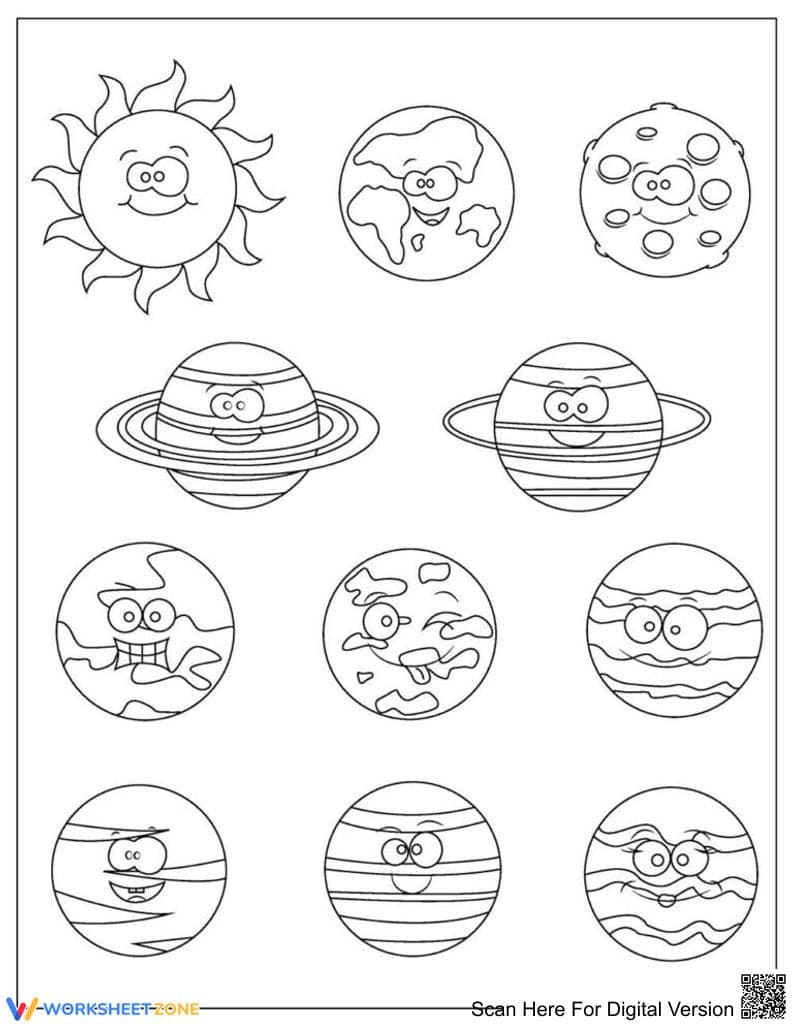

Chibi Solar System Printable Coloring Worksheet
Paste this activity's link or code into your existing LMS (Google Classroom, Canvas, Teams, Schoology, Moodle, etc.).
Students can open and work on the activity right away, with no student login required.
You'll still be able to track student progress and results from your teacher account.
This Grade 1 solar system worksheet provides a creative way for students to engage with celestial bodies. By coloring 11 smiling chibi-style planets and the sun, learners develop fine motor control while building familiarity with the components of our galaxy. It serves as an ideal introductory activity for space units or a relaxing science-themed reward.
At a Glance
- Grade: 1 · Subject: Science
- Standard:
1-ESS1-1— Use observations of the sun, moon, and stars to describe patterns- Skill Focus: Solar system identification
- Format: 1 page · 11 items · No answer key · PDF
- Best For: Science centers and early finishers
- Time: 15–20 minutes
The worksheet features a single-page layout containing 11 distinct celestial illustrations, including the sun and various planets. Each character is designed in a "chibi" aesthetic with large eyes and friendly expressions to reduce anxiety around complex scientific topics. The high-contrast line art ensures clean coloring boundaries for younger students using crayons or markers.
Zero-Prep Workflow
- Print: Generate the single-page PDF for your class size in less than 30 seconds.
- Distribute: Hand out the sheets during a transition period or as part of a dedicated "Space" themed learning station.
- Review: Briefly name the planets as a group while students work to reinforce vocabulary.
This resource requires zero teacher setup and functions as an effective emergency sub plan or quiet-time activity.
Standards Alignment
This resource aligns with `1-ESS1-1`, which requires students to observe and describe objects in the sky. While primarily an artistic exercise, it supports the identification of the sun and planets as distinct entities within the solar system. Both standard codes can be copied directly into lesson plans, IEP goals, or district curriculum mapping tools.
How to Use It
Use this worksheet during the "Engage" phase of a 5E science lesson to spark curiosity about space. It also works well as a formative assessment tool; ask students to color the sun yellow or identify the rings of Saturn to check for basic recognition. Expect students to spend 15 to 20 minutes completing the page depending on their artistic detail.
Who It's For
This activity is designed for Kindergarten through Grade 2 students, particularly those who benefit from tactile engagement. It is an excellent pairing for a read-aloud book about the planets or an introductory anchor chart showing the order of the solar system from the sun. It provides a gentle entry point for English Language Learners to practice space-related nouns.
According to the RAND AIRS 2024 report, integrating visual arts into primary science instruction increases student engagement and retention of domain-specific vocabulary. This worksheet supports standard 1-ESS1-1 by providing a low-stakes environment for students to interact with celestial concepts. Research from Fisher & Frey (2014) emphasizes that instructional frameworks are strengthened when independent tasks include creative elements that reinforce the primary lesson objective. By identifying and coloring 11 unique celestial bodies, students build a mental schema for the solar system that serves as a foundation for more complex astronomical studies in later grades. This printable resource offers a practical, research-backed method for teachers to bridge the gap between abstract space concepts and concrete classroom activities without increasing prep time or requiring expensive materials.


