


























Views
Downloads

Grade Pre-K Ch Digraph — Printable No-Prep Worksheet
Paste this activity's link or code into your existing LMS (Google Classroom, Canvas, Teams, Schoology, Moodle, etc.).
Students can open and work on the activity right away, with no student login required.
You'll still be able to track student progress and results from your teacher account.
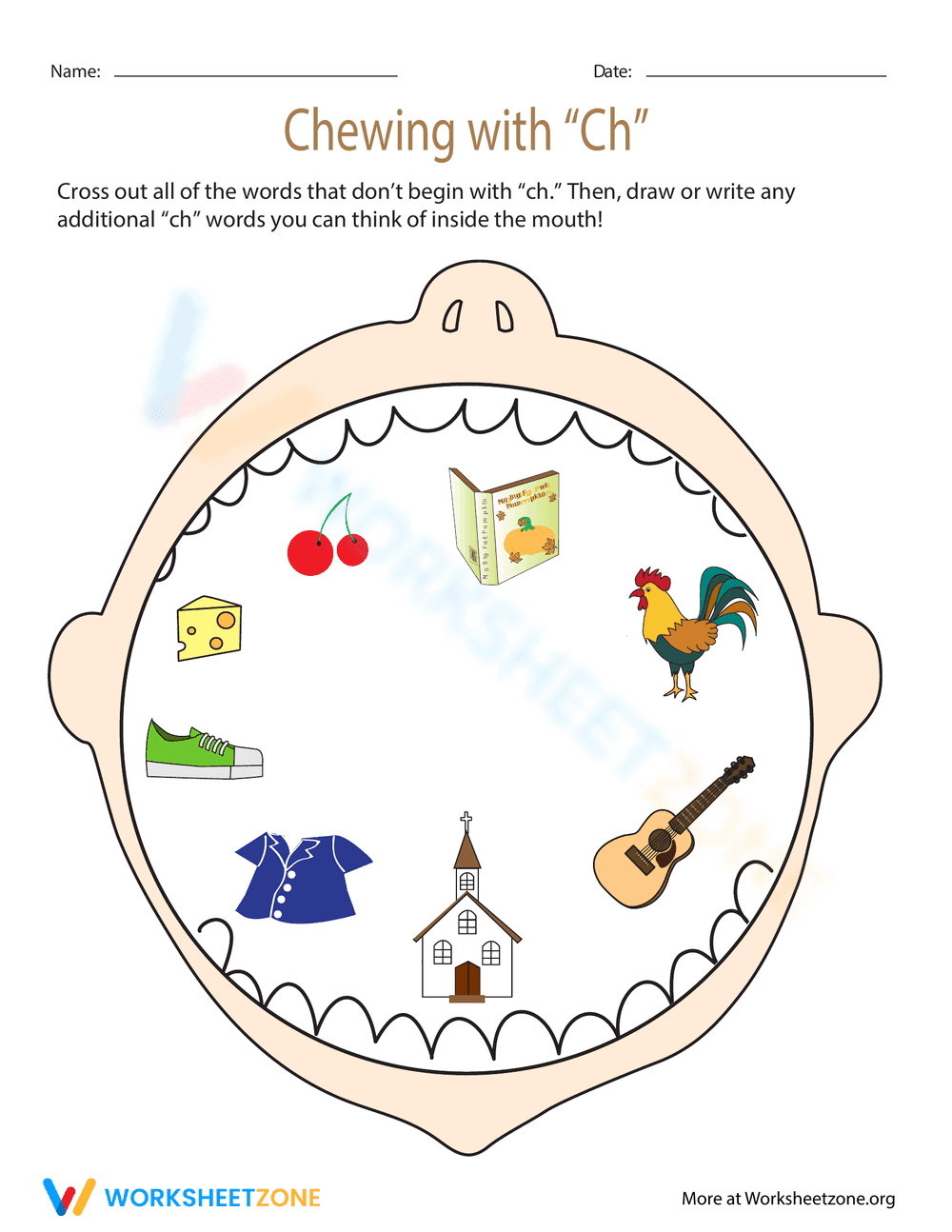
This foundational phonics worksheet develops early phonemic awareness by focusing on the "ch" consonant digraph. Students identify initial sound correspondences through an engaging visual elimination activity. By evaluating illustrated vocabulary items inside a playful graphic mouth, young learners isolate beginning sounds and reinforce essential pre-reading letter-sound connections.
At a Glance
- Grade: Pre-K · Subject: Phonics
- Standard:
CCSS.ELA-LITERACY.RF.K.3.A— Demonstrate basic knowledge of one-to-one letter-sound correspondences for consonant digraphs- Skill Focus: Beginning "ch" digraph sounds
- Format: 1 page · 8 problems · Answer key included · PDF
- Best For: Independent phonics practice
- Time: 10–15 minutes
This single-page worksheet features eight illustrated vocabulary items arranged inside a large graphic mouth. Students evaluate pictures—including cherries, cheese, a shoe, a church, and a guitar—to determine whether each word begins with the "ch" sound. Learners cross out items lacking the target digraph. An extension prompt invites students to draw additional "ch" words directly inside the mouth. A complete answer key is included.
Zero-Prep Workflow
This resource is designed for immediate classroom implementation with minimal teacher setup, making it highly effective for daily phonics routines or substitute plans.
- Print (30 seconds): Generate the single-page PDF worksheet and answer key directly from your digital dashboard.
- Distribute (30 seconds): Hand out the activity sheet along with pencils or crayons for the drawing extension.
- Review (1 minute): Read instructions aloud, modeling one correct example (cherries) and one non-example (shoe).
Total teacher preparation time is under two minutes, providing an efficient solution for early childhood educators.
Standards Alignment
This worksheet aligns directly with primary standard CCSS.ELA-LITERACY.RF.K.3.A, requiring students to demonstrate basic knowledge of one-to-one letter-sound correspondences for consonants. Additionally, it supports CCSS.ELA-LITERACY.RF.K.2.D by asking students to isolate initial sounds in spoken words. Both standard codes can be copied directly into lesson plans, IEP goals, or district curriculum mapping tools.
How to Use It
This worksheet functions effectively across multiple instructional moments. Teachers can assign the activity immediately after direct instruction on consonant digraphs to solidify initial sound recognition. Alternatively, it serves as an independent literacy center station. As a formative-assessment observation tip, teachers should listen to students whisper-read picture names; observing whether a student confuses the "sh" sound in shoe with "ch" in church provides immediate diagnostic data. Expected completion time ranges from 10 to 15 minutes.
Who It's For
This resource is designed for preschool students developing foundational phonemic awareness. For differentiation, teachers can support emerging bilingual students by pre-teaching vocabulary names for each illustration. Advanced learners can be challenged to write words for their drawings. This worksheet pairs naturally with classroom anchor charts displaying common digraph pictures.
Effective early reading instruction relies on explicit phonemic awareness and systematic letter-sound correspondence practice. According to research highlighted in EdReports 2024, foundational literacy materials must provide clear opportunities for young learners to isolate and manipulate initial phonemes to establish strong decoding pathways. This worksheet directly supports these evidence-based practices by focusing on beginning "ch" digraph sounds aligned with CCSS.ELA-LITERACY.RF.K.3.A. By requiring students to actively evaluate visual representations of words and eliminate non-examples, the activity reinforces essential auditory discrimination skills before introducing complex printed text. Structured phonics tasks that combine visual identification with immediate phoneme isolation ensure early learners build the necessary phonological architecture for future reading fluency. Furthermore, integrating multimodal extension tasks, such as drawing new vocabulary items, deepens cognitive engagement and solidifies retention of target consonant digraphs within daily classroom literacy routines.


