


























Views
Downloads
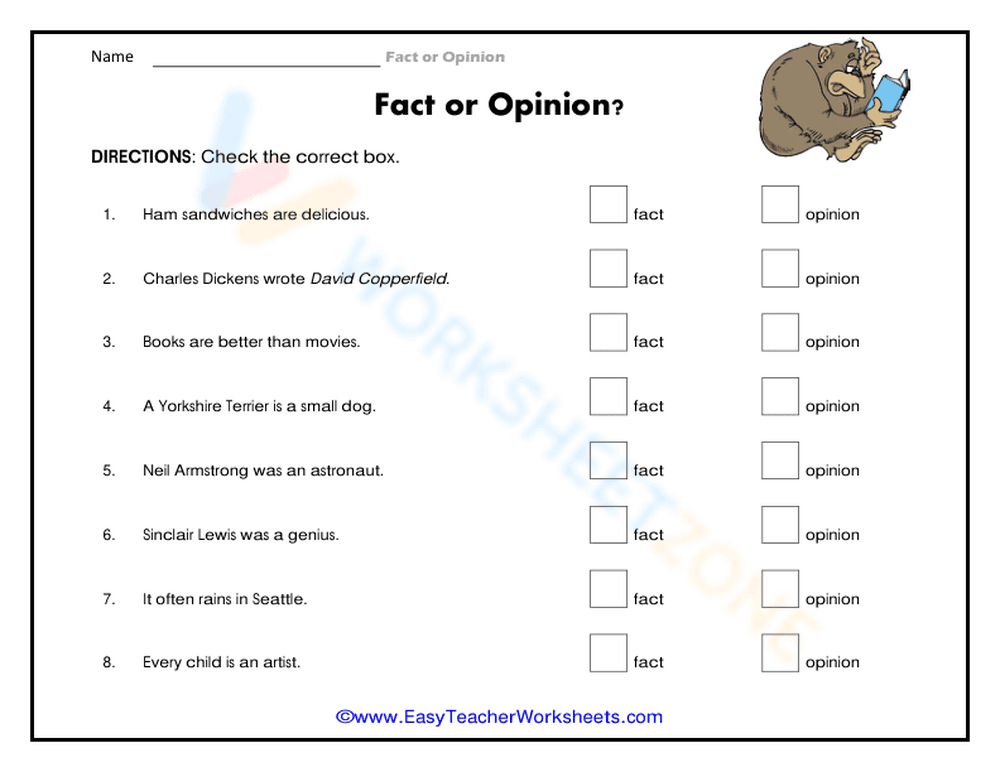

Essential Fact or Opinion Worksheet | Grade 3 Printable
Paste this activity's link or code into your existing LMS (Google Classroom, Canvas, Teams, Schoology, Moodle, etc.).
Students can open and work on the activity right away, with no student login required.
You'll still be able to track student progress and results from your teacher account.
This Grade 3 fact or opinion worksheet helps students master the critical distinction between objective statements and subjective viewpoints. By analyzing eight distinct prompts ranging from historical facts to personal tastes, learners build the analytical skills necessary for reading comprehension and argumentative writing. This resource provides immediate practice in identifying verifiable information versus personal beliefs.
At a Glance
- Grade: 3 · Subject: English Language Arts
- Standard:
CCSS.ELA-LITERACY.RI.3.6— Distinguish their own point of view from that of the author- Skill Focus: Fact vs. Opinion Identification
- Format: 1 page · 8 problems · Answer key included · PDF
- Best For: Independent practice and quick formative assessment
- Time: 10–15 minutes
What's Inside
This single-page PDF features eight numbered exercises designed for clarity and ease of use. Each item presents a statement—such as "Ham sandwiches are delicious" or "Neil Armstrong was an astronaut"—followed by two clear checkboxes labeled "fact" and "opinion." The layout includes a name field and a friendly illustration, making it an inviting task for young learners. A complete answer key is provided for rapid grading.
Zero-Prep Workflow
Teachers can implement this worksheet in three simple steps. First, print the single-page document (30 seconds). Second, distribute it to students for independent or guided work (1 minute). Third, review the answers as a class or individually using the included key (1 minute). With a total prep time of under two minutes, it serves as an ideal emergency sub plan or bell-ringer activity.
Standards Alignment
The primary focus of this worksheet is CCSS.ELA-LITERACY.RI.3.6, which requires students to distinguish their own point of view from that of the author of a text. By evaluating statements like "Books are better than movies," students learn to recognize the markers of subjective perspective. This standard code can be copied directly into lesson plans, IEP goals, or district curriculum mapping tools.
How to Use It
Use this worksheet as a warm-up activity during an informational text unit to check for prior knowledge. Alternatively, assign it as an exit ticket after a lesson on persuasive writing. A key formative-assessment tip is to look for students who struggle with statements of general consensus, like "It often rains in Seattle," versus pure opinion.
Who It's For
This resource is designed for elementary students in Grades 2 through 4, particularly those exploring bias and perspective. It provides a helpful scaffold for English Language Learners through simple sentence structures. Pair this worksheet with a short non-fiction passage or an anchor chart that defines "fact" and "opinion" with concrete examples.
Distinguishing between factual statements and opinions is a foundational literacy skill that directly impacts a student's ability to evaluate the credibility of information. According to RAND AIRS 2024, early mastery of informational text structures, including the identification of objective evidence, is a strong predictor of later success in standardized reading assessments. This Grade 3 worksheet aligns with CCSS.ELA-LITERACY.RI.3.6 by requiring students to classify statements based on verifiability. The eight tasks provide a low-stakes environment for students to practice this plain-English skill of recognizing when an author is sharing a belief rather than a proven truth. By integrating this focused practice into the daily ELA block, educators support the development of critical thinking and media literacy. This printable resource ensures that students can confidently navigate the differences between subjective preferences and objective realities, a skill emphasized by the NAEP framework for reading comprehension.


