


























Views
Downloads
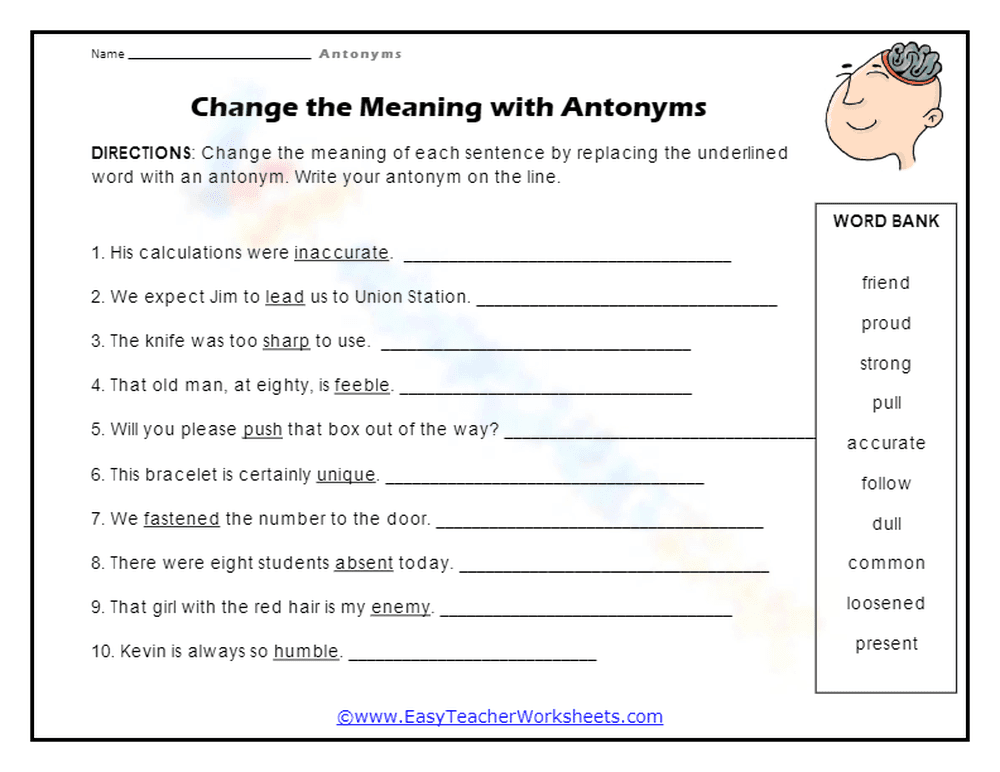

Essential Antonyms Worksheet | Grades 3-5 ELA Ready
Paste this activity's link or code into your existing LMS (Google Classroom, Canvas, Teams, Schoology, Moodle, etc.).
Students can open and work on the activity right away, with no student login required.
You'll still be able to track student progress and results from your teacher account.
Strengthen your students' vocabulary and linguistic flexibility with this focused antonyms worksheet. By identifying and applying opposites within the context of complete sentences, learners move beyond simple rote memorization to active language application. This resource ensures students understand how a single word choice can fundamentally alter the meaning and tone of a statement.
At a Glance
- Grade: 3-5 · Subject: ELA Grammar
- Standard:
CCSS.ELA-LITERACY.L.4.5.c— Demonstrate understanding of words by relating them to their opposites (antonyms)- Skill Focus: Contextual Antonym Substitution
- Format: 1 page · 10 problems · Answer key included · PDF
- Best For: Independent practice and vocabulary warm-ups
- Time: 15–20 minutes
What's Inside
This one-page PDF features ten carefully crafted sentences, each with an underlined target word for students to replace. To support diverse learners, a structured Word Bank is provided on the right, offering immediate scaffolding for vocabulary selection. The clean, distraction-free layout includes clear response lines and an answer key to facilitate quick grading or self-correction sessions.
Zero-Prep Workflow
This zero-prep resource is ideal for busy educators or inclusion in substitute teacher folders. Total teacher preparation time is targeted at under 2 minutes using these steps:
- Print: Generate the single-page PDF for your class (under 1 minute).
- Distribute: Hand out the copies; the Word Bank allows students to begin immediately without extra resources (under 1 minute).
- Review: Use the provided key for instant formative feedback or peer-grading (under 2 minutes).
Standards Alignment
This worksheet is directly aligned with `CCSS.ELA-LITERACY.L.4.5.c`, which requires students to demonstrate understanding of words by relating them to their opposites (antonyms). It also supports broader vocabulary acquisition goals by encouraging students to consider word nuances and context clues. This standard code can be copied directly into lesson plans, IEP goals, or district curriculum mapping tools.
How to Use It
Use this as a high-impact morning work activity or a transition "Do Now" at the start of an ELA block. Alternatively, try a "Think-Pair-Share" where students complete sentences individually then discuss how the antonym changed the statement's tone. Observe if students rely on the Word Bank or generate words independently; this serves as an excellent formative assessment of vocabulary depth.
Who It's For
This resource is designed for Grades 3-5 students mastering vocabulary relationships and descriptive writing. It is highly effective for English Language Learners due to the integrated Word Bank and clear sentence structures. This worksheet pairs naturally with a short reading passage or a direct instruction lesson on word choice and semantic relationships.
According to the RAND AIRS 2024 report, providing students with structured opportunities to manipulate word meanings within context significantly improves long-term vocabulary retention compared to isolated list-based memorization. This Grade 4 antonyms worksheet leverages this principle by requiring students to replace words in complete sentences, thereby reinforcing the standard `CCSS.ELA-LITERACY.L.4.5.c`. By focusing on the plain-English skill of relating words to their opposites, educators can effectively bridge the gap between basic recognition and functional application. The inclusion of a Word Bank aligns with evidence-based practices for tiered vocabulary instruction, ensuring that all learners can access the cognitive demands of the task. Research from NAEP suggests that students who excel in identifying word relationships like antonyms often demonstrate higher overall reading comprehension scores. This resource provides a targeted, 15-minute intervention that can be integrated into any literacy framework to support diverse learner populations.


