




























Views
Downloads
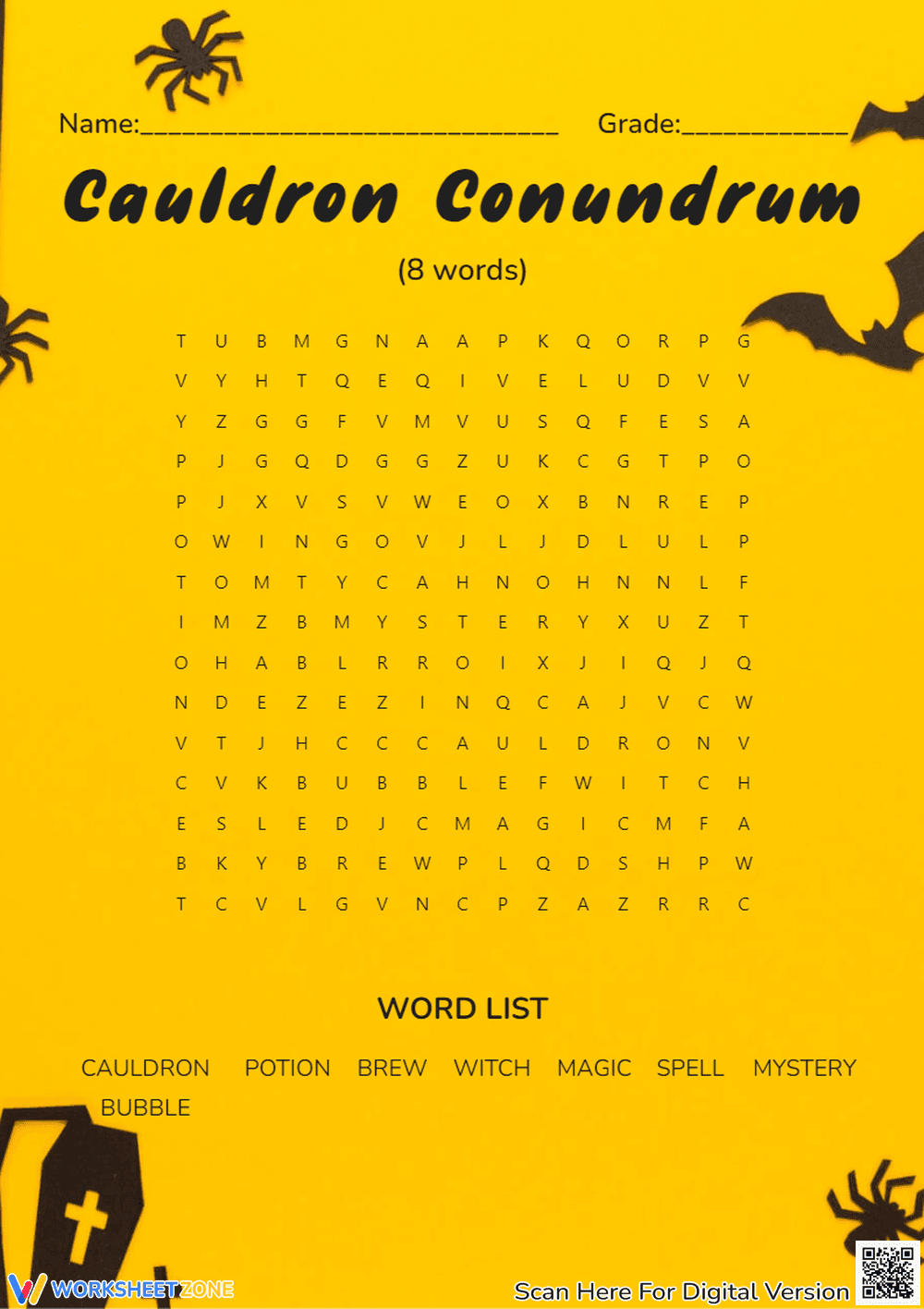

Cauldron Conundrum Word Search | Printable ELA Activity

Paste this activity's link or code into your existing LMS (Google Classroom, Canvas, Teams, Schoology, Moodle, etc.).
Students can open and work on the activity right away, with no student login required.
You'll still be able to track student progress and results from your teacher account.
This Halloween-themed vocabulary worksheet helps elementary students reinforce spelling and word recognition skills through an engaging word search puzzle. Students locate eight cauldron-themed vocabulary terms hidden within the grid, strengthening visual scanning and letter-pattern identification. This activity provides an enjoyable way to build seasonal language skills during independent practice.
At a Glance
- Grade: 2-5 · Subject: Vocabulary
- Standard:
CCSS.ELA-LITERACY.L.3.6— Acquire and use grade-appropriate conversational, general academic, and domain-specific words and phrases- Skill Focus: Word recognition and spelling
- Format: 1 page · 8 problems · Answer key included · PDF
- Best For: Morning work, early finishers, or seasonal vocabulary practice
- Time: 10–15 minutes
This single-page PDF features a clean, themed layout containing a grid of letters and a clear word bank at the bottom. The word bank includes eight specific vocabulary terms: cauldron, potion, brew, witch, magic, spell, mystery, and bubble. The worksheet includes a complete answer key, allowing teachers or students to quickly verify correct word placements.
This resource is designed for an immediate, zero-prep classroom workflow. First, print the single-page PDF document, which takes less than one minute. Second, distribute the sheets directly to students, requiring only thirty seconds of transition time. Third, review the completed puzzles using the included answer key, taking under one minute to verify student work. The total teacher preparation time is under two minutes, making this activity highly suitable for emergency sub plans, transition periods, or seasonal morning work.
This activity aligns directly with the primary standard CCSS.ELA-LITERACY.L.3.6, which requires students to acquire and use grade-appropriate conversational, general academic, and domain-specific words. Additionally, it supports spelling development under CCSS.ELA-LITERACY.L.3.2.F by encouraging students to recognize correct spelling patterns in a visual grid. Both standard codes can be copied directly into lesson plans, IEP goals, or district curriculum mapping tools.
Use this worksheet during two distinct instructional moments. First, assign it as a warm-up activity at the start of a reading block to activate prior knowledge about seasonal themes. Second, use it as a quiet, independent task during center rotations. For a quick formative assessment, observe which students systematically scan the grid row-by-row versus those who search randomly, noting their visual tracking abilities. Students typically complete the puzzle in 10 to 15 minutes.
This worksheet is ideal for general education students in grades 2 through 5, as well as English language learners who benefit from visual word association. Teachers can differentiate the task by providing a highlighter for students who need visual support, or by asking advanced students to write a short story using all eight vocabulary words. Pair this activity with a read-aloud Halloween story or a seasonal anchor chart.
This vocabulary worksheet aligns with CCSS.ELA-LITERACY.L.3.6 to support word recognition and spelling acquisition. According to research from Fisher & Frey (2014) on vocabulary development, structured word play and puzzle-based activities reinforce orthographic mapping and help students solidify their understanding of letter sequences. By identifying the eight themed words in the grid, students engage in active visual processing that aids long-term lexical retrieval. This resource provides a practical application of these principles, offering teachers a reliable tool for low-stakes formative assessment and vocabulary reinforcement. The inclusion of a clear word bank supports diverse learners by reducing cognitive load during the search process, ensuring that students focus on letter patterns and spelling structures. The worksheet serves as an effective supplement to direct vocabulary instruction, helping to bridge the gap between word recognition and active usage in writing.


