




























Views
Downloads

Printable Cat Handwriting Worksheet | Grade 2

Paste this activity's link or code into your existing LMS (Google Classroom, Canvas, Teams, Schoology, Moodle, etc.).
Students can open and work on the activity right away, with no student login required.
You'll still be able to track student progress and results from your teacher account.
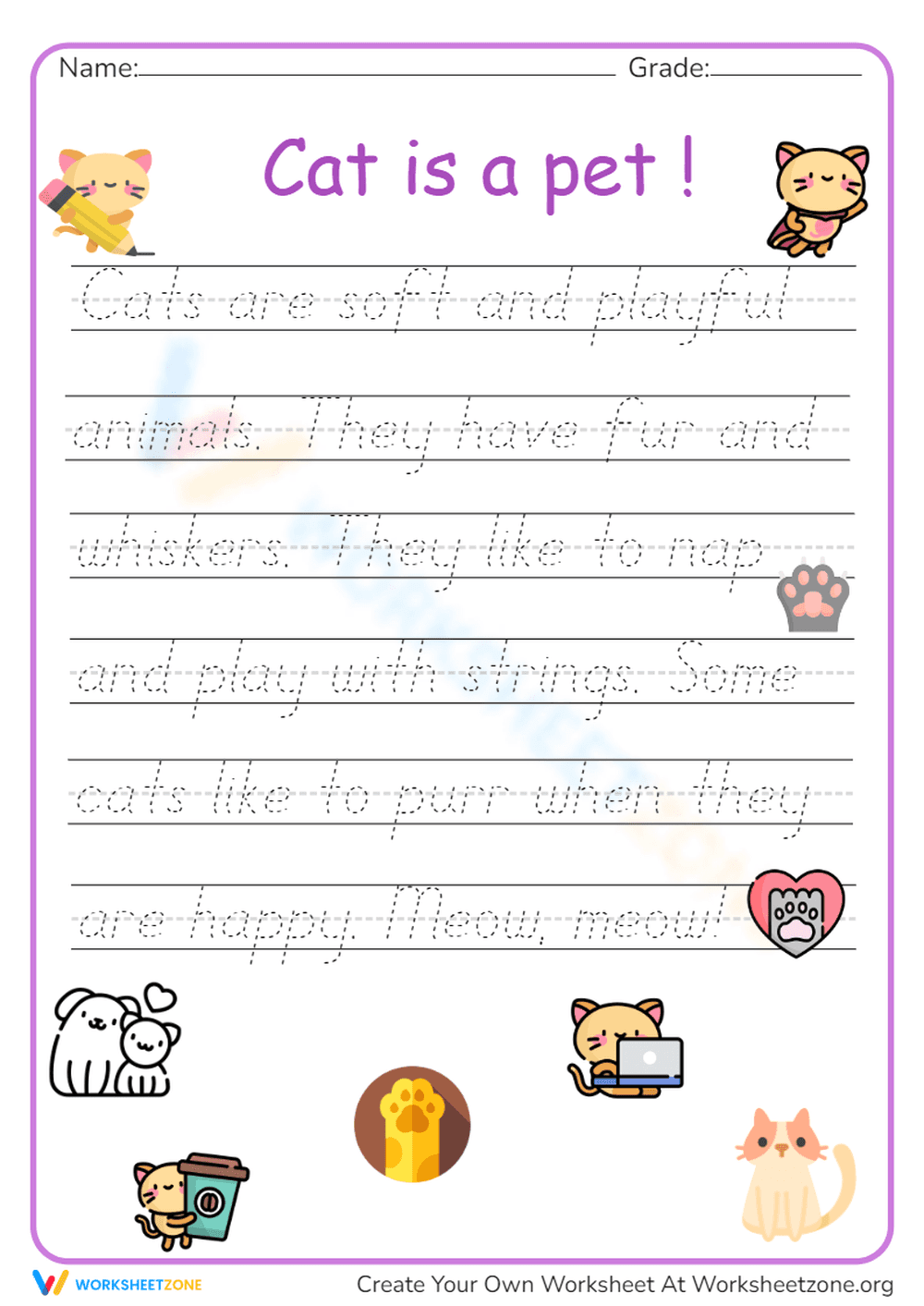
This Grade 2 handwriting worksheet provides students with focused sentence tracing practice to improve letter formation and fine motor control. By tracing engaging facts about cats, young learners build confidence in their print handwriting while reinforcing basic sentence structure, capitalization, and punctuation.
At a Glance
- Grade: 2 · Subject: Handwriting
- Standard:
CCSS.ELA-LITERACY.L.2.2— Write sentences with correct capitalization and punctuation- Skill Focus: Print letter formation and tracing
- Format: 1 page · 6 problems · No answer key needed · PDF
- Best For: Morning work or literacy centers
- Time: 10–15 minutes
Inside this single-page resource, educators will find a highly structured tracing activity featuring a short paragraph about cats. The worksheet includes six dotted-line sentences that guide students through proper letter sizing and spacing. Fun, kid-friendly illustrations of cats and paws decorate the margins, keeping students engaged as they trace words like "whiskers," "playful," and "purr." The clear, primary-style font ensures that students have an accurate model for their own handwriting development.
This resource offers a zero-prep workflow for busy teachers.
- Print (1 minute): Download the PDF and print a class set.
- Distribute (1 minute): Hand out during morning routines. The task is self-explanatory, requiring no teacher setup.
- Review (1 minute): Scan student work to ensure correct letter formation.
With total prep time under two minutes, it is perfect for sub plans.
This worksheet is aligned to CCSS.ELA-LITERACY.L.2.2, requiring students to demonstrate command of the conventions of standard English capitalization, punctuation, and spelling when writing. As students trace the provided sentences, they internalize the mechanics of starting with a capital letter and ending with appropriate punctuation marks. Both standard codes can be copied directly into lesson plans, IEP goals, or district curriculum mapping tools.
Teachers can utilize this handwriting practice during morning work to establish a calm, focused classroom environment before direct instruction begins. It also serves as an excellent independent activity for literacy centers while the teacher conducts small reading groups. As a formative assessment observation tip, watch how students grip their pencils and whether they trace letters from top to bottom. Expected completion time ranges from 10 to 15 minutes, depending on the student's fine motor proficiency.
This resource is primarily designed for second and third-grade students who need targeted reinforcement in print handwriting and fine motor stamina. It is easily differentiated for occupational therapy sessions or special education students who benefit from heavy visual scaffolding and dotted-line guides. For a complete lesson, pair this tracing activity with a read-aloud book about cats or a direct instruction mini-lesson on identifying nouns and adjectives within the traced text.
Developing automaticity in handwriting is a critical foundational skill that directly impacts a student's ability to express complex ideas in later grades. When students practice writing sentences with correct capitalization and punctuation, as outlined in CCSS.ELA-LITERACY.L.2.2, they reduce the cognitive load required for basic transcription. According to Fisher & Frey (2014), providing structured, repetitive practice with clear models allows learners to internalize these essential conventions, freeing up working memory for higher-order composition tasks. This targeted tracing worksheet supports that cognitive transition by offering a low-stakes, highly scaffolded environment for fine motor development. By integrating engaging thematic content with rigorous mechanical practice, educators can foster both writing stamina and technical accuracy. Consistent application of these guided exercises ensures that young writers build the muscle memory necessary for fluent, legible communication across all academic subjects.


