


























Views
Downloads

Printable Proper Nouns Capitalization Worksheet | Grade 1
Paste this activity's link or code into your existing LMS (Google Classroom, Canvas, Teams, Schoology, Moodle, etc.).
Students can open and work on the activity right away, with no student login required.
You'll still be able to track student progress and results from your teacher account.
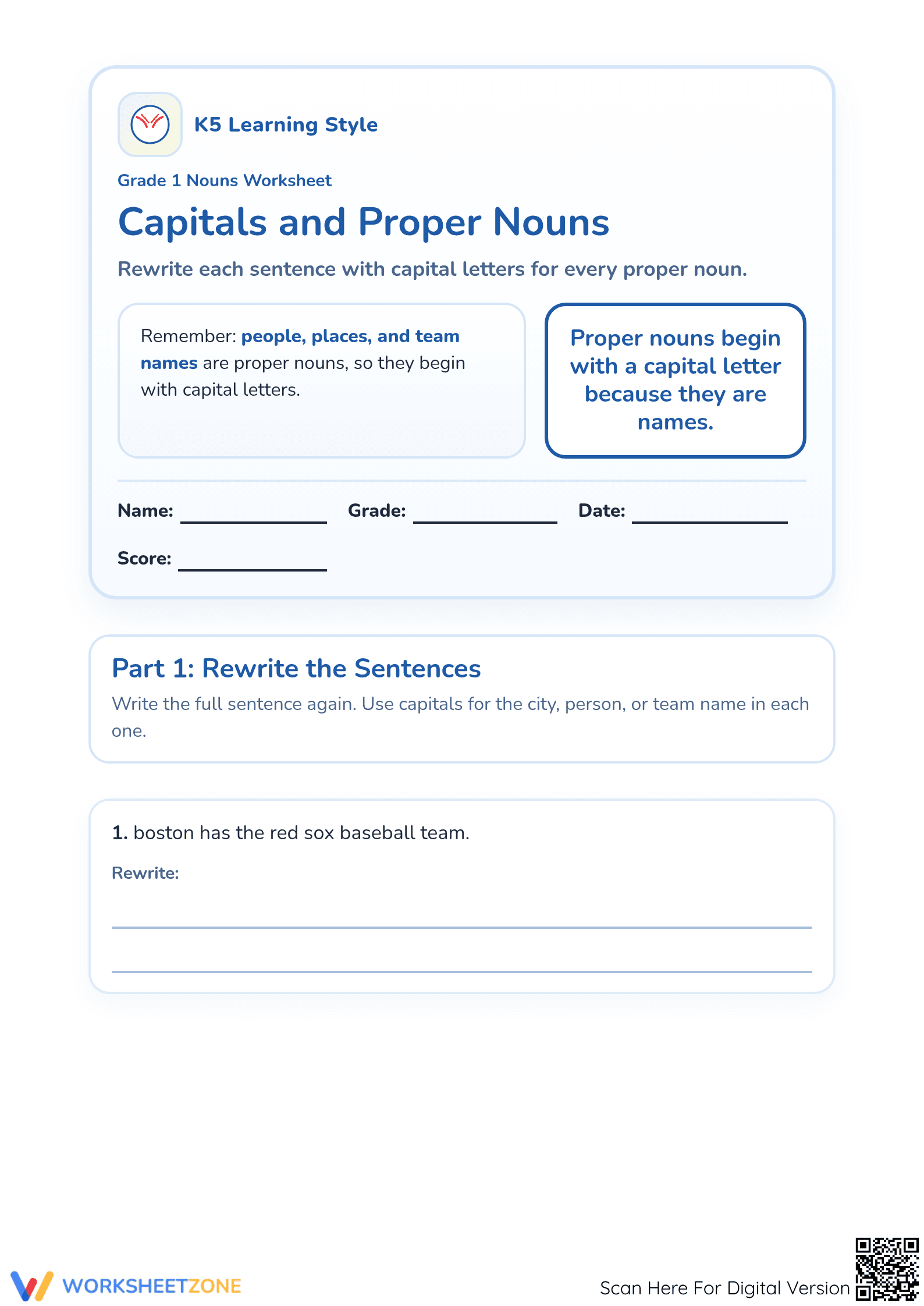
Students master the mechanics of capitalizing proper nouns through this targeted Grade 1 English Language Arts worksheet. By rewriting nine sentences that feature lowercase names of people, places, and sports teams, learners develop the essential ability to apply formal writing conventions. This resource ensures that students can distinguish between common and proper nouns in diverse, real-world contexts.
At a Glance
- Grade: 1 · Subject: English Language Arts · Category: Lexical Word Classes
- Standard:
CCSS.ELA-LITERACY.L.1.2.A— Capitalize dates and names of people in daily written sentences- Skill Focus: Proper Noun Capitalization (People, Places, and Teams)
- Format: 3 Printable pages · 9 Structured problems · Full answer key included · PDF
- Best For: Literacy centers, independent grammar practice, or morning work routines
- Time: 15–20 minutes
What's Inside
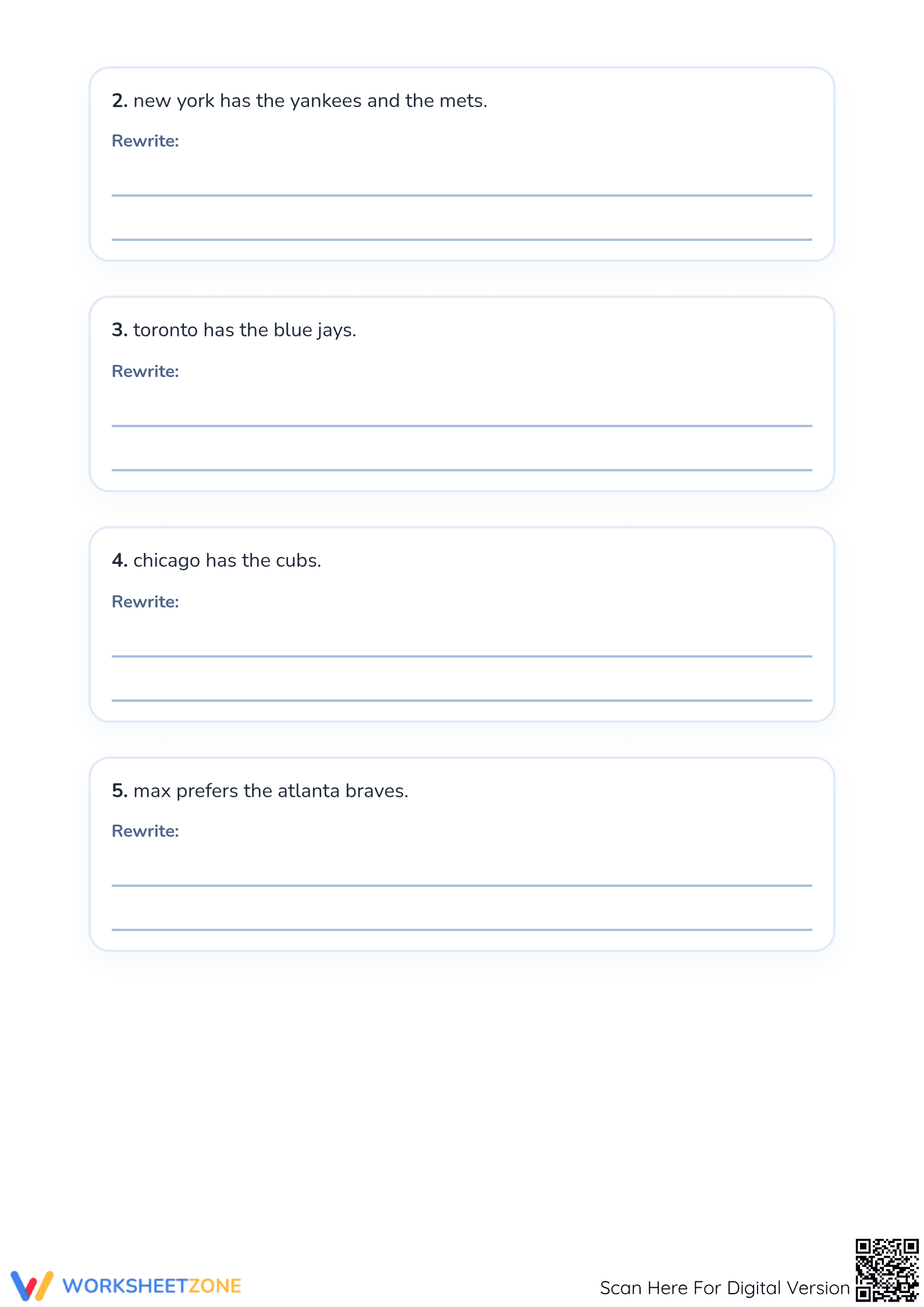
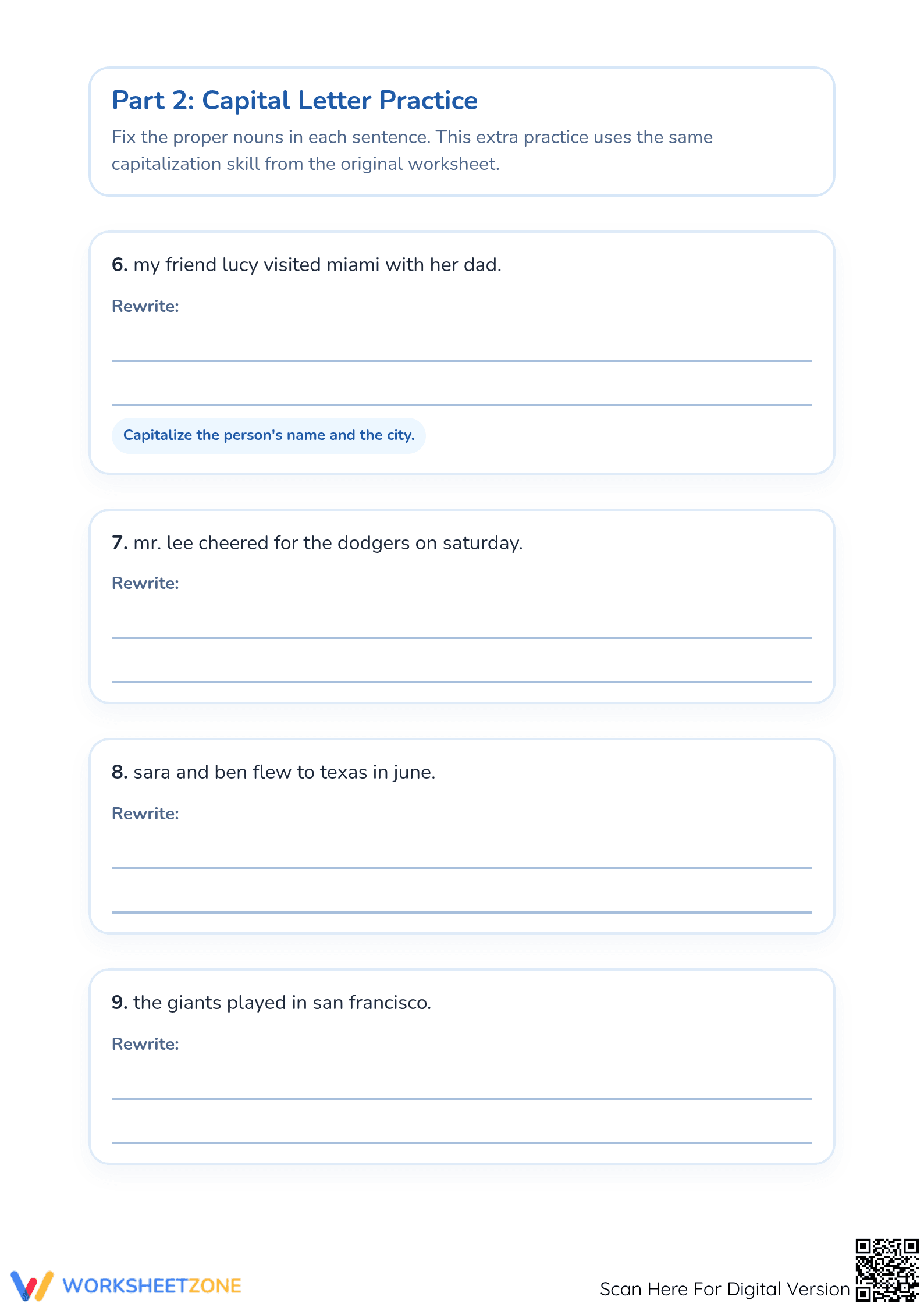
The resource contains three structured pages of sentence-correction exercises. It begins with a clear instructional box defining proper nouns as people, places, and team names. Part 1 features five sentences focused on cities and sports teams, while Part 2 provides four additional practice sentences including people's names and states. A complete answer key ensures easy grading for teachers or parents.
Skill Progression
- Guided Practice: The worksheet opens with explicit definitions and a modeled example, allowing students to see the transition from lowercase to capitalized proper nouns across initial problems.
- Supported Practice: Students tackle problems involving compound proper nouns like 'Red Sox,' reinforcing that every part of a specific name requires a capital letter.
- Independent Practice: The final problems remove hints, requiring students to identify and fix errors in sentences involving names and cities without direct prompting.
This release strategy ensures students move from recognition to mastery using the gradual release of responsibility model.
Standards Alignment
The primary alignment is CCSS.ELA-LITERACY.L.1.2.A, which mandates that students capitalize the names of people. This worksheet extends that reach to include specific places and teams, which falls under the broader noun classification in CCSS.ELA-LITERACY.L.1.1.B. Both standard codes can be copied directly into lesson plans, IEP goals, or district curriculum mapping tools.
How to Use It
Assign this during the independent practice portion of a direct instruction lesson on capitalization. Before students begin, use the first problem as a whole-class demonstration. For a formative assessment, observe if students remember to capitalize multi-word names like 'San Francisco'; if they only capitalize one word, it indicates a need for targeted re-teaching. Completion typically takes 18 minutes.
Who It's For
This is designed for first-grade students or second-grade learners requiring foundational grammar review. It is an excellent pairing for a reading passage about cities or sports teams. The clear, uncluttered layout supports students with executive functioning challenges, providing enough white space for legible handwriting without sensory overload or unnecessary distractions.
According to the research of Fisher & Frey (2014) on the gradual release of responsibility, structured practice that transitions from explicit modeling to independent application is vital for internalizing grammatical mechanics. This resource applies that methodology to CCSS.ELA-LITERACY.L.1.2.A by focusing on the specific skill of proper noun capitalization. Students must move beyond simple identification to active correction, which requires a higher level of cognitive processing than circling a word. By targeting names of people, cities, and teams, the worksheet provides a wide breadth of lexical examples that students encounter in everyday texts. Providing 9 focused problems allows for enough repetition to achieve fluency without causing task fatigue in Grade 1 learners. Standardized formatting and the inclusion of a full answer key make this an essential tool for evidence-based ELA instruction. This summary serves as a citation-ready overview for district-level curriculum audits.


