




























Views
Downloads

Capitalize Titles Worksheet | Grade 1 Essential Practice

Paste this activity's link or code into your existing LMS (Google Classroom, Canvas, Teams, Schoology, Moodle, etc.).
Students can open and work on the activity right away, with no student login required.
You'll still be able to track student progress and results from your teacher account.
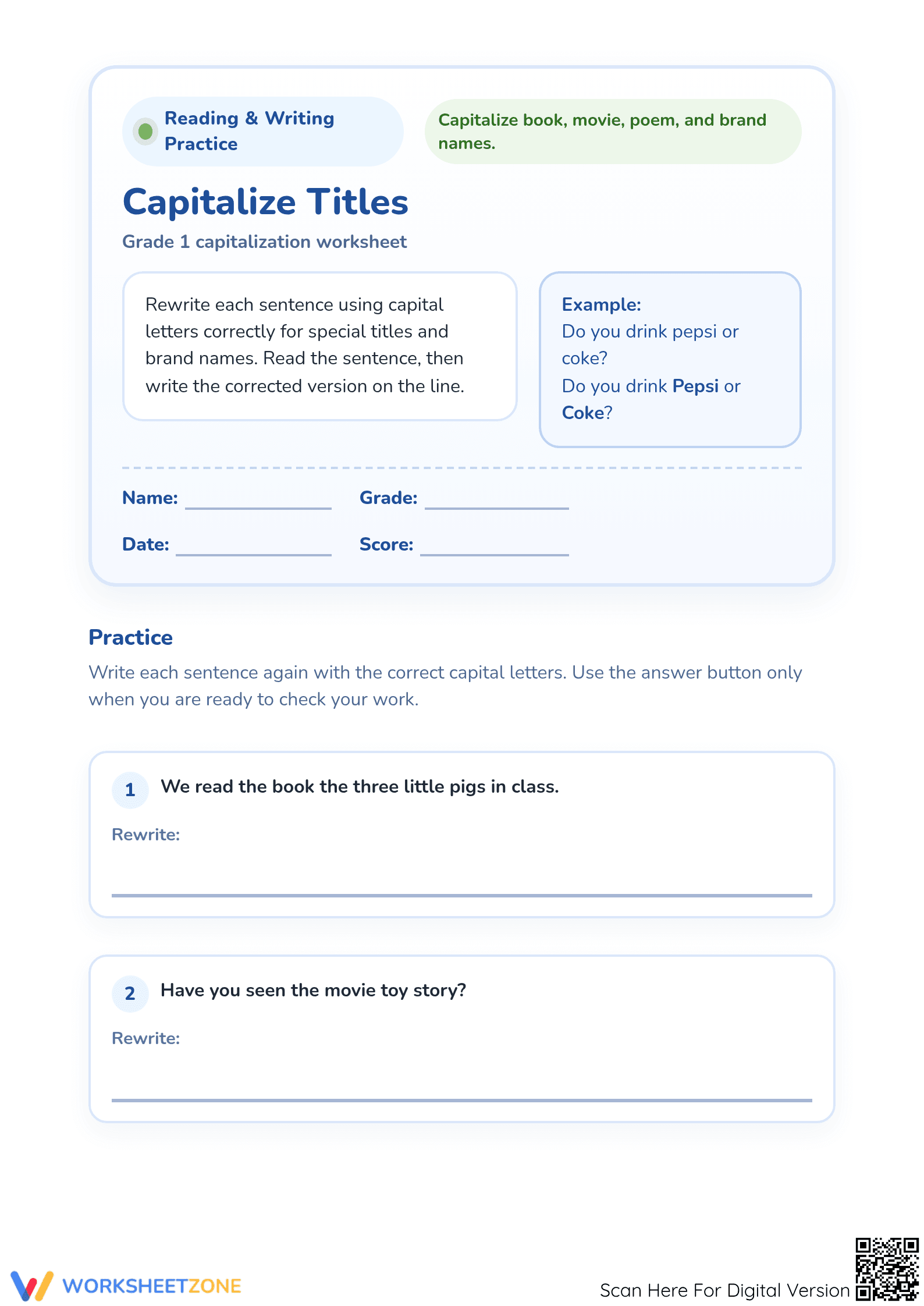
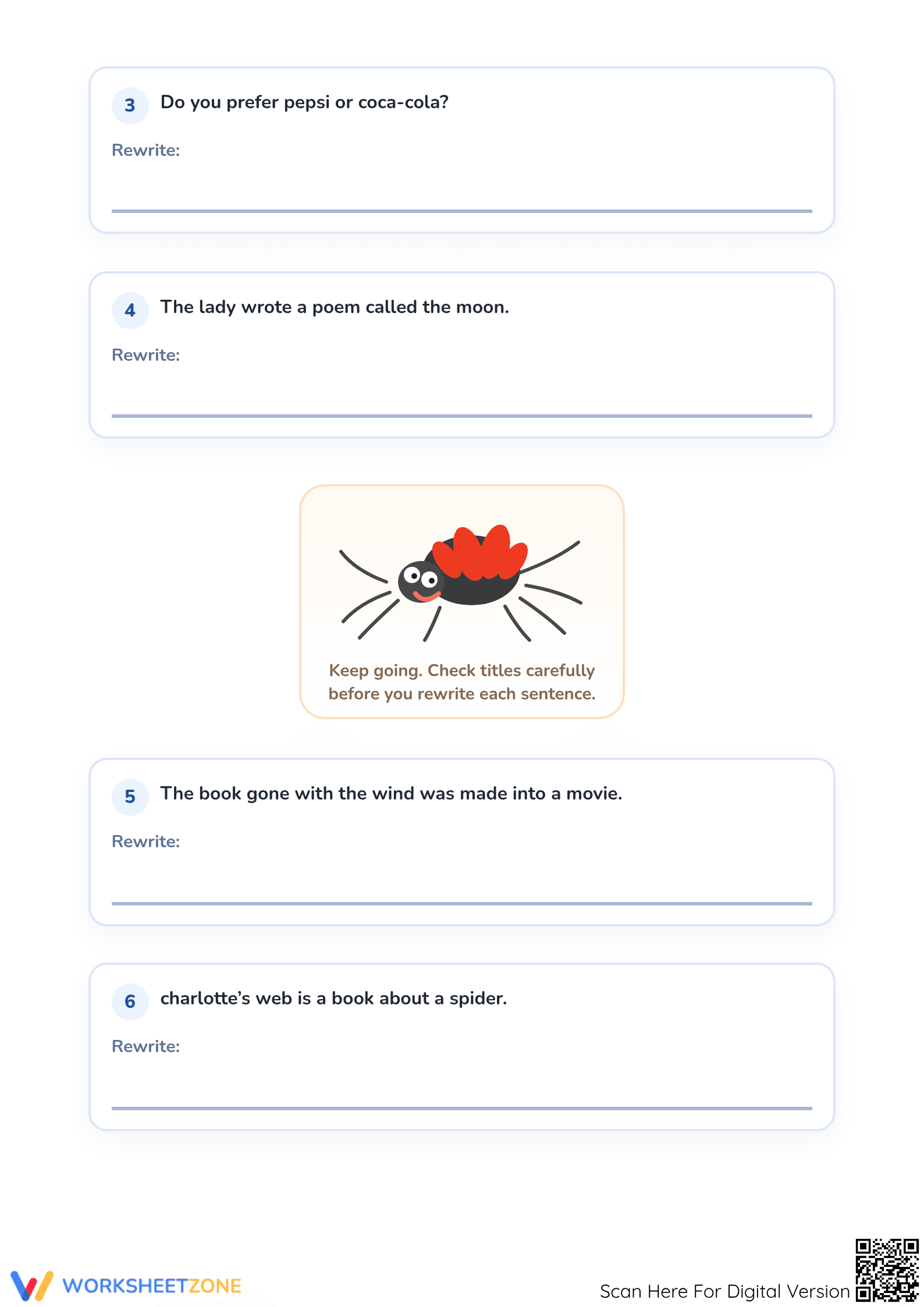
This Grade 1 ELA worksheet provides targeted practice for capitalizing titles of books, movies, poems, and brand names. Students learn to identify proper nouns within sentences and apply correct capitalization rules through rewriting exercises. By focusing on real-world examples like "Toy Story" and "Pepsi," learners build foundational grammar skills necessary for clear and professional writing.
At a Glance
- Grade: 1 · Subject: ELA
- Standard:
CCSS.ELA-LITERACY.L.1.2— Capitalize proper nouns including titles and brand names in sentences- Skill Focus: Capitalization of titles and brands
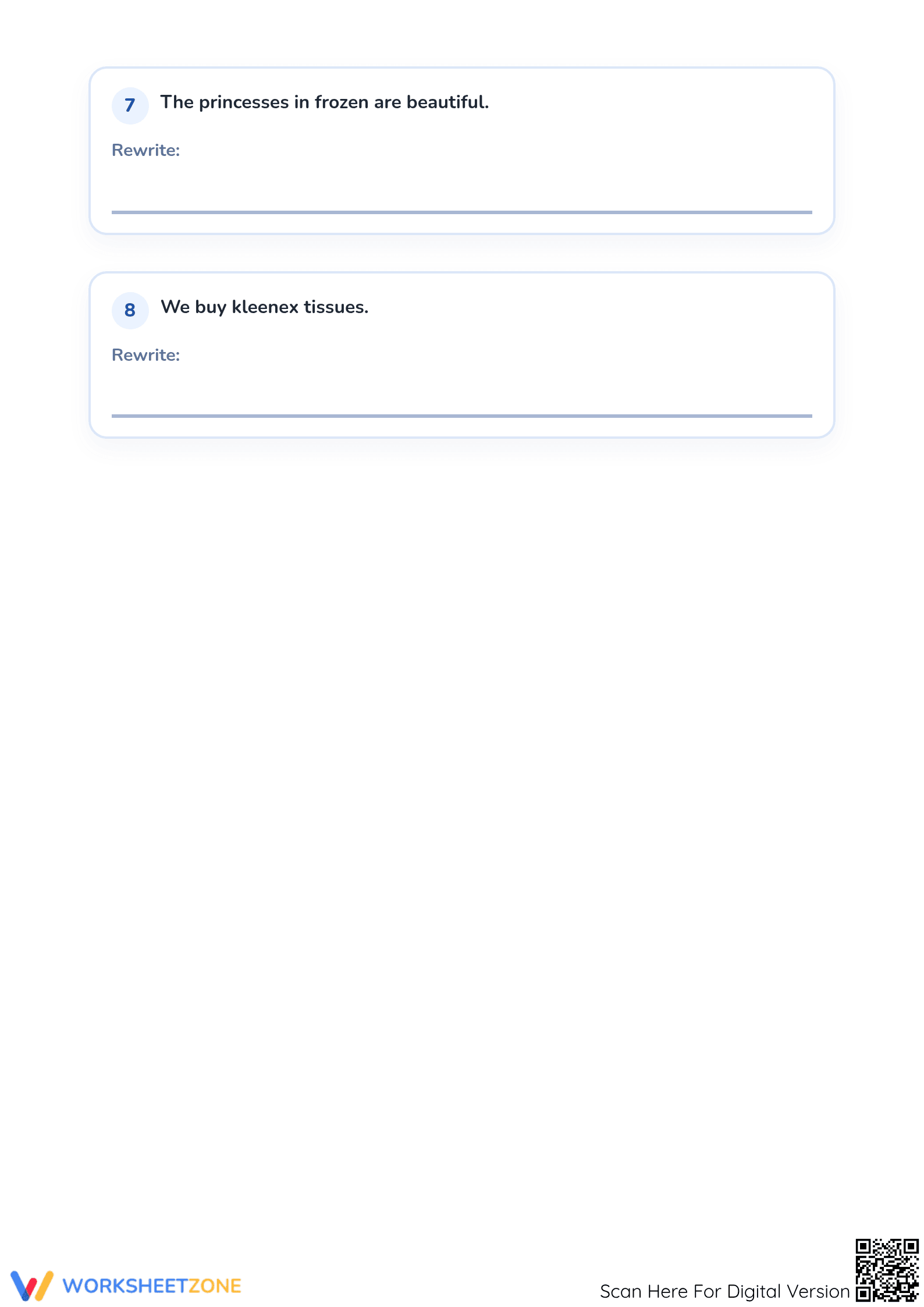
- Format: 3 pages · 8 problems · Answer key included · PDF
- Best For: Independent practice or morning work
- Time: 15–20 minutes
What's Inside: This three-page PDF contains eight distinct sentence-rewriting tasks. Each page features large, clear text boxes for student responses. The first page includes a helpful example box that demonstrates the transformation from lowercase to capitalized proper nouns. A comprehensive answer key is provided for all eight items, allowing for quick grading or student self-correction.
Zero-Prep Workflow: This resource is designed for immediate classroom implementation. First, print the three activity pages (1 minute). Second, distribute the sheets to students during your grammar block or as a transition activity (30 seconds). Finally, use the included answer key to review the eight sentences as a whole group or during individual check-ins (under 1 minute). Total teacher preparation time is less than two minutes.
Standards Alignment: The primary focus is `CCSS.ELA-LITERACY.L.1.2`, which requires students to demonstrate command of the conventions of standard English capitalization, punctuation, and spelling when writing. Specifically, it targets the identification and capitalization of proper nouns within the context of a complete sentence. Both standard codes can be copied directly into lesson plans, IEP goals, or district curriculum mapping tools.
How to Use It: Use this worksheet as a formative assessment after a direct instruction lesson on proper nouns. It works exceptionally well as a "Show What You Know" exit ticket. While students work, observe if they are capitalizing only the first letter of the title or every word, which provides a perfect opportunity for immediate corrective feedback. Expect completion in approximately 15 to 20 minutes.
Who It's For: This resource is ideal for first-grade students who are beginning to distinguish between common and proper nouns. It is also suitable for second-grade review or English Language Learners (ELL) who need explicit practice with English capitalization conventions. Pair this with a favorite classroom picture book to have students practice identifying the title on the cover.
This Grade 1 ELA resource targets CCSS.ELA-LITERACY.L.1.2 by focusing on the capitalization of titles and brand names. Research from Fisher & Frey (2014) emphasizes the importance of the gradual release of responsibility, which this worksheet supports through its clear example and structured rewriting tasks. By engaging with eight specific practice items, students move from recognizing errors to producing correct grammatical structures. The inclusion of familiar cultural references like movies and books helps bridge the gap between abstract grammar rules and concrete application. According to the RAND AIRS 2024 report, high-quality instructional materials that provide immediate feedback opportunities—such as the included answer key—significantly improve student mastery of language conventions. This worksheet serves as a reliable tool for teachers seeking to reinforce foundational literacy skills without extensive preparation time, ensuring that students meet grade-level expectations for written English.


