


























Views
Downloads
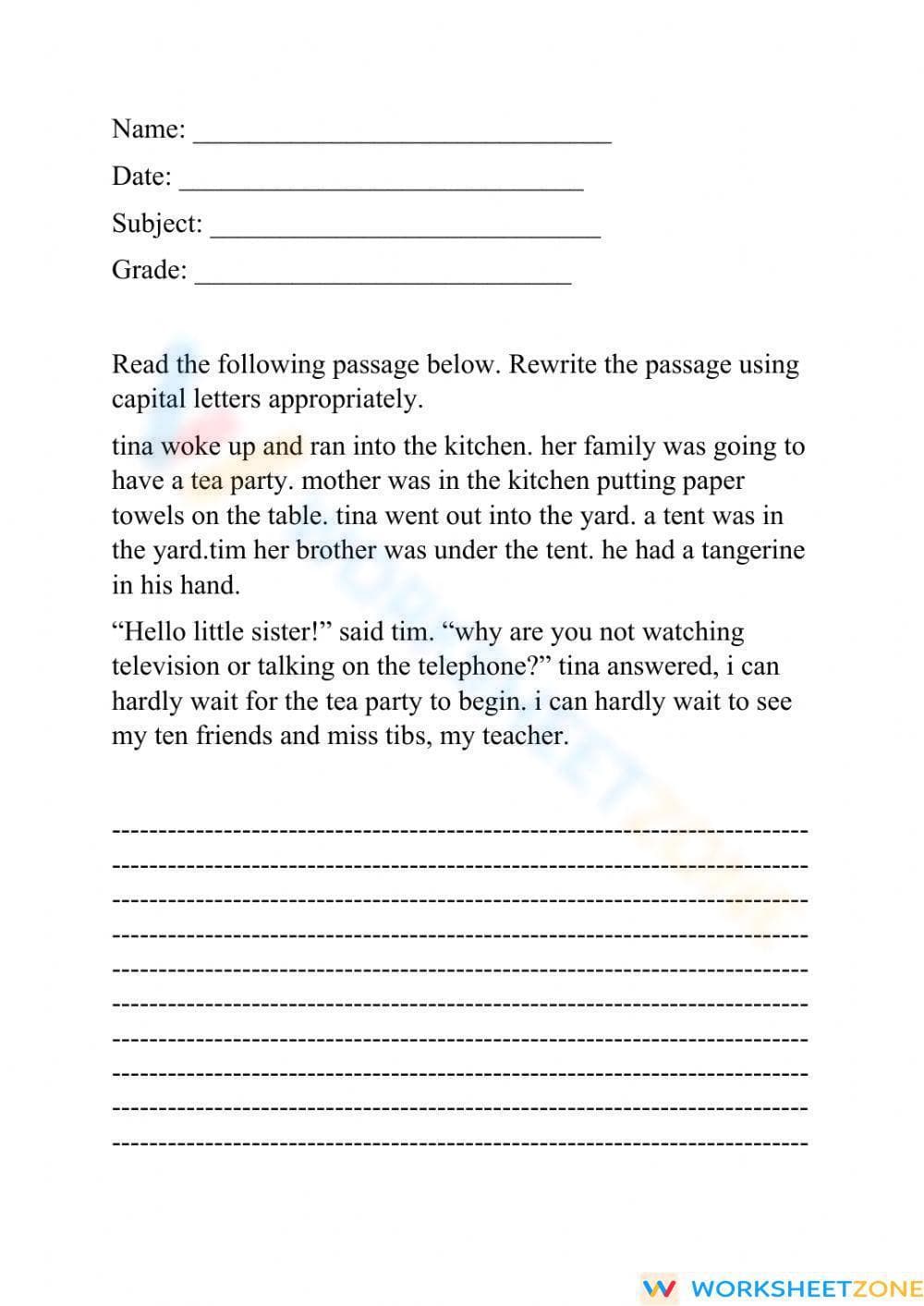


Grade 2 Capitalization — Printable No-Prep Worksheet
Paste this activity's link or code into your existing LMS (Google Classroom, Canvas, Teams, Schoology, Moodle, etc.).
Students can open and work on the activity right away, with no student login required.
You'll still be able to track student progress and results from your teacher account.
This ready-to-use worksheet offers targeted practice for second and third graders on essential capitalization rules. Students read a short passage and rewrite it, correctly capitalizing sentence beginnings, proper nouns, and the pronoun "I". The single-page format provides a focused way to reinforce fundamental writing conventions.
At a Glance
- Grade: 2–3 · Subject: ELA
- Standard:
CCSS.ELA-LITERACY.L.2.2— Use standard English capitalization conventions when writing.- Skill Focus: Capitalizing sentence beginnings, names, and the pronoun "I"
- Format: 1 page · 1 editing task · Answer key included · PDF
- Best For: Independent practice, morning work, grammar review
- Time: 10–15 minutes
A Seamless Addition to Your ELA Block
This resource is a single-page PDF designed for immediate use. The page features a paragraph with several deliberate capitalization errors. Below the passage, lines are provided for students to rewrite the text correctly. A comprehensive answer key is included for quick grading or student self-correction.
Designed for the busy teacher, this capitalization worksheet requires virtually no prep. The entire workflow can be completed in minutes.
- Print (1 min): The resource is a single, self-contained page. Simply print copies for your class.
- Distribute (1 min): With clear instructions, students can begin work immediately. No extensive explanation is needed.
- Review (5 mins): Use the provided answer key to review the corrected passage with the class or have students check their own work.
This makes the worksheet excellent for sub plans or a quick grammar warm-up.
Standards-Aligned for Core Instruction
This worksheet directly supports skills in the Common Core State Standards. The primary standard addressed is CCSS.ELA-LITERACY.L.2.2, which requires students to "Demonstrate command of the conventions of standard English capitalization...when writing." This activity provides focused practice on foundational capitalization rules for this grade level. The standard code can be copied directly into lesson plans or curriculum maps.
Flexible Classroom Application
This resource can be integrated into instruction in multiple ways. Use it as a follow-up activity after a direct lesson on capitalization for hands-on practice. Alternatively, assign it as morning work or a literacy center task. For a quick formative assessment, observe which rules students apply correctly and which they miss (e.g., catching names but missing the pronoun "I"). The task is designed for a 10 to 15-minute work block.
Built for Developing Writers
This activity is ideal for second-grade students learning capitalization conventions. It also serves as an effective review for third graders needing reinforcement. The simple task is accessible to most students. Pair this worksheet with a classroom anchor chart displaying key capitalization rules (like the M.I.N.T.S. acronym) to provide extra support.
Effective writing instruction demands targeted practice of conventions, a principle supported by extensive research. This worksheet aligns with findings from the RAND AIRS (2024) report on instructional materials, emphasizing skill-focused tasks. By asking students to edit a passage, the activity addresses CCSS.ELA-LITERACY.L.2.2, where learners must demonstrate command of standard English capitalization. This task gives students a concrete opportunity to apply rules for capitalizing sentence beginnings, names, and the pronoun "I". Such deliberate practice is crucial for building automaticity, allowing students to focus on higher-order writing skills. The worksheet’s design reflects evidence-based practices for grammar instruction, where skills are practiced in the context of authentic sentences.


