


























Views
Downloads

Printable Letter I Tracing Worksheet | Kindergarten ELA
Paste this activity's link or code into your existing LMS (Google Classroom, Canvas, Teams, Schoology, Moodle, etc.).
Students can open and work on the activity right away, with no student login required.
You'll still be able to track student progress and results from your teacher account.
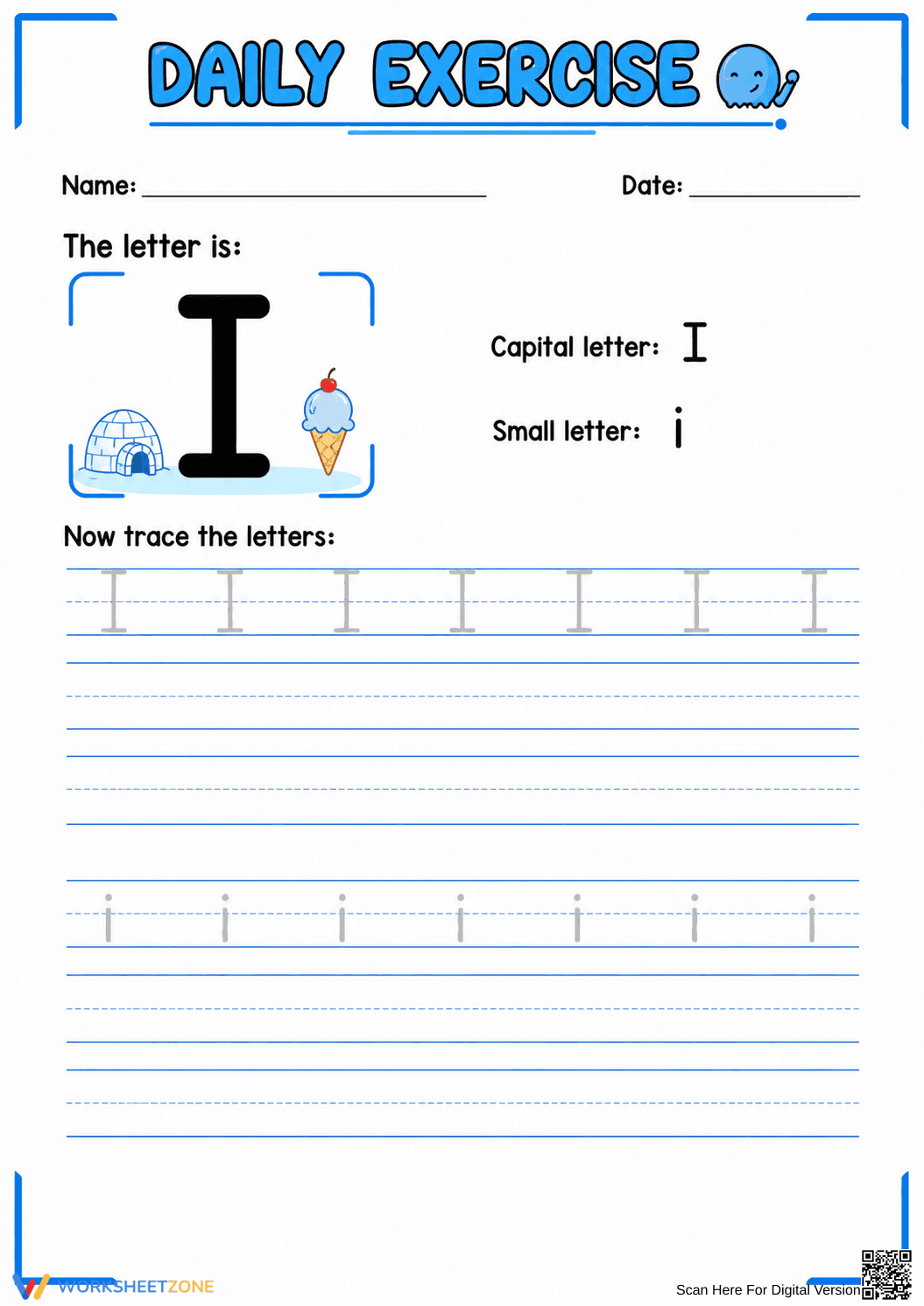
This foundational phonics worksheet helps young learners master the letter I through targeted handwriting practice and visual association. Students build fine motor skills by tracing uppercase and lowercase forms while connecting the letter to familiar beginning sounds like igloo and ice cream.
At a Glance
- Grade: Kindergarten · Subject: ELA
- Standard:
CCSS.ELA-LITERACY.L.K.1.A— Print many upper- and lowercase letters.- Skill Focus: Letter I formation and recognition
- Format: 1 page · 14 problems · No answer key needed · PDF
- Best For: Morning work or literacy centers
- Time: 10–15 minutes
This single-page resource features a clear, uncluttered layout designed specifically for early childhood education. The top section introduces the capital and small letter I alongside engaging illustrations of an igloo and an ice cream cone to reinforce beginning phonics sounds. The bottom section provides standard primary writing lines with dashed guides, offering 14 distinct tracing opportunities for both uppercase and lowercase letter forms.
This resource is designed for immediate classroom implementation with a streamlined workflow:
- Print (1 minute): The high-contrast PDF prints clearly in black and white or color, requiring no special formatting.
- Distribute (1 minute): Hand out the single page directly to students with pencils or crayons.
- Review (1 minute): The intuitive tracing format requires minimal verbal instruction, allowing students to begin working independently right away.
With less than three minutes of total teacher preparation time, this worksheet serves as an excellent emergency sub plan or quick transition activity.
This activity aligns directly with CCSS.ELA-LITERACY.L.K.1.A, requiring students to print many upper- and lowercase letters. It also supports foundational reading skills by pairing the letter with corresponding phonetic images. Both standard codes can be copied directly into lesson plans, IEP goals, or district curriculum mapping tools.
Teachers can utilize this worksheet during morning arrival as a quiet, focused task to start the day. Alternatively, it functions perfectly within a literacy center rotation where students practice handwriting independently. While students trace, educators can conduct quick formative assessments by observing pencil grip and stroke direction, correcting any bottom-to-top letter formation habits early. Most kindergarteners will complete this activity within a 10 to 15-minute timeframe.
This resource is ideal for kindergarten students developing basic handwriting and phonemic awareness. It provides necessary repetition for early writers who need structured guidelines to control their letter sizing. For differentiation, teachers can pair this worksheet with tactile letter-building activities or a direct instruction lesson focusing on the short and long vowel sounds of the letter I.
Effective handwriting instruction remains a critical component of early literacy development. According to a comprehensive EdReports 2024 analysis of foundational reading programs, explicit practice with letter formation directly correlates with improved letter recognition and subsequent decoding skills. By aligning with CCSS.ELA-LITERACY.L.K.1.A, which expects students to print many upper- and lowercase letters, this worksheet provides the exact type of targeted, repetitive motor practice recommended by literacy researchers. When young learners physically trace the letter I, they build the muscle memory required for fluent writing, reducing cognitive load during later composition tasks. This automaticity allows students to focus their mental energy on spelling and expressing ideas rather than the mechanics of drawing shapes. Integrating visual cues like the igloo and ice cream further bridges the gap between physical writing and phonemic awareness, creating a holistic approach to early alphabet mastery.


