


























Views
Downloads
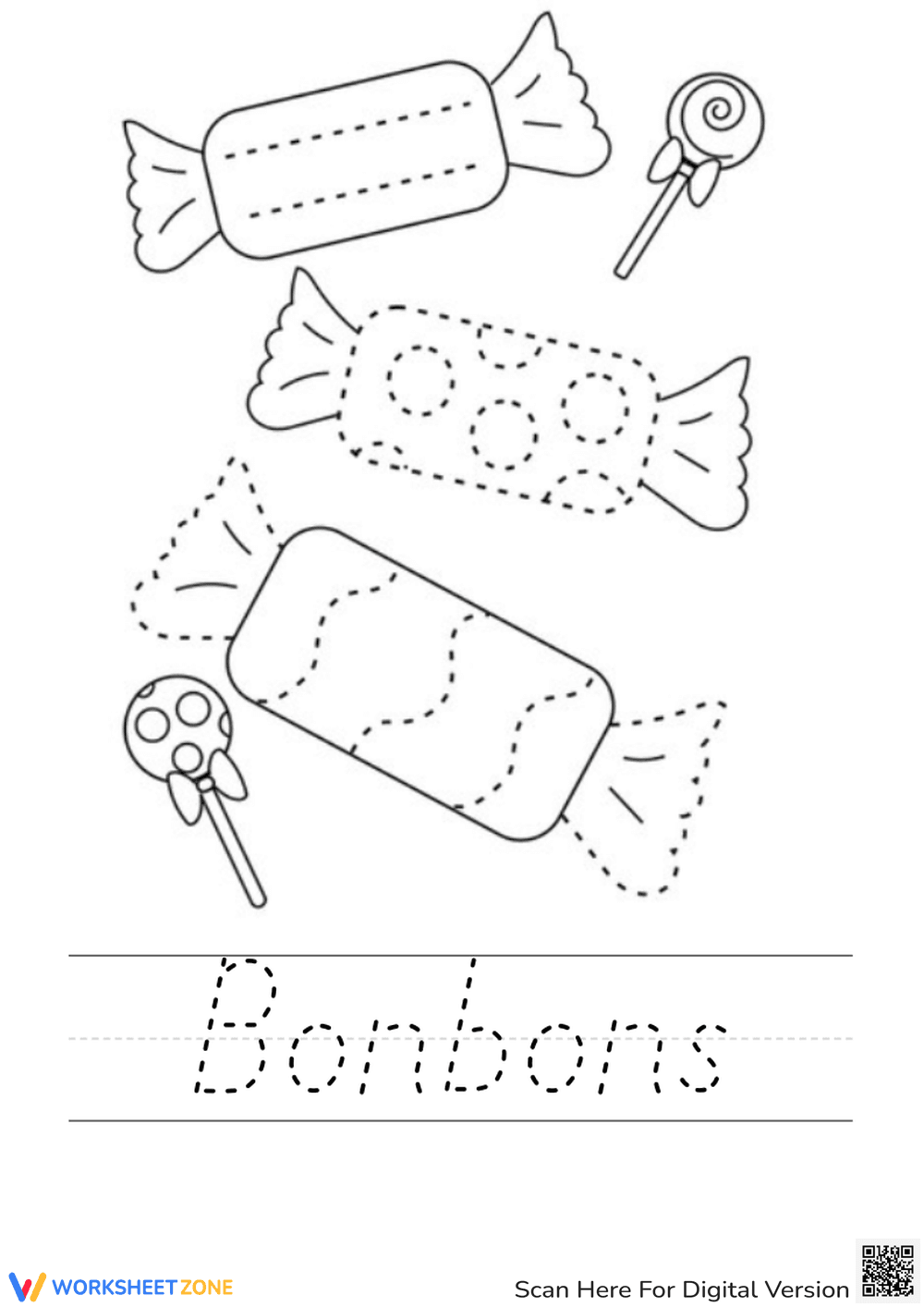

Candy Tracing Worksheet | Essential Kindergarten Handwriting
Paste this activity's link or code into your existing LMS (Google Classroom, Canvas, Teams, Schoology, Moodle, etc.).
Students can open and work on the activity right away, with no student login required.
You'll still be able to track student progress and results from your teacher account.
This Kindergarten handwriting worksheet helps young learners develop essential fine motor control through engaging candy-themed tracing activities. By following dashed lines on various shapes and letters, students strengthen the hand muscles required for fluent writing. It provides a playful yet structured environment for early literacy development and pencil grip mastery.
At a Glance
- Grade: Kindergarten · Subject: Handwriting
- Standard:
CCSS.ELA-LITERACY.L.K.1.A— Print many upper- and lowercase letters with proper form- Skill Focus: Fine motor control and letter tracing
- Format: 1 page · 6 tasks · No answer key needed · PDF
- Best For: Morning work or fine motor centers
- Time: 10–15 minutes
Inside this single-page PDF, you will find five distinct candy illustrations, including lollipops and wrapped bonbons, each featuring dashed paths for tracing. At the bottom of the page, a primary handwriting line features the word "Bonbons" in a large, traceable font. The clear, high-contrast lines ensure that students can easily follow the paths without visual overwhelm.
The zero-prep workflow for this resource is designed for maximum efficiency in a busy classroom. First, print the single-page PDF (30 seconds). Second, distribute the sheets along with crayons or pencils to your students (1 minute). Finally, observe student grip and path-following during the activity, providing immediate verbal feedback. Total teacher preparation time is under two minutes, making it an ideal sub plan addition.
This resource aligns with CCSS.ELA-LITERACY.L.K.1.A, which requires students to print many upper- and lowercase letters. While the top half focuses on pre-writing shapes, the bottom half provides direct practice with letter formation for the word "Bonbons." Both standard codes can be copied directly into lesson plans, IEP goals, or district curriculum mapping tools.
Use this worksheet during the settling in period of morning work or as a dedicated station in a fine motor center. It is particularly effective after a brief direct instruction session on proper pencil grip. Teachers should observe if students are starting their strokes from the top down, which is a key formative assessment indicator for future writing fluency. Expect completion in 10 to 15 minutes.
This worksheet is designed for Kindergarten students, but it also serves as an excellent intervention tool for first graders struggling with line precision. It pairs naturally with alphabet anchor charts or a thematic unit on sweets. The large tracing paths accommodate students still developing their pincer grasp and require minimal teacher supervision once the task is explained.
According to the Fisher & Frey (2014) framework for gradual release of responsibility, providing structured scaffolds like dashed-line tracing is a critical component of the guided practice phase. This worksheet specifically targets CCSS.ELA-LITERACY.L.K.1.A by bridging the gap between abstract shapes and concrete letter formation. Research from the 2024 RAND AIRS report suggests that frequent, short bursts of fine motor practice—such as tracing 6 to 10 items daily—significantly improve handwriting legibility and speed in early elementary learners. By focusing on the plain-English skill of printing letters with proper form, this resource ensures that students develop the muscle memory necessary for more complex writing tasks. The inclusion of both curved and straight dashed lines provides a comprehensive workout for the small muscles in the hand, supporting long-term literacy outcomes and reducing writing fatigue in later grades.


