


























Views
Downloads



7.RP.A.3 Worksheet: Advanced Percentages — Grade 7 Aligned
Paste this activity's link or code into your existing LMS (Google Classroom, Canvas, Teams, Schoology, Moodle, etc.).
Students can open and work on the activity right away, with no student login required.
You'll still be able to track student progress and results from your teacher account.
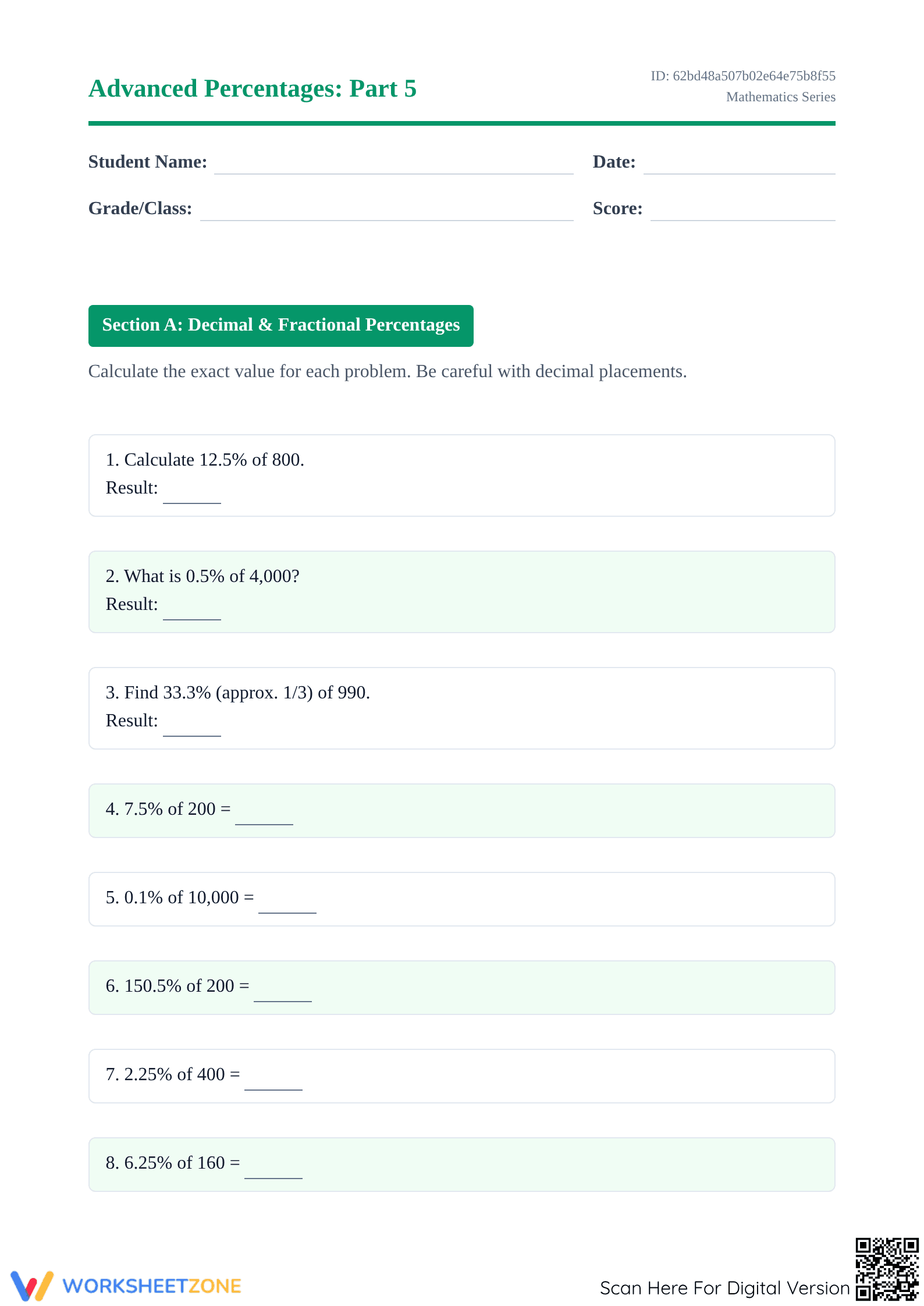
Master complex percentage calculations and real-world financial applications with this comprehensive Grade 7 math resource. Students progress from decimal and fractional percentages to calculating percent change and solving multi-step financial problems. This worksheet ensures deep conceptual understanding and procedural fluency, enabling students to apply ratio and proportional reasoning to everyday fiscal scenarios with accuracy.
At a Glance
- Grade: 7 · Subject: Math
- Standard:
7.RP.A.3— Use proportional relationships to solve multistep ratio and percent problems- Skill Focus: Financial Math & Percent Change
- Format: 5 pages · 36 problems · Answer key included · PDF
- Best For: Mastery Assessment & End-of-Unit Review
- Time: 45–60 minutes
What's Inside
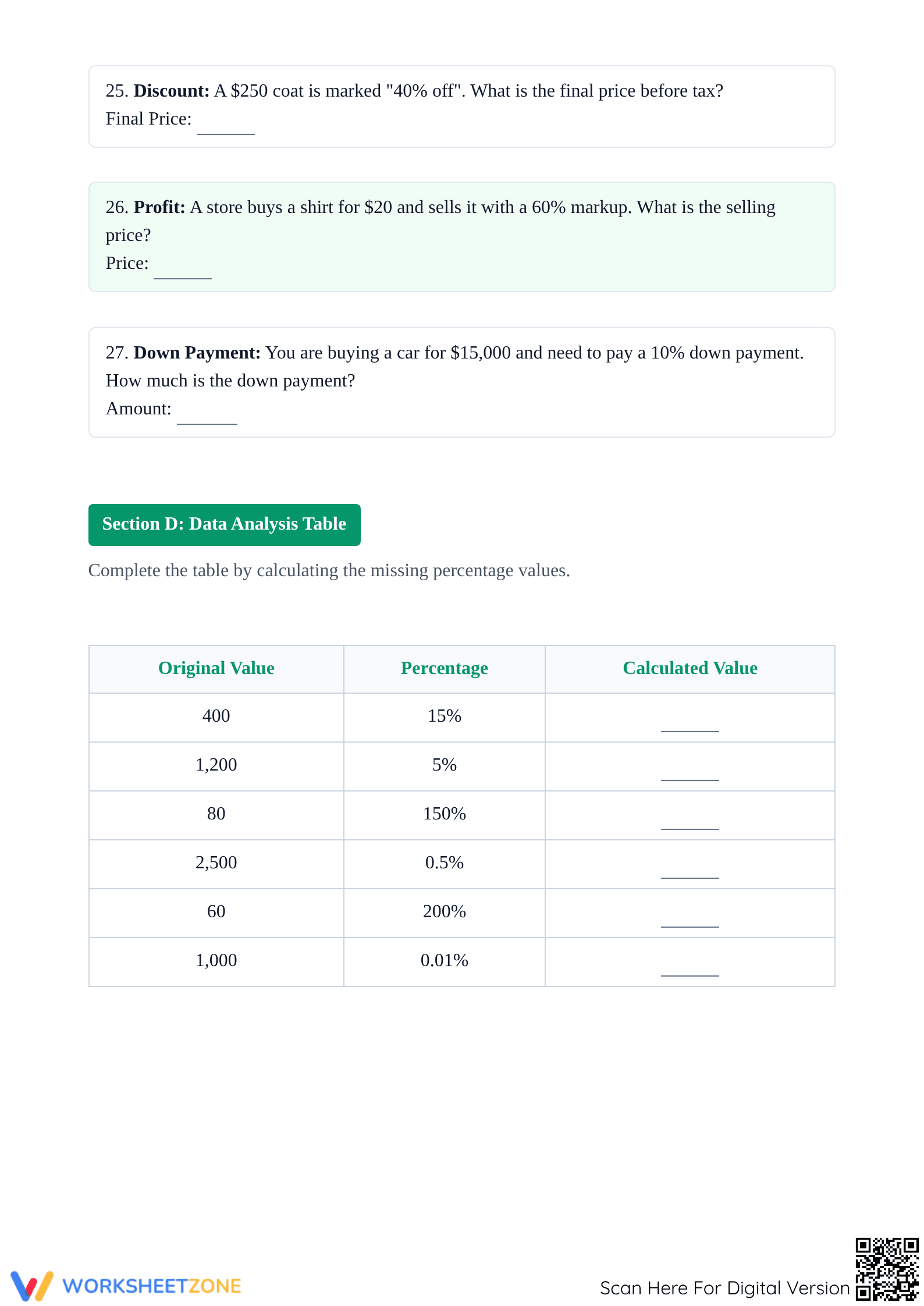
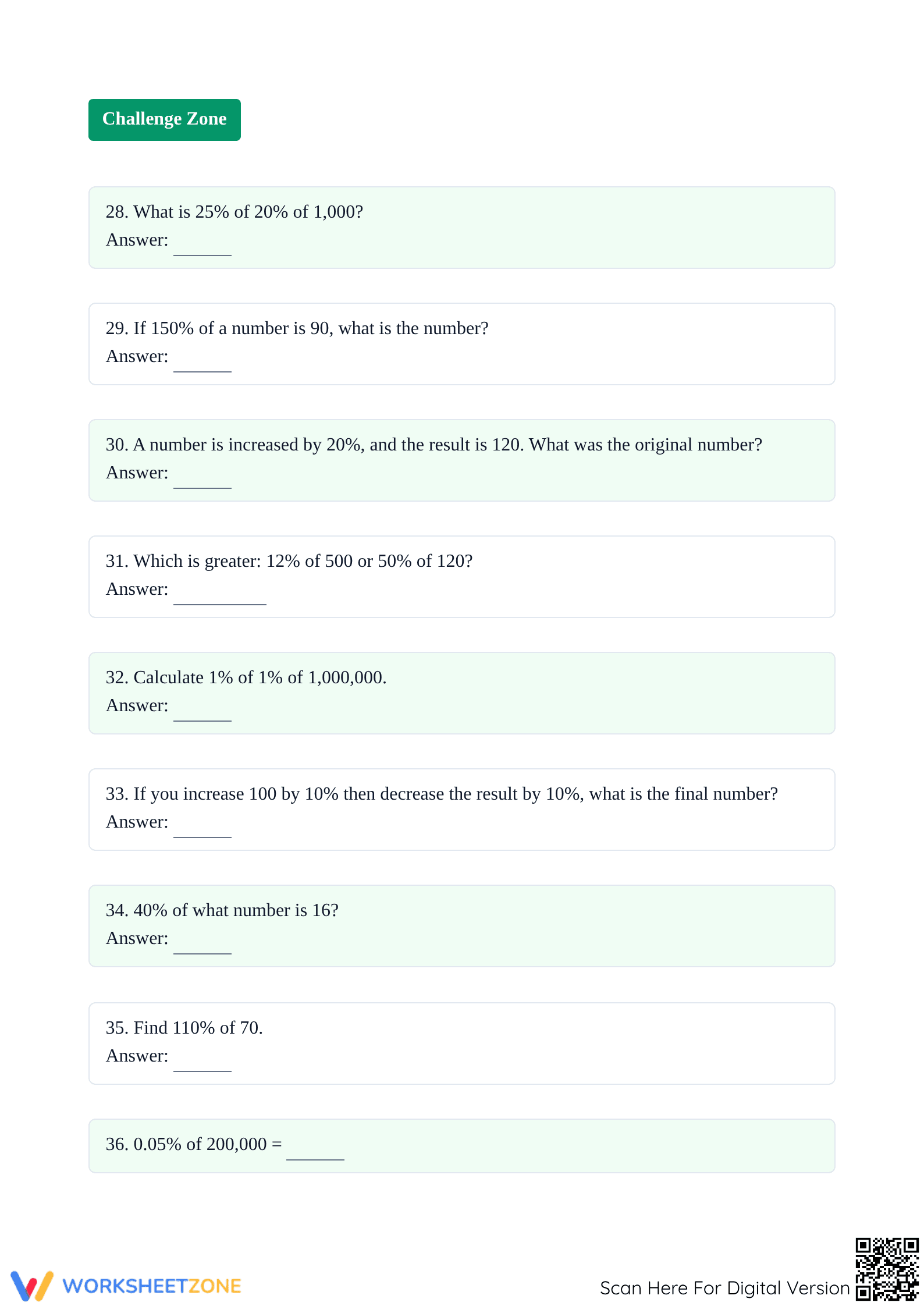
This five-page comprehensive practice set features 36 structured problems divided into five distinct sections. Students encounter decimal percentages, percentage increase and decrease, and real-world applications including sales tax, gratuity, simple interest, and commission. The layout includes a data analysis table and a high-stakes "Challenge Zone" for extension. A complete five-page answer key is provided for immediate feedback and efficient grading.
Mastery Evidence
Each section of this worksheet is intentionally mapped to specific cognitive demands of the 7.RP.A.3 standard. Section A focuses on procedural fluency with decimals, while Section B and C require students to demonstrate meeting-level proficiency by applying those skills to context-rich scenarios. The Challenge Zone serves as evidence for students exceeding grade-level expectations through multi-step logic. Performance data from these 36 tasks can be entered directly into standards-based gradebooks or used to inform IEP progress monitoring for mathematics goals.
Standards Alignment
The primary focus is 7.RP.A.3: "Use proportional relationships to solve multistep ratio and percent problems." It covers simple interest, tax, markups, gratuities, and percent change. This worksheet provides exhaustive coverage of the standard's requirements through varied problem sets. This standard code can be copied directly into lesson plans, IEP goals, or district curriculum mapping tools to ensure instructional alignment.
How to Use It
Utilize this resource as a summative assessment following direct instruction on ratios and proportions. During the activity, circulate to observe if students are correctly converting percentages to decimals or fractions before calculating. The expected completion time ranges from 45 to 60 minutes. For formative use, assign specific sections (like Financial Applications) as a targeted warm-up or "Exit Ticket" to gauge student readiness for real-world mathematical modeling.
Who It's For
This resource is designed for seventh-grade students mastering proportional reasoning, though it serves as excellent remediation for eighth-grade learners or acceleration for advanced sixth-graders. It pairs naturally with financial literacy units or consumer math projects. The clear section headings allow for easy differentiation by task selection, ensuring that every learner can engage with the material at their current level of mathematical proficiency.
The 7.RP.A.3 standard requires students to transition from basic percentage identification to applying proportional reasoning across diverse, multi-step contexts. According to the RAND AIRS 2024 report, students who engage with varied problem types—ranging from abstract decimal calculations to concrete financial applications like interest and commission—demonstrate higher retention of ratio concepts. This worksheet provides that necessary variety through 36 targeted problems, building the procedural stamina required for high-stakes testing and real-world fiscal literacy. Research from ScienceDirect TpT Analysis indicates that structured practice focusing on percent change and tax calculations significantly improves student accuracy in consumer math. By integrating a "Challenge Zone" for higher-order thinking, this resource aligns with best practices for gradual release and mastery-based learning. Educators can confidently cite this resource as a standard-aligned tool for developing essential algebraic thinking and quantitative reasoning skills in middle school mathematics programs.


