


























Views
Downloads


Essential Grade 7 Math: Advanced Percent Calculations
Paste this activity's link or code into your existing LMS (Google Classroom, Canvas, Teams, Schoology, Moodle, etc.).
Students can open and work on the activity right away, with no student login required.
You'll still be able to track student progress and results from your teacher account.
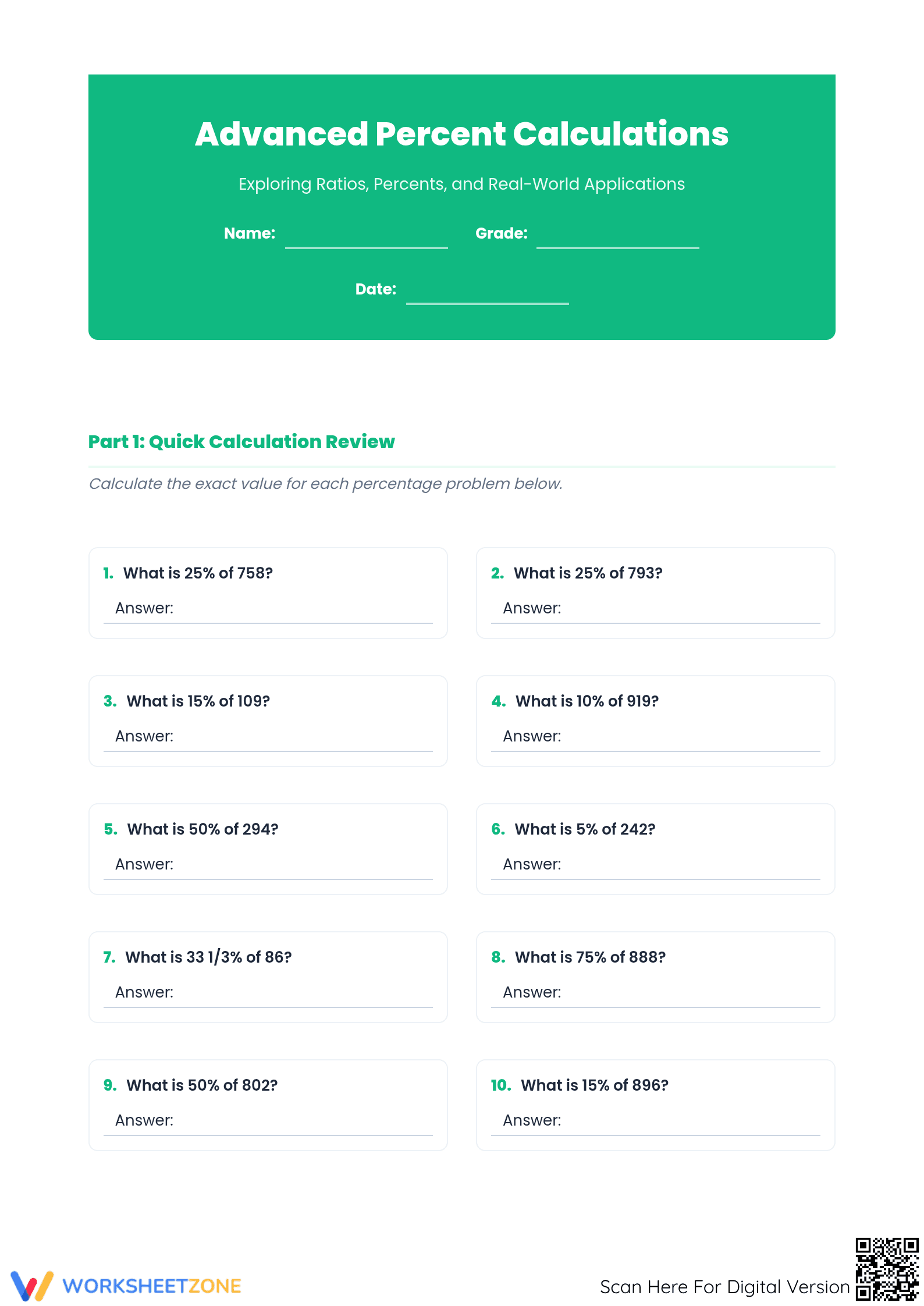
This Grade 7 math worksheet provides comprehensive practice on advanced percent calculations, including finding the part, the whole, and percentage changes. Students will progress from basic computation to solving complex real-world word problems, ensuring a deep understanding of proportional relationships. This resource is designed to build procedural fluency and conceptual mastery in middle school mathematics.
At a Glance
- Grade: 7 · Subject: Mathematics · Level: Intermediate to Advanced
- Standard:
7.RP.A.3— Solve multi-step percent problems involving tax, markups, markdowns, and interest- Skill Focus: Multi-step Percent Calculations and Real-World Application Word Problems
- Format: 5-page PDF worksheet · 40 diverse problems · Full answer key provided
- Best For: Middle school mathematics unit assessment or comprehensive skill review
- Time: 45–60 minutes of focused classroom or home study
What's Inside
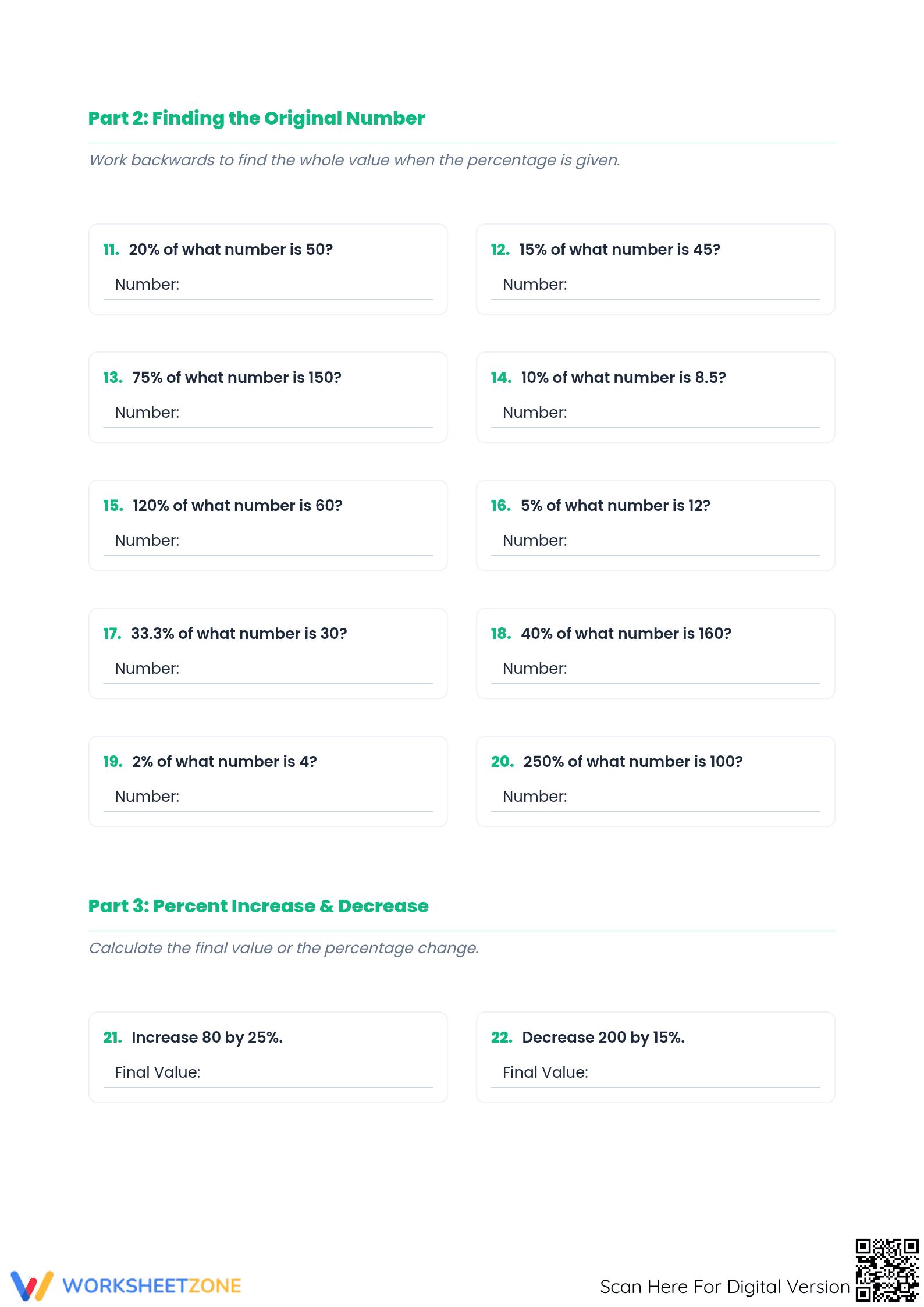
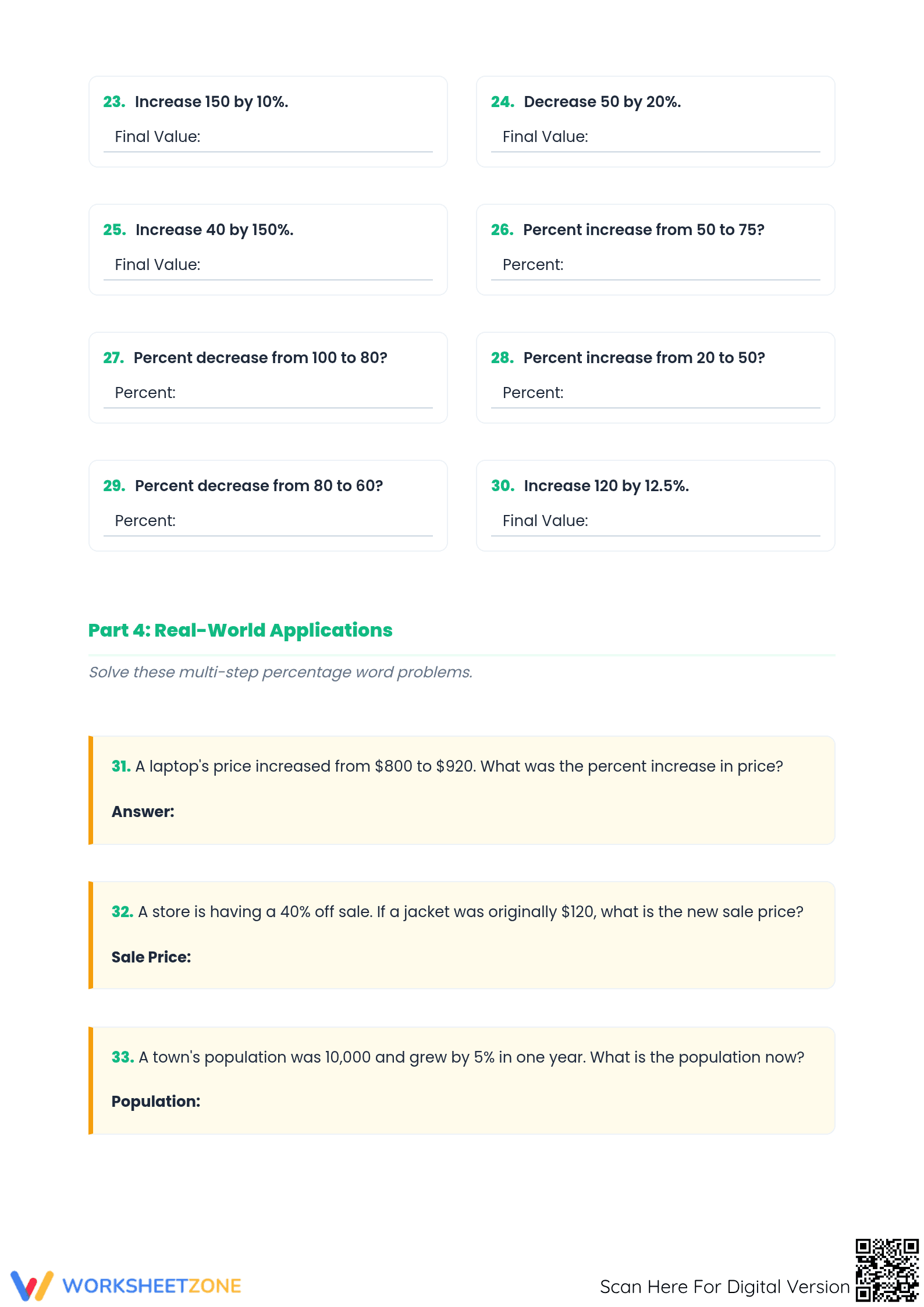
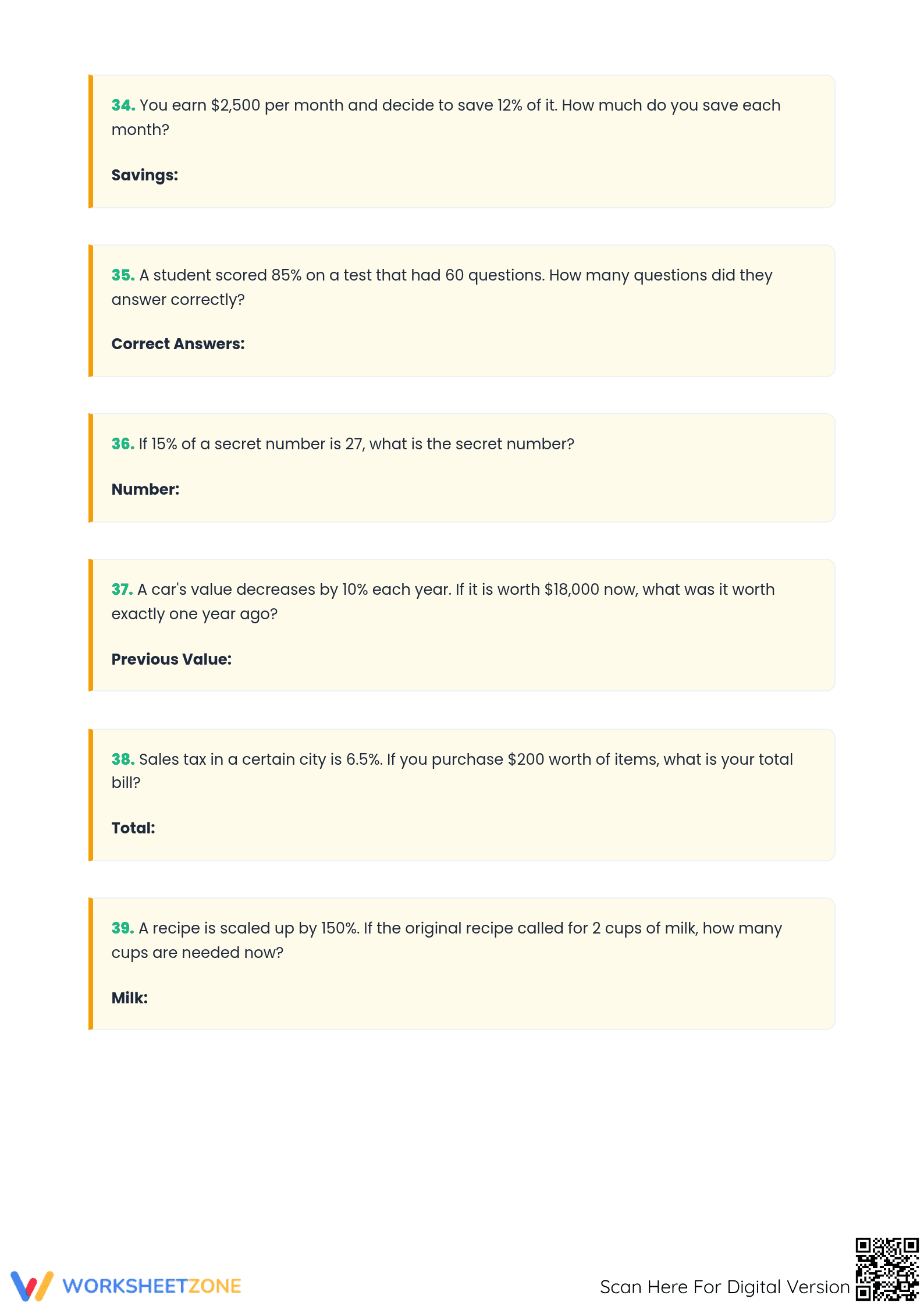
This five-page PDF features 40 distinct problems divided into four logical parts. Part 1 reviews quick calculations; Part 2 focuses on finding the original number (working backwards); Part 3 introduces percent increase and decrease; and Part 4 challenges students with multi-step real-world applications. A full answer key is provided to facilitate quick grading and immediate student feedback.
Skill Progression
- Guided Practice: The first 10 problems provide direct calculation practice, allowing students to stabilize their basic percentage algorithms with varying numbers.
- Supported Practice: Tasks 11 through 30 introduce algebraic thinking by requiring students to find missing bases and calculate directional changes.
- Independent Practice: The final 10 word problems require students to extract data from context, representing the highest level of standard application.
This worksheet utilizes a gradual-release model to ensure students move confidently from calculation to application.
Standards Alignment
This resource is directly aligned with 7.RP.A.3, which requires students to "Use proportional relationships to solve multistep ratio and percent problems." It specifically addresses tax, markups, markdowns, and percent increase/decrease. Both standard codes can be copied directly into lesson plans, IEP goals, or district curriculum mapping tools.
How to Use It
Use this as a summative assessment for a ratios unit or assign parts as focused warm-ups. Observe how students set up equations for multi-step problems to identify misconceptions. Completion time is approximately 50 minutes.
Who It's For
This worksheet is ideal for Grade 7 students working toward grade-level mastery, but it also serves as an excellent challenge for Grade 6 students or a necessary review for Grade 8 and high school students. It pairs naturally with a lesson on proportional reasoning or a unit on financial literacy involving sales tax and discounts.
According to the RAND AIRS 2024 analysis of instructional materials, high-quality mathematics practice must bridge the gap between abstract calculation and contextual application to ensure long-term retention of proportional reasoning skills. This worksheet implements these findings by providing a balanced 40-problem set that transitions systematically through the cognitive demands of the 7.RP.A.3 standard. By requiring students to work forward from parts and backward from wholes, the resource reinforces the bi-directional nature of percentage operations, which is a critical precursor to algebraic functions. Fisher & Frey (2014) emphasize that gradual release of responsibility is most effective when tasks are segmented into manageable phases of increasing complexity, a structure mirrored in this four-part curriculum. Educators can utilize this data-driven approach to document student progress toward mastery in both formative and summative instructional environments, ensuring all learners develop the essential financial literacy required for secondary education.


